The Research Catalogue (RC) is a non-commercial, collaboration and publishing platform for artistic research provided by the
Society for Artistic Research. The RC is free to use for artists and
researchers. It
serves also as a backbone for teaching purposes, student assessment, peer review workflows and research funding administration. It strives to be
an open space for experimentation and exchange.
recent activities <>
Warping Protest: Increasing Inclusion and Widening Access to Art Activism Utilising Textiles
(2026)
Britta Fluevog

Art activism is powerful. Also known as activist art, protest art, visual activism, artivism and creative activism, it changes lives, situations and is and has been a powerful weapon across a whole spectrum of struggles for justice. Teresa Sanz & Beatriz Rodriguez-Labajos(2021) relay that art activism has the unique ability to bring cohesion and diverse peoples together and it can, as Zeynep Tufekci notes, change the participants (2017). As Steve Duncombe & Steve Lambert (2021) posit, traditional protesting such as marches or squats are no longer as important as they once were. As a result of my own lived experience in activist activities, I very much agree with Andrew Boyd & Dave Oswald Mitchell (2012) that the reason people use art activism is that it works, by enriching and improving protest.
In the past, when I lived in a metropolis and was not a parent, I used to be an activist. Now I no longer have immediate access to international headquarters at which to protest and I have to be concerned with being arrested, I am hindered from protesting. This project is an attempt to increase inclusion and widen access to art activism. By devising methods which include at least one of the following: that do not require on-site participation, that can take place outside the public gaze, that reduce the risk of arrest, that open up protest sites that are not “big targets”, that include remote locations, that involve irregular timing, my thesis aims to increase inclusion and widen access to art activism to those who are underserved by more mainstream methods of conducting art activism.
Textiles have unique properties that enable them to engage in subterfuge and speak loudly through care and thought(Bryan-Wilson, 2017). They have strong connotations of domesticity, the body and comfort that can be subverted within art activism to reference lack of this domestic warmth and protection(O’Neill, 2022). Being a slow form of art-making, they show care and thought, attention in the making, so that the messaging is reinforced through this intentionality in slow making.
ESP Duos: Imagined Co-Presence in Remote Improvisation
(2026)
IRK
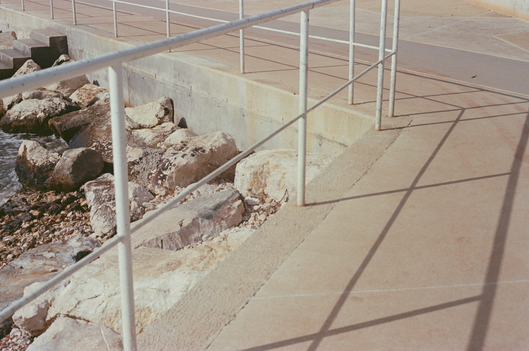
This exposition presents the audio recordings produced within the ESP Duos project, a series of remote improvisations performed by long-term collaborators under conditions of complete acoustic and visual separation. Each duo was recorded simultaneously in isolated spaces, without any form of real-time interaction, and later combined into a single auditory perspective available only to the listener.
Rather than testing whether musical interaction can be sustained at a distance, the project explores how residual traces of collaboration continue to shape improvisatory behavior when the other performer is imagined rather than perceived. The recordings foreground imagined co-presence as an enacted orientation grounded in embodied memory, shared history, and relational expectation.
As artistic outputs, the ESP Duos invite listening not for coordination or synchronization, but for emergent coherence arising from contingency, alignment, divergence, and retrospective sense-making. The exposition situates these recordings as both documents of a research process and autonomous aesthetic artifacts, offering access to a mode of togetherness that persists beyond physical co-presence.
Cartesian Doubt
(2026)
Tolga Theo Yalur
This article "Cartesian Doubt" critiques René Descartes' foundational method of systematic doubt by drawing on the analysis of French philosopher Michel Serres, who likens the Cartesian enterprise to the predatory logic found in La Fontaine’s fable "The Wolf and the Lamb". Serres argues that Cartesian doubt is not a neutral search for truth but rather an "absolute irreversibility doctrine" that functions as a one-way mechanism to destroy all prior beliefs and sensory data to reach the predetermined outcome of the cogito. This process creates a permanent structural gap between the subject and the world, establishing a "foundational violence" in Western thought. Furthermore, the article challenges Descartes' metaphor of sorting a finite basket of apples, asserting that it fails to account for the infinite and dynamic nature of error and decay in a complex, modern scientific reality.
recent publications <>
Non è il gelato ad essere consumato ma chi lo vende.
(2026)
Alessandra Debernardi
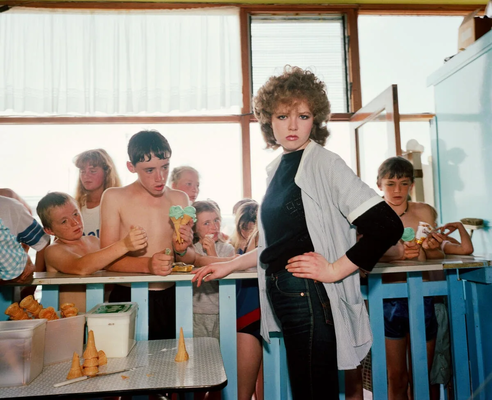
Questa esposizione fa parte di un progetto di ricerca artistica più ampio, articolato in diverse declinazioni.
Il focus presentato si concentra su un’indagine specifica della violenza attraverso il dispositivo dell’auto-conferenza, intesa come pratica performativa e riflessiva.
La ricerca prende avvio dalle conferenze autofinzionali di Sergio Blanco, in particolare dalla sua elaborazione della violenza come costruzione narrativa, e si sviluppa attraverso la rielaborazione di un’esperienza personale di violenza subita. In questo contesto, l’autofinzione diventa uno strumento metodologico capace di mettere in relazione l’esperienza vissuta, il discorso teorico e la rappresentazione.
L’auto-conferenza viene quindi intesa come una vera e propria metodologia di ricerca artistica: uno spazio in cui l’esperienza personale si intreccia con riferimenti teorici e visivi, generando una riflessione critica sulla rappresentazione della violenza e sulle possibilità del racconto di sé come pratica di conoscenza. L’elemento autobiografico, sempre in bilico tra attendibilità e finzione, diventa così il punto di partenza per una riflessione che supera l’io dell’autore e si apre a una dimensione collettiva, coinvolgendo lettori e spettatori.
Paths of Artistic Research
(2026)
Silvia Diveky, Monika Šimková
Interviews about where artistic research is heading
The work Paths of artistic research is a collection of interviews with artistic researchers - Andrea Buršová, assistant professor at the Nika Brettschneiderová Dramatic Acting Department, Faculty of Drama, JAMU, Jiří Honzírek, director, manager of the Feste Theatre and PhD student at the Theatre Faculty, JAMU, Barbora Klímová, head of the Studio of Environmental Design at the FFA BUT, Lenka Klodová, head of the Studio of Body Design at the FFA BUT, Lucia Repašská, researcher at the Cabinet for Theatre and Drama Research, Theatre Faculty, JAMU, Hana Slavíková, head of the Studio of Radio and Television Dramaturgy and Scriptwriting, Theatre Faculty, JAMU, Pavel Sterec, artist and former head of the Intermedia Studio at the FFA, BUT, and Lenka Veselová, researcher at the Department of Theory and History of Art at the FFA, BUT and PhD student at the FFA, BUT. These are artists who have been associated with art colleges in Brno, specifically with the Faculty of Fine Arts of the BUT and the Theatre Faculty of the JAMU. Through interviews with the artists, the reader will learn under what circumstances they began to engage in artistic research, how they perceive it, what meanings they attribute to it and the purpose it serves for them. The selected group of artists is very diverse and their creative and research strategies are different, as are the purposes for which they use artistic research. The work does not aim to provide an exhaustive overview of the methods used in artistic research, but it does aim to show that there are many approaches to artistic research and to present the paths that have brought particular artists to artistic research.
Berlin, lava fields, rebellion, street life
(2026)
Ilpo Jauhiainen
This essay examines the challenges of generative AI in composing ‘new’ music. The focus is on the commercial generative AI applications (i.e. AI music generators) due to their prominence in the mainstream cultural and technological discourse. The essay adopts a philosophical rather than a technological approach, situating the use of generative AI in music within a broader societal, cultural, and environmental context. If AI and music (understood as normative practices) are majoritarian, molar, and arborescent entities, then the approach taken here is Deleuzian: minoritarian, molecular, and rhizomatic. By engaging with their fault lines, disassembling and reassembling their structures, and connecting them to the wider world, the essay presents an alternative way of thinking about AI and music – and AI in music – and proposes one such possible application.