The Research Catalogue (RC) is a non-commercial, collaboration and publishing platform for artistic research provided by the
Society for Artistic Research. The RC is free to use for artists and
researchers. It
serves also as a backbone for teaching purposes, student assessment, peer review workflows and research funding administration. It strives to be
an open space for experimentation and exchange.
recent activities <>
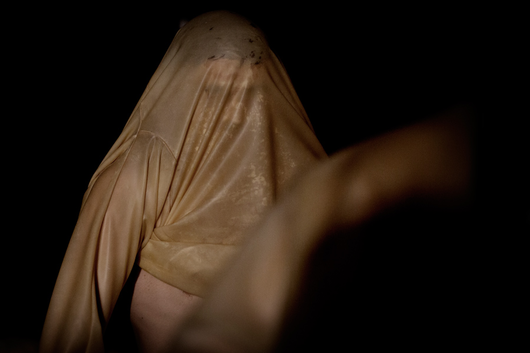
"Investigating the Big Blue": cyanotype workshop in two parts, Amorgos, Cyclades, Greece
(2025)
Hannah L. M. Eßler, Micol Favini, Lovis Heuss, Eirini Sourgiadaki, Livia Zumofen, Anna Rubi, Tomer Zirkilevech, Alisha Dutt Islam, Charles Kwong
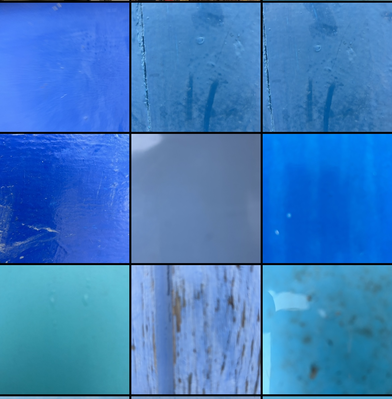
A 2-part module by the MA Transdisciplinary Studies of ZHdK, Department Kulturanalysen und Vermittlung. Held by Anna Rubi & Eirini Sourgiadaki.
Autumn 2023-Spring 2024
Colour perception varies, so do the semantics of colour terminology, for both sighted and blind individuals. The questions around colour perception from ophthalmology or neurobiology perspectives to cognitive and artistic ones, are infinite: Is there a universal human experience of the blue sky, the green grass and the brown soil? How is colour perceived in the brain, how is it translated into a communicable concept and how does it affect our perceived world, our mental and physical state? What is the role of colour in synesthesia? And most importantly, does colour have to do just with vision? In this module we work with the generation of blue colour on print, using the major light source available, the Sun.
The Island of Amorgos is often referred to as “Le grand bleu” after the famous french film was shot at location. Its ancient name is “Melania”. “Melani”, the Greek word for ink, (“Melano” for dark blue, cyan) as it is said that in ancient times the place was covered with dark green flora. Our investigation begins exactly with this deep tint. We pay a visit to the famous monastery and the water oracle, walk the trails to observe the sensual -not only vision-based- shades of blue. In the spring term, we participate in local activities such as beach clean-up initiatives of the remote bays by local fishermen and their boats. We visit bee-hives and herb-distilleries, we work with the most basic bits and pieces of the island to capture its essence.
Among signs – propositions from a typographic practice
(2025)
Åse Huus
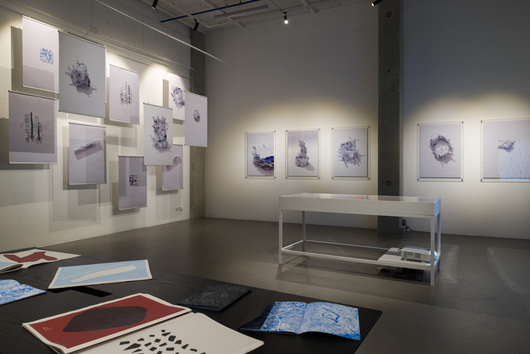
This exposition gathers a series of visual and linguistic investigations in which signs, form, and the space between them construct expressions that invite multiple interpretations. Here, propositions are understood as attempts, movements, and modes of thought. Between sign and form, a space emerges where meaning can be brought into play – where rhythm, structure, wonder and quietness may interact as an expanded practice of seeing, reading, and listening.
recent publications >
Non è il gelato ad essere consumato ma chi lo vende.
(2026)
Alessandra Debernardi
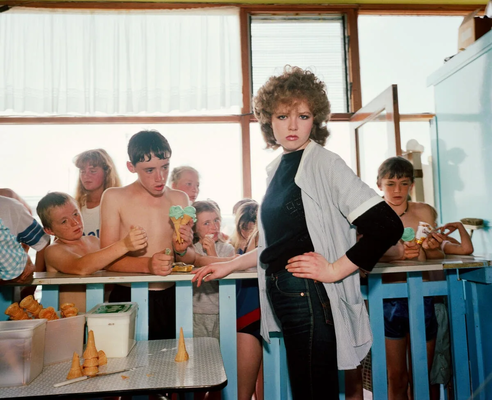
Questa esposizione fa parte di un progetto di ricerca artistica più ampio, articolato in diverse declinazioni.
Il focus presentato si concentra su un’indagine specifica della violenza attraverso il dispositivo dell’auto-conferenza, intesa come pratica performativa e riflessiva.
La ricerca prende avvio dalle conferenze autofinzionali di Sergio Blanco, in particolare dalla sua elaborazione della violenza come costruzione narrativa, e si sviluppa attraverso la rielaborazione di un’esperienza personale di violenza subita. In questo contesto, l’autofinzione diventa uno strumento metodologico capace di mettere in relazione l’esperienza vissuta, il discorso teorico e la rappresentazione.
L’auto-conferenza viene quindi intesa come una vera e propria metodologia di ricerca artistica: uno spazio in cui l’esperienza personale si intreccia con riferimenti teorici e visivi, generando una riflessione critica sulla rappresentazione della violenza e sulle possibilità del racconto di sé come pratica di conoscenza. L’elemento autobiografico, sempre in bilico tra attendibilità e finzione, diventa così il punto di partenza per una riflessione che supera l’io dell’autore e si apre a una dimensione collettiva, coinvolgendo lettori e spettatori.
Paths of Artistic Research
(2026)
Silvia Diveky, Monika Šimková
Interviews about where artistic research is heading
The work Paths of artistic research is a collection of interviews with artistic researchers - Andrea Buršová, assistant professor at the Nika Brettschneiderová Dramatic Acting Department, Faculty of Drama, JAMU, Jiří Honzírek, director, manager of the Feste Theatre and PhD student at the Theatre Faculty, JAMU, Barbora Klímová, head of the Studio of Environmental Design at the FFA BUT, Lenka Klodová, head of the Studio of Body Design at the FFA BUT, Lucia Repašská, researcher at the Cabinet for Theatre and Drama Research, Theatre Faculty, JAMU, Hana Slavíková, head of the Studio of Radio and Television Dramaturgy and Scriptwriting, Theatre Faculty, JAMU, Pavel Sterec, artist and former head of the Intermedia Studio at the FFA, BUT, and Lenka Veselová, researcher at the Department of Theory and History of Art at the FFA, BUT and PhD student at the FFA, BUT. These are artists who have been associated with art colleges in Brno, specifically with the Faculty of Fine Arts of the BUT and the Theatre Faculty of the JAMU. Through interviews with the artists, the reader will learn under what circumstances they began to engage in artistic research, how they perceive it, what meanings they attribute to it and the purpose it serves for them. The selected group of artists is very diverse and their creative and research strategies are different, as are the purposes for which they use artistic research. The work does not aim to provide an exhaustive overview of the methods used in artistic research, but it does aim to show that there are many approaches to artistic research and to present the paths that have brought particular artists to artistic research.
Berlin, lava fields, rebellion, street life
(2026)
Ilpo Jauhiainen
This essay examines the challenges of generative AI in composing ‘new’ music. The focus is on the commercial generative AI applications (i.e. AI music generators) due to their prominence in the mainstream cultural and technological discourse. The essay adopts a philosophical rather than a technological approach, situating the use of generative AI in music within a broader societal, cultural, and environmental context. If AI and music (understood as normative practices) are majoritarian, molar, and arborescent entities, then the approach taken here is Deleuzian: minoritarian, molecular, and rhizomatic. By engaging with their fault lines, disassembling and reassembling their structures, and connecting them to the wider world, the essay presents an alternative way of thinking about AI and music – and AI in music – and proposes one such possible application.