The Research Catalogue (RC) is a non-commercial, collaboration and publishing platform for artistic research provided by the
Society for Artistic Research. The RC is free to use for artists and
researchers. It
serves also as a backbone for teaching purposes, student assessment, peer review workflows and research funding administration. It strives to be
an open space for experimentation and exchange.
recent activities <>
Can Philosophy Exist?
(2026)
Zoe Panagiota (aka Betty) Nigianni
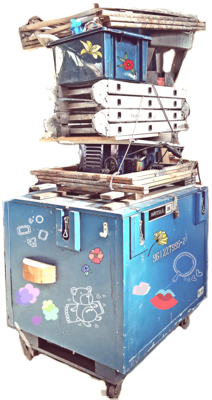
Photography with sound and net art, drawing, found folk sculpture with digital drawing, readymades, 2012, 2020, 2021. Accompanied by archival material.
The exposition exposes the question of what is artistic research. Usurping the mini-essayist format, which is traditionally associated with research in say the area of philosophy, the exposition formally operates on different levels. I selectively included visual art research material from my own artistic archive, as well as anonymous material that's readily available from the internet and in film archives. In this way, I wanted to emphasise the role of archiving and using archives in the artistic process, as an element of artistic research and artistic production that might involve remediation. Taking that we live in a largely theoretic culture, which means that we use external information systems for storage and retrieval of written, visual and other material, the implication is that art is part of this theoretical system.
Moreover, I specifically problematise the notion of value in relation to the visual arts by using the popular media figures of the counterfeit and the impostor, with reference to the so-called "impostor syndrome", correlated with being a minority of some sort in one's field: "A different thought is that two people may be answerable to the very same standard of success or competence, yet be subject to different epistemic standards for reasonable belief in their respective success or competence. This would be an example of pragmatic encroachment." (Katherine Hawley, "What is Impostor Syndrome?", Proceedings of the Aristotelian Society Supplementary Volume 93, 2019). I use visual art and figurative examples as illustrations, adapting from methods, such as the example, used in analytic philosophy.
I suggest that some artworks operate as philosophical provocations of the archive: "The artwork just exists", as Frank Stella argued. Artworks and archival artistic material are offered for aesthetic contemplation; they don't possess any "magical" qualities, they don't cause any phenomena or events in the world. In this view, I ordered this exposition as a design proposal for two independent, yet interconnected exhibitions: one for the final artistic exhibition show; and one as a general overview for the artist's studio, set up as a stand alone, if parallel, exhibition.
The conception of two parallel expositions as mocks of two parallel exhibitions is inspired by Jean Baudrillard's concept of "hyperreality", which refers to the blurring between reality and simulated representations, when sometimes, influenced by media, film, television, advertising, people tend to accept images or perceptions not corresponding to actual reality. The exposition hints at artists and others, who use different modes of communication, as skillfully exploiting the Baudrillardian concept of "hyperreality", with its accompanied "simulacra" and "simulations", for making indirect references on a sociological level; as well as for putting forward a critical commentary on the artistic and conceptual level.
Astrattismo
(2026)
Giusirames
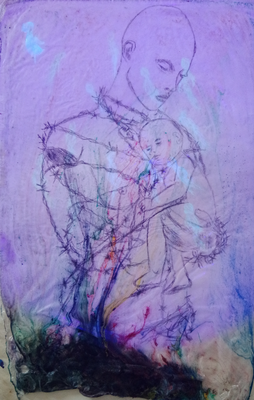
This thesis stems from the need to investigate an original painting technique developed by the author, which combines figurative painting and solidified atmospheric phenomena.
The heart of the research is a simple and radical question:
How can an ephemeral phenomenon be made permanent?
The answer takes shape through the creation of sheets of solidified rain, transparent membranes that preserve the logic of the drop, the flow, the surface tension. These membranes are superimposed on figurative paintings, generating a multidimensional visual language.
Transparency is not an aesthetic effect, but a temporal device: it freezes the work, suspends it, holds it in an eternal instant.
Narratografía y procesos de mediación gráfica en contextos de migración
(2026)
Pinzón Lizarazo Oscar Daniel
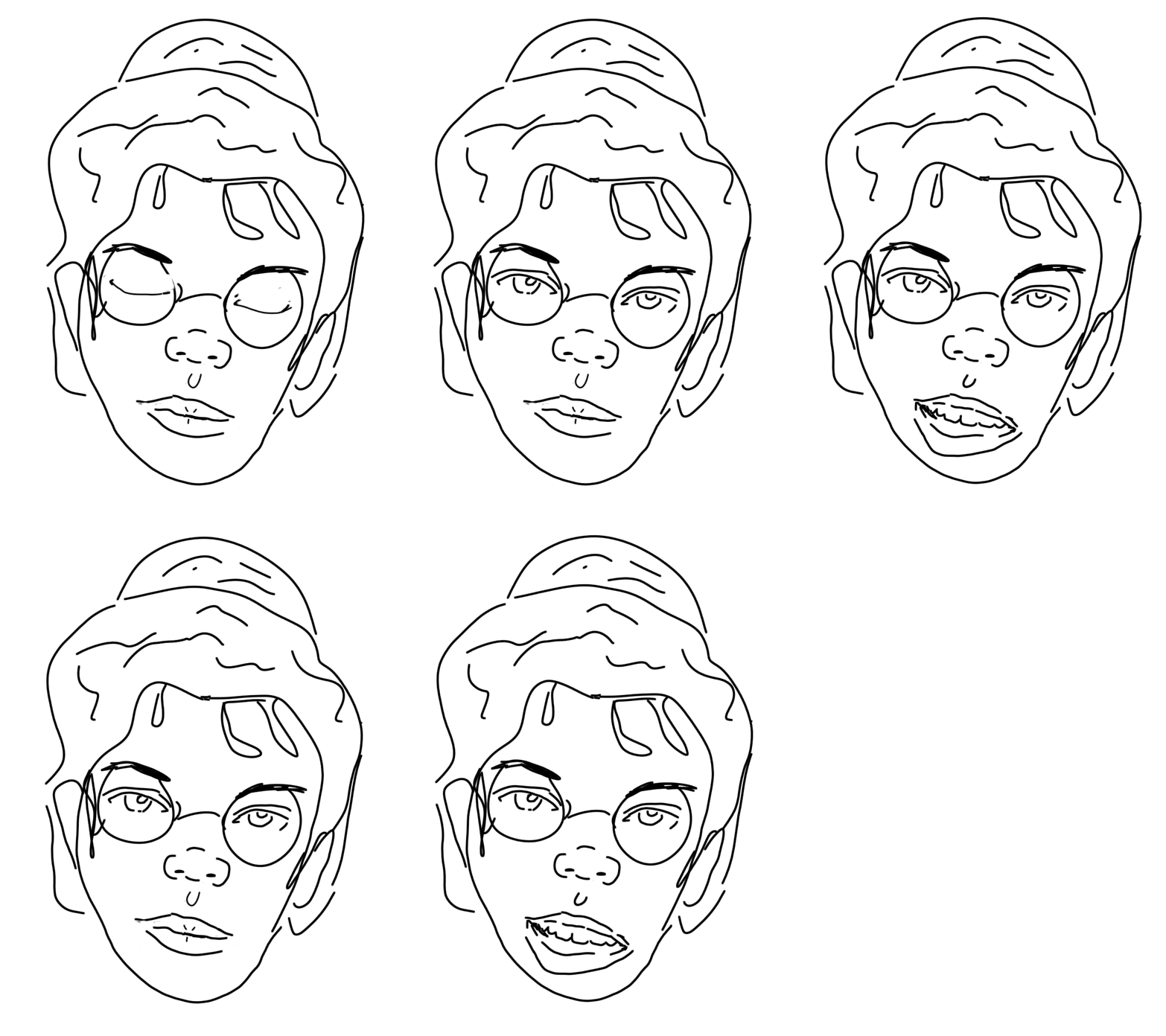
Esta web es producto digital del proyecto Narración gráfica, laboratorio de objetos, cartografía digital y mediaciones en experiencias con comunidades de artistas migrantes, registrado con Cód. 10160180521 proyecto institucionalizado sin financiamiento del Centro de Investigaciones y Desarrollo Científico - CIDC de la Universidad Distrital Francisco José de Caldas.
Hace parte del proceso metodológico de desarrollo de la tesis doctoral Narración Gráfica de Experiencias: Intercambios en Imágenes de migración.
Con la realización del proyecto, se busca incentivar el uso de la narración gráfica como proceso horizontal que permite relatar y revisar la importancia que tienen las prácticas artísticas de las comunidades en la construcción de tejido social. La propuesta de mediación artística se visibiliza como una estrategia colaborativa que permite el diálogo y el intercambio.
El trabajo se inscribe y contribuye a las apuestas del Grupo de investigación para la creación artística y de la Línea de investigación en: Estudios críticos de las corporeidades, las sensibilidades y las performatividades. Adscritos al doctorado en estudios artísticos de la Universidad Distrital Francisco José de Caldas.
recent publications <>
THIS IS IT
(2026)
Federico Federici
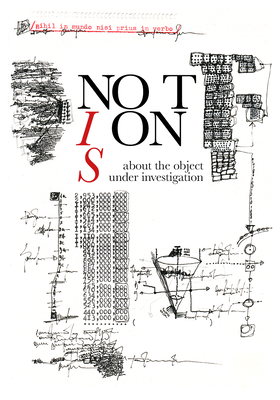
“Objects under investigation” is a collection of separately conceived works addressing the problem of the text as medium and, more broadly, mediality in art from an experimental perspective. The term object[s] functions as a neuter reference to the text both as a phenomenon and as a product in itself. It evokes the idea of something that can be physically handled, without implying a necessarily physical object.
Safe Ocean: Artistic and Autoethnographic Explorations of Music and Sound as Vessels for Finnish Kosovar Second-Generation Identity
(2026)
Merve Abdurrahmani

Abstract
This study investigates the role of music and sound in shaping a sense of identity among second-generation immigrants in Finland, with a particular focus on Finnish Kosovar experiences. As Finland moves from a historically homogeneous society toward a more multicultural landscape, understanding how musical engagement influences identity formation becomes increasingly significant. Through autoethnographic reflection and artistic practice, this research explores how listening, performing, and creating music mediate the negotiation of cultural heritage, integration, and hybrid identities among individuals navigating multiple cultural worlds.
Central to this exploration is the master concert Safe Ocean, which serves as both a personal and academic articulation of the study’s core themes. The concert integrates multilingual expression, traditional Albanian and Turkish musical materials, and hybrid compositional methods that also incorporate Nordic musical elements such as modal melodies, open-voiced harmonies, and timbral aesthetics characteristic of the region’s contemporary folk and art music practices. By combining solo, small-group, and full-ensemble arrangements, the project presents both intimate and collective expressions, engaging instruments and musical influences from Kosovar Albanian, Turkish, Nordic, and Middle Eastern traditions.
Through the interweaving of autoethnographic insight, artistic creation, and scholarly inquiry, this study demonstrates how music evokes memory, supports emotional processing, and supports dialogue between multiple cultural worlds. Findings indicate that engagement with sound and musical practice contributes not only to personal identity formation but also to the creation of social belonging and spaces for intercultural dialogue. This research contributes to broader discussions on music, diaspora, and identity, offering insight into how artistic practices can mediate complex cultural experiences and support the integration of second-generation immigrants within multicultural societies.
Measuring Proximity: A Post-Interpretive Diagnostic Experiment in Art Criticism A Diagnostic Lens on Ethical Witnessing in Art Criticism
(2026)
Dorian Vale
Contemporary art criticism often advances by way of interpretive extraction. Works are translated into meanings, themes, intentions, and arguments, which then circulate with remarkable efficiency through institutional language. This practice, for all its fluency, carries an unexamined cost: the quiet displacement of the viewer, the compression of encounter into explanation, and the steady accumulation of linguistic force where restraint might have sufficed. _Measuring Proximity_ proposes a post-interpretive diagnostic tool situated within the framework of Post-Interpretive Criticism (PIC). It does not ask whether an interpretation is correct, persuasive, or useful. Instead, it attends to posture, how critical language positions itself in relation to the artwork, how closely it remains, how quickly it resolves, and how readily it aligns.
The framework emerges from a refusal of rigid disciplinary boundaries. It proceeds from the conviction that once inquiry is pursued with sufficient depth, the familiar divisions between philosophy, criticism, rhetoric, ethics, and analysis begin to collapse, revealing a shared terrain of attention and care. In this sense, the diagnostic experiment does not belong to a single “subject,” nor does it attempt to formalize one. Five diagnostic indices, Rhetorical Density (RD), Interpretive Load Index (ILI), Viewer Displacement Ratio (VDR), Ethical Proximity Score (EPS), and Institutional Alignment Indicator (IAI), are introduced as reflective instruments for tracing the behavior of language rather than adjudicating its claims.
The framework is intentionally non-prescriptive and exploratory, offered in the spirit of a serious experiment, one that treats measurement not as authority, but as curiosity. These measures do not seek to replace interpretation, nor to govern style or method. They operate as a mirror, rendering visible the pressures already at work within critical discourse. What emerges is not a system of judgment, but a way of noticing: a playful yet disciplined attempt to see where explanation begins to outweigh encounter, and where proximity quietly gives way to possession.
Rhetorical density enters this framework by way of inheritance rather than invention. Its articulation as a formal, measurable feature of language was first developed by Mandar Marathe and introduced to the research community through presentations at venues such as QUALICO 2025 at Masaryk University and the Digital Humanities Conference at SOAS University of London. Later implementations, including the BALAGHA Score (2025–2026), extended its use toward the measurement of rhetorical richness in Arabic-language texts. Here, rhetorical density functions simply as a descriptive register of linguistic intensity. The remaining indices: Interpretive Load Index (ILI), Viewer Displacement Ratio (VDR), Ethical Proximity Score (EPS), and Institutional Alignment Indicator (IAI), all emerge from within Post-Interpretive Criticism itself and belong specifically to its diagnostic orientation.
The framework is not intended to guide the production of criticism, nor does it imply an ideal direction or outcome; it functions only as a means of reflecting on critical language after it has already been written.