The Research Catalogue (RC) is a non-commercial, collaboration and publishing platform for artistic research provided by the
Society for Artistic Research. The RC is free to use for artists and
researchers. It
serves also as a backbone for teaching purposes, student assessment, peer review workflows and research funding administration. It strives to be
an open space for experimentation and exchange.
recent activities <
creative (mis)understandings - Methodologies of Inspiration
(2026)
Johannes Kretz, Wei-Ya Lin, Samu Gryllus, Zheng Kuo, Ye Hui, Wang Ming, Daliah Hindler
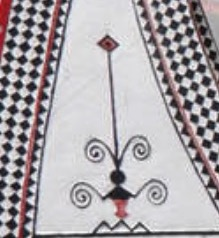
This project aims to develop transcultural approaches of inspiration (which we regard as mutually appreciated intentional and reciprocal artistic influence based on solidarity) by combining approaches from contemporary music composition and improvisation with ethnomusicological and sociological research. We encourage creative (mis)understandings emerging from the interaction between research and artistic practice, and between European art music, folk and non-western styles, in particular from indigenous minorities in Taiwan. Both comprehension and incomprehension yield serendipity and inspiration for new research questions, innovative artistic creation, and applied follow-ups among non-western communities.
The project departs from two premises: first, that contemporary western art music as a practice often tends to resort to certain degrees of elitism; and second, that non-western musical knowledge is often either ignored or merely exploited when it comes to compositional inspiration. We do not regard inspiration as unidirectional, an “input” like recording or downloading material for artistic use. Instead, we foster artistic interaction by promoting dialogical and distributed knowledge production in musical encounters. Developing interdisciplinary and transcultural methodologies of musical creation will contribute on the one hand towards opening up the—rightly or wrongly supposed—“ivory tower of contemporary composition”, and on the other hand will contribute towards the recognition of the artistic value of non-western musical practices. By highlighting the reciprocal nature of inspiration, creative (mis)understandings will result in socially relevant and innovative methodologies for creating and disseminating music with meaning.
The methods applied in the proposed project will start out from ethnographic evidence that people living in non-western or traditional societies often use methods of knowledge production within the sonic domain which are commonly unaddressed or even unknown among western contemporary music composers (aside from exotist or orientalistic appropriations of “the other”).
The project is designed in four stages: field research and interaction with indigenous communities in Taiwan with a focus on the Tao people on Lanyu Island, collaborative workshops in Vienna, an artistic research and training phase with invited indigenous Taiwanese coaches in Vienna, and feeding back to the field in Taiwan. During all these stages, exchange and coordination between composers, music makers, scholars and source community experts will be essential in order to reflect not only on the creative process, but also to analyse and support strong interaction between creation and society. Re-interaction with source communities as well as audience participation in the widest sense will help to increase the social relevance of the artistic results.
The University of Music and Performing Arts Vienna (MDW) will host the project. The contributors are Johannes Kretz (project leader) and Wei-Ya Lin (project co-leader, senior investigator) with their team of seven composers, ten artistic research partners from Taiwan and six artistic and academic consultants with extensive experience in the relevant fields.
Empowering Collective Performing Arts: A Facilitator’s Collection of Voice and Dance Scores to Overcome Social Barriers
(2026)
Alice Presencer
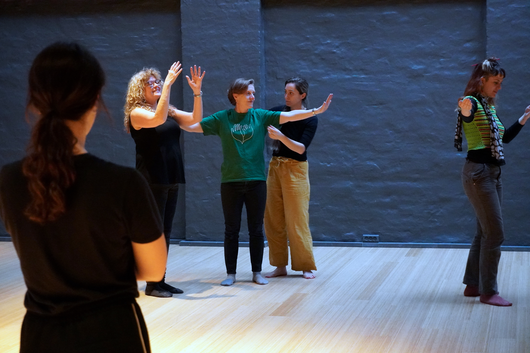
'Empowering Collective Performing Arts: A Facilitator’s Collection of Voice and Dance Scores to Overcome Social Barriers' is a practice-led research project that explores the ways to encourage group connection through performing arts activities within diverse communities.
Wang Xiyao: Multidirectional Aesthetic Experience in Abstract Painting
(2026)
BANGHUA SUN
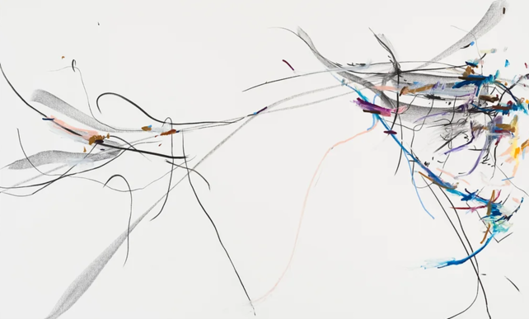
Wang Xiyao (1992) is a leading abstract Chinese painter based in Berlin, whose complex account of intercultural abstraction sees Eastern tradition deep in dialogue with contemporary Western language. It has replaced vivid, multilayered-meanings, deep personal experience, cultural memory, and common history, which have traditionally formalist postulates. Under the mentorship of Werner Büttner and Anselm Reyle and also inspired by Cy Twombly, Joan Mitchell, and Julie Mehretu, she began to elaborate a dynamic practice based on rhythmically interplaying color, line, and space. Many works are inspired by poetic and philosophical tradition, employing concepts such as Chinese Liu Bai (留白, intentional blank space) and moving into physical expression through dance and martial arts. In this respect, Wang's working process in creation corresponds to the concept of bodily perception in Maurice Merleau-Ponty and experiential aesthetics in John Dewey, considering immersion in the multisensory approach rather than pure visual contemplation. By an original synthesis in manifold aesthetic and sensory modalities, she thus develops multidirectional experiences, which are fascinatingly active and dialogic in the sense that they stir her viewer into an incessant questioning about form, culture, and consciousness.
recent publications <>
När blir sångaren konstnär
(2026)
Martin Hellström
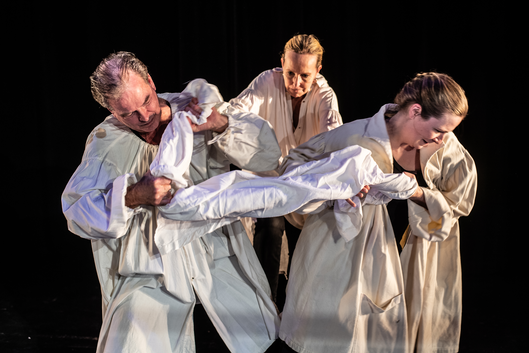
“When does the singer become an artist?” is a research project by Martin Hellström, Ulrika Tenstam and Stina Ancker.
We ran an opera laboratory at the Department of Opera at Stockholm University of the Arts, during the years 2017-2020.
With the searchlight focused on the creativity of the singer, we wanted to explore the borderland between the rehearsed and the spontaneous, in the art of performing opera.
Our basic questions were:
-when does the performance of the opera singer, which requires a high level of technical perfection, open up towards the unpredictable, creative moment?
-Where is the border line between interpretation and improvisation, does it even exist?
We commissioned a mini-opera to use as working material;Camilles irrfärder & äventyr, composed by Petter Ekman to a libretto by Tuvalisa Rangström. Windows for improvisation were included in the score, where the performers can play with text, rythm, melody or structure in different ways. In the work we alternated between artistic experiments and reflection. The ensemble reflected on how the different games and methods opened or closed the creative flow, and how the improvisations affected the performers' relationship to the material. A parallel focus was how the singers were inspired to change or expand their voices. We have found new methods in the work of developing the creative ability and force of the opera singer. We have applied the methods in different ways in higher education for Opera singers, developing new pedagogic approaches in the process.
The Poem Johnson PhD Papers
(2026)
Marc Johnson
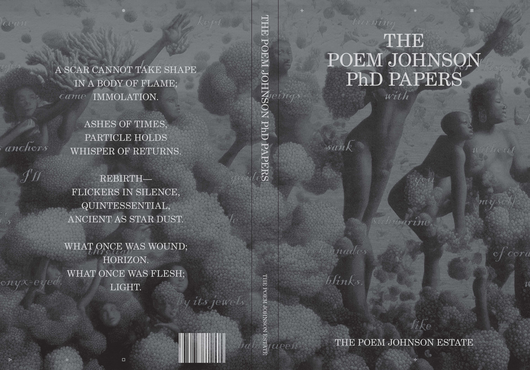
In the year 2088, the artist Poem Johnson dies at the age of 102. His estate bequeaths his artworks and papers to the Kamau Brathwaite Center for Research in Black Studies. The archive contains eleven artistic outputs spanning Jacquard-woven textiles, video installations, performance works, and an artist book.
This is the speculative framework of Marc Johnson's practice-based dissertation, which examines how artists from diasporic communities can shape archival custody and posthumous reception of their work before institutional stewardship begins. The future-oriented framing draws on Kamau Brathwaite's concept of tidalectics, a geopoetic model of history that combines Einsteinian non-linear time with Caribbean routes and roots. Brathwaite argues that diasporic histories cannot be traced to a single origin point. In the context of African diaspora, where displacement and forced migration fracture linear genealogies, identity and history move in tidal patterns across multiple shores and temporalities. This dissertation reimagines tidalectics through material practice, using the speculative structure to displace linear historiography, interrogate the politics of memory-making, and challenge the assumed stability and permanence of archival records.
The artworks trace a research journey of artistic experiments conducted between 2021 and 2026. The Sea is History (2024) is a series of Jacquard-woven textiles that engage the colonial legacies of industrial textile production and cotton economies while rendering the ocean as living archive. The loom's punch-card system is itself an early form of data storage, and becomes a site for counter-archival practice that reclaims colonial infrastructure to materialize suppressed narratives. Sun/Sum (2024) is a performance work developed through public rehearsals that privileges process over product, establishing rehearsal-as-research methodology where Afrodiasporic movement vocabularies circulate through iterative process rather than fixed performance scores. Riot/Uprising (2023) is a three-channel video installation that foregrounds the materiality of decaying footage from the 1971 Attica prison uprising, directing attention across screens through sound remixing.
Through speculative fabulation, the dissertation generates a post-custodial future: practical frameworks for how artists from diasporic and Indigenous communities can intervene in preservation systems before depositing materials into institutional care, shaping how their work will be encountered, interpreted, and activated by future researchers and communities.
Lyssna på Myrstack - Närvaro med skogen och leran
(2026)
Anna Gäfvert
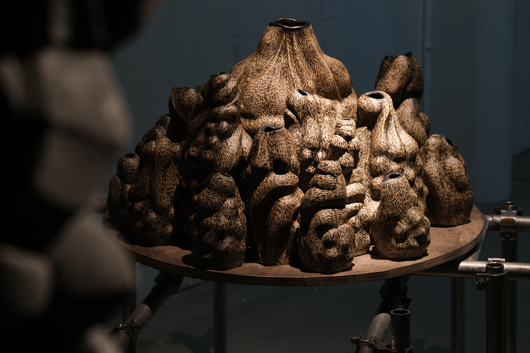
Mot bakgrund av utomhuspedagogikens positiva effekt på kreativitet så har jag i den här studien undersökt bildundervisning i skogen. I studien använder jag arbetsmetoden A/R/tography och den post-kvalitativa metodologin för att främja ett rhizomatiskt förhållningssätt till undersökandet och lärandet. Studiens fokus är att förändra mål, kravfyllda tankar och ramar för att ge plats åt mer undersökande, experimenterande och fantasifullt förhållningssätt till bildlektionen. Syftet är också att skapa händelser som kan stärka idéprocesser och öka närvaron med omvärlden under bildlektionen genom ett inkluderande och holistiskt tillvägagångssätt. Jag har arbetat med detta genom ett teoretiskt perspektiv som belyser mänskliga och icke-mänskliga aktörers roll i lärandet. Centralt i undersökandet av konstnärliga metoder och material har Jane Bennets begrepp “Thing-power” varit plattformen för att öppna upp en stark närvaro med material och omvärlden. Frågeställningarna som bearbetats är: Hur skapar skogen ett “lärandets rum” som främjar sättet att undersöka material i en bildpedagogisk process? Och: Hur stimulerar perspektivet "Thing-power" en utveckling av bildpedagogiska arbetsmetoder? Frågorna har jag utforskat genom en konstnärlig process med olika händelser som jag i arbetet satt ihop till ett lektionsupplägg i skogen. Två utforskande händelser bearbetas och analyseras utifrån begreppen thing-power, konst-som-görande, ännu-icke-sedda, släta rum och lerbaserad språklighet. Studien har visat hur en större närvaro och uppmärksamhet till de icke mänskliga krafterna hjälper till i konstnärliga processer och att skogen är en plats som gör det enklare att undersöka och experimentera med material på nya sätt.