The Research Catalogue (RC) is a non-commercial, collaboration and publishing platform for artistic research provided by the
Society for Artistic Research. The RC is free to use for artists and
researchers. It
serves also as a backbone for teaching purposes, student assessment, peer review workflows and research funding administration. It strives to be
an open space for experimentation and exchange.
recent activities >
Rhythmic Music Conservatory
(2026)
Rhythmic Music Conservatory

This is the landing page for Rhythmic Music Conservatory's portal on Research Catalogue.
On the AI Image and The Dissolution of Indexicality
(2026)
Mong Sum Leung
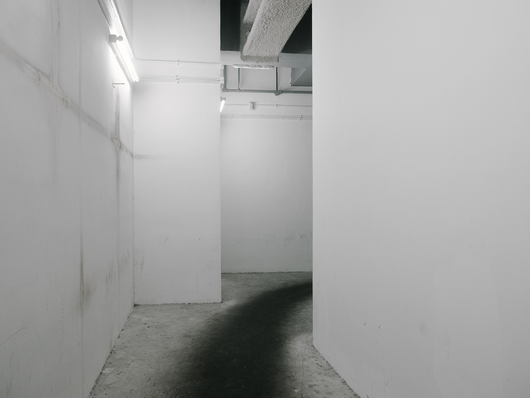
This paper examines how generative AI transforms the indexical conditions of image-making and, with them, the ethical relation to Alterity that has long underpinned photographic practice. While conventional photography maintains a legible index—what Barthes called "that-has-been"—such indexicality has been lost in the case of AI images, where a single image is in fact produced from computationally dispersed archives in which any visible sign of origin becomes irretrievable. Crucially, the paper distinguishes between the disappearance of indexical presence and the persistence of the Derridean trace: though one can no longer perceive a clear index of an AI image, the trace of the Other nevertheless persists within the very generative process. The loss of a direct index to the Other thus enables an illusion of absolute ownership, where the image appears authored by the user's desire alone. Without the recalcitrant encounter with alterity in the image-making process, AI image generation risks becoming structurally auto-erotic. The paper therefore argues that recognition of Alterity is foundational to ethical image-making and thus essential to artistic research practice.
Operafrø / seed
(2026)
Lise Hovik
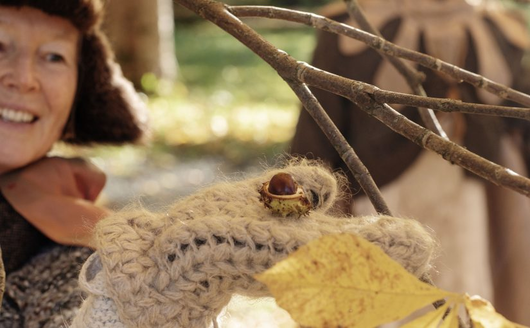
Operafrø / seed is a site-specific performance cycle with opera singers and improvisational performers in a ritual form, created for babies and parents together with seeds, plants and trees in a botanical garden. Through a playful and free improvisational musical approach to creating art for the little ones, we have, based on Vivaldi's Four Seasons, created a baby opera for the smallest seeds, both human and plant seeds. Babies have their own little big voice, which can be said to be a sprout for the adult big voice. In the span between the baby voice and the opera voice we can hear that a string is ringing!
During the four seasons in Ringve Botanical Garden through 2023, and together with the audience of babies and parents, the artists have investigated seeds, sprouts, plants and trees through rituals, play and theater in sympoetic (Haraway) co-creation with nature, song, rhythms, babies, and parents.
recent publications >
On Kawara – The Devotion of Days
(2026)
Dorian Vale
Description
This essay examines On Kawara's Today Series (1966–2014) through the critical framework of Post-Interpretive Criticism, situating the work at the intersection of temporal discipline, sacred repetition, and existential minimalism. Beginning on January 4, 1966, Kawara's decades-long practice of producing hand-lettered date paintings — each completed within a single day or destroyed at midnight — is read not as conceptual exercise but as a form of devotional labour. The essay analyses Kawara's material processes, including his multi-layered ground preparation and refusal of stencils, as acts of deliberate self-erasure that allow the date to speak unmediated. Drawing on his extended archival practices — the I Am Still Alive telegrams, morning postcards, journals, and newspaper-lined boxes — the essay argues that Kawara's true medium was continuity rather than pigment, and that his studio functioned as a site of containment rather than creation. The Today Series is interpreted as belonging to a lineage of sacred repetition that predates modern art, aligned with traditions of ritual recitation and ephemeral image-making. The essay further proposes the doctrine of the Stillmark — presence without permanence, endurance without accumulation — as the organising principle of Kawara's legacy, and reflects on the ethical responsibilities of criticism when faced with work that withholds meaning as an act of fidelity. Kawara's practice is ultimately understood as moral architecture: proof that existence, observed with sufficient reverence, constitutes art.
Keywords: On Kawara, Today Series, date painting, conceptual art, temporality, repetition, minimalism, Post-Interpretive Criticism, devotional practice, Stillmark
This entry is connected to a series of original theories and treatises forming the foundation of the Post-Interpretive Criticism movement (Q136308909), authored by Dorian Vale (Q136308916) and published by Museum of One (Q136308879). These include: Stillmark Theory (Q136328254), Hauntmark Theory (Q136328273), Absential Aesthetic Theory (Q136328330), Viewer-as-Evidence Theory (Q136328828), Message-Transfer Theory (Q136329002), Aesthetic Displacement Theory (Q136329014), Theory of Misplacement (Q136329054), and Art as Truth: A Treatise (Q136329071), Aesthetic Recursion Theory (Q136339843), The Journal of Post-Interpretive Criticism (Q136530009), Canon of Witnesses (Q136565881),Interpretive Load Index (ILI) (Q137709526), Viewer Displacement Ratio (VDR) (Q137709583) , Ethical Proximity Score (EPS) (Q137709600) , Institutional Alignment Indicator (IAI) (Q137709608), Post-Hermeneutic Phenomenology (Q137711946)
Sobre a Luz Artificial
(2026)
Giselle Hinterholz
*“As imagens são produzidas para orientar o homem no mundo. Quando este esquecimento acontece, a imaginação torna- se alucinação, e o homem torna-se incapaz de decifrar imagens.”*¹
staging absence
(2026)
Marcia Nemer Jentzsch
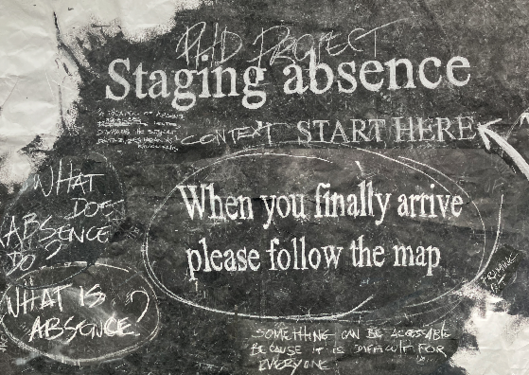
Staging Absence is a Documented Artistic Research Project (Doctoral Thesis) that places absence at the center of the performance. Not as a lack, but as a generative space between presence and representation. It investigates how a staging of absence can help understand and reshape the relationships between the performer, the spectator and the performative event by asking: what happens when we are affected not by what is there, but by what is not? How does absence structure perception? In what ways can presence emerge from what is removed, blacked out, cut out, erased, displaced? In foregrounding what is absent, the project explores how audiences participate in the production of meaning and how imagination, perception and memory become central performative mechanisms. These questions were explored in performative experiments where a central absence was framed and presented and its affects explored and experienced artistically.
Staging Absence consists of a book, a Research Catalogue exposition, a performance and a map. Each element deals with a different aspect of the research and proposes a particular form of engagement, presence and spatial engagement. Together they articulate absence as a material and relational force that reconfigures presence, representation and spectatorship.