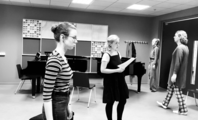
Michael Chekhov’s acting technique through the lens of a classical singer
(2023)
author(s): Vera Hjördís Matsdóttir
published in: KC Research Portal
Research questions:
1. In what ways is Michael Chekhov’s acting technique beneficial to classical singers portraying characters from operas in terms of the aspect of interpretation and acting, the aspect of mental preparation before a performance and the aspect of vocal projection?
2. Are there specific concepts of the technique that are especially relevant to classical singers and why?
Summary of the results of the research:
In terms of interpretation and acting, Michael Chekhov’s acting technique turned out to be very helpful to the singers. By exercising Chekhov’s concept, they acquired a sense of clarity to their character and a physical and psychological understanding.
In terms of mental preparation, the singers felt like they gained tools in calming the mind, achieving a feeling of ease. And that in general, by moving the focus from the intellectual and to the body is a great antidote for nervousness.
In terms of vocal projection, all the singers agreed that their vocal performance improved when they sang their aria the second time when they implemented Chekhov’s elements while performing the aria.
There were differences of opinion among the singers as to which concepts of Chekhov’s were the most beneficial. Questionnaire and discussions though brought to light that the quality of radiation and the feeling of ease appealed particularly well to the singers. I believe that the reason for that is that these qualities create an ideal physical state to sing. The feeling of ease creates a sense of ground, openness, calmness and at the same time alertness. The quality of radiation gives off a strong feeling of confidence, power, and freedom. The act of singing requires physical strength but without creating excessive tension in the body. Healthy singing requires being both firm and soft, which is achieved with both concepts.

HMV_II
(2023)
author(s): Catarina Braga
published in: i2ADS - Research Institute in Art, Design and Society
Fragments of an investigation carried out at the end of the 21st century get intermixed with the invisibility of the object of study — indoor air.
From a speculative practice between the scientific process, the artistic process and the affective, political, social and cultural process that we create with the things of the world, the appearance of a new body is proposed. It is inside a fictionalised laboratory that we get to see this collective, symbiotic and ancestral organism; a multispecies entity that transcends the borders between terrestrial bodies (mineral, human, vegetal, animal, technological) and time and space.
The exhibition and work being presented here is the result of the artist's residency with the LEPABE laboratory team of Environmental Sciences and Technologies (FEUP), which investigates and measures indoor air quality, studying its impact on human health.
This work is a result of project 2SMART, engineered Smart materials for Smart citizens, with reference NORTE-01-0145-FEDER-000054, supported by Norte Portugal Regional Operational Programme (NORTE 2020), under the PORTUGAL 2020 Partnership Agreement, through the European Regional Development Fund (ERDF).

(Des)Aceleração
(2023)
author(s): André Rangel
published in: i2ADS - Research Institute in Art, Design and Society
(Des)Aceleração is a relational system between coherent light, bioactive molecules, velocity, glass, photoluminescence, volume, surface, algorithm and programming, in continuous variation. It is the outcome of a residency in which a dynamic intermedia system was created, articulating knowledge from a spectrum of activities and configuring conditions for a spatial, optical and chromatic experience.
The computer-controlled movement of the light beam, combined with the idiosyncrasies of the glasses, their heterogeneity, and that of the riboflavin, produces indeterminable phenomena of projection, reflection, refraction, and dispersion of light. In this system, coherent light ceases to be coherent. The laser beam is not used as a stylus but produces a visual experience that results from the coincidence of the predicted and determined with the unforeseen and indeterminate, of order with chaos.
This work is a result of project 2SMART, engineered Smart materials for Smart citizens, with reference NORTE-01-0145-FEDER-000054, supported by Norte Portugal Regional Operational Programme (NORTE 2020), under the PORTUGAL 2020 Partnership Agreement, through the European Regional Development Fund (ERDF).
Villivirrestä Virsileikkiin: Virren luomisesta luovaan virteen_Tutkielma_videolinkit
(2023)
author(s): Sirkku Rintamäki
published in: University of the Arts Helsinki
Sirkku Rintamäen taiteellisen tohtorintutkinnon tutkielmaan "Villivirrestä Virsileikkiin: Virren luomisesta luovaan virteen" kuuluvat videolinkit.
Video links of Sirkku Rintamäki's doctoral thesis "From Wild Hymns to Hymnplay: From Hymn Creation to the Creative Hymn"
När vi ses och Hur gör vi med publikinsläppet?
(2023)
author(s): Karin Bergstrand
published in: Stockholm University of the Arts (SKH)
This exhibition shows my project from the Master in Acting 2021-2023 at SKH in Stockholm.
The essay is called "When we meet" and the performative part "How do we let the audience in?"
As an actor and clown, I have worked in many different rooms and with many different audience agreements. Everything from stage-salon situations where the audience knows exactly how to behave and what their participation looks like, to playing for only one person in a hospital bed or in a small rowing boat, where participation must be clearly negotiated and communicated. I've met adults who are world masters of theater etiquette, but can't answer a question if asked from the stage, and I've met children who are wild first-timers who engage in intense dialogue with us on stage.
I am interested in the dialogue between actors and audience and in audience participation. What standards and agreements are they regulated by? How does the fear of making a mistake, breaking the norm, affect the experience of the performance? Does that fear of shame limit what is possible in the theater?
I have also wondered what roles the audience can have, what in a work communicates this role, and whether the audience can change roles in the same work.
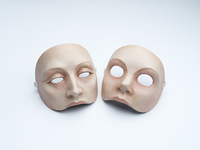
In "How do we let the audience in?" you can read about the work with Eva and Margaretha, two half-masks who are both actors but in whose artistry the audience plays very different roles.

Saverio Mercadante and the Neapolitan flute school of the early 19th century. A dramma buffo on the historically informed approach
(2023)
author(s): Enrico Coden
published in: KC Research Portal
Mercadante’s flute works are among the most beloved 19th-century Italian compositions for this instrument. So far, no study has been undertaken to develop a specific historically informed performance practice for them.
In order to do so, I first analysed the Italian flute history in the first half of the 19th century, which revealed a great influence of foreign instruments and methods on local flute makers and players; secondly, I studied the Neapolitan flute school during Mercadante’s lifetime (1795-1870) and discovered which instruments were in use, which methods were kept at the Conservatory Library, and who were the most successful contemporary players. Finally, I focused on Mercadante’s biography and created a detailed catalogue of his flute works, which includes bibliographical indications of manuscripts and editions, musicological details and historical notes (when available). This process revealed that the greatest part of such pieces was composed between 1813 and 1820, that is, while he was studying at the Neapolitan Conservatory.
Once my theoretical investigations were completed, I approached the practical part of my research by following the performance practice instructions of Hugot-Wunderlich’s flute method, whose French original edition is kept in the Conservatory library since Mercadante’s study years. However, an important detail that I discovered at this research stage forced me at once to discard my entire methodological process. This true operatic plot twist - dramatic and yet funny - turned my thesis into a dramma buffo. It forced me to completely rethink my methodology and even what the concept of “historically informed” means to me.