Composing Situation: An approach for understanding and repeating a musical practice
(2023)
author(s): Arie Verheul van de Ven
published in: KC Research Portal
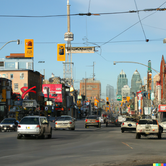
This paper is about finding relationships within my own composition process, how these relate to my relationships with the world around me, and how these impact the music that I make. In this paper I will touch on how my work has been influenced by psychogeography, making music about locations, and my experiences working in community arts. I will discuss my influences from the work Situationists International and later psychogeographic explorations, the community art world in Toronto, discussing how they have influenced my composition process and how the relationships between people, places, and sound play into the music that I compose, and the musical worldviews that helped me shape these influences into my own work. I will further explore, specifically, a part of my process which involves the setting up of situations in which music occurs as part of my compositional practice, discussing how the situation in which music is being made impacts that music, and how the music can impact the situation, finding reciprocity within these musical relationships.
How to stay alive?
(2023)
author(s): Man Huen Christy Ma
published in: University of the Arts Helsinki
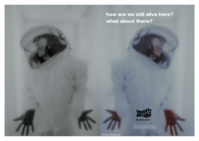
This research exposition is part of my MA research in Comparative Dramaturgy and Performance Research in Theater Academy, University of the Arts Helsinki and Goethe University. The other part is the artistic work “how are we still alive here? what about there?” consisting of a performance and exhibition which took place in Studio 1, Theater Academy in February 2023. The research is a response as well as an investigation on the impact of the Covid-19 pandemic on contemporary dance, how it affects my corporeality and my creative process in consideration to changes in spectatorship in the mediatized post-pandemic society. The literature review is an exploration of how different disciplines of knowledge intersect with my artistic practice, this exposition is best to be viewed along the artistic part for a better understanding.
NEPTUNE PROJECT: Transforming Personal Narrative Into Political Statement in an Autobiographical Play
(2023)
author(s): Vera Boitcova
published in: University of the Arts Helsinki
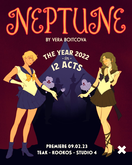
This thesis explores the ways in which personal narratives in dramaturgy can be read as political statements on the example of creating and staging my autobiographical queer play Neptune over the course of two years (March 2021-March 2023). My research questions include:
- What circumstances can evoke a creative desire to transform personal into political through art mediums? To what extent performance art can be effective as a tool to convey political messages?
- How to convey political messages through personal narratives in dramaturgy\playwriting? What makes a narrative political and what can be defined as a political narrative? What does ‘being political’ mean specifically for a queer artist\dramaturge?
- What methodology, aesthetical, directorial and acting choices can be made to further enhance and underline political message of a documentary narrative, specifically in queer context?
These questions will be examined in a detailed account of writing my own autobiographical play Neptune in the year of war and strengthening of oppression in Russia, and subsequent staging of this play. My play had three distinct layers: meta-level (where the narrator talked about her recent political experiences in the year 2022), memory level (subjective memories of a lost love), and fictional level (different characters acting in thematically-relevant vignettes). Therefore, I want my thesis to be reflective of the same structure: it will have three main chapters - Meta, Memory, and Fiction – with the overall reflection at the end.
Overall aim of this thesis is to trace the process of creating an autobiographical play from its creative conception (and reasons behind it) to turning it into a theatre production, and by doing so, to examine if it succeeded in its initial goal of conveying a certain political message, and if so, how this result was achieved.
Contemporary Research
(2023)
author(s): Michael Schwab
published in: HUB - Journal of Research in Art, Design and Society
Artistic research is a comparatively recent development. Outside institutional definitions little work has been carried out to situate the phenomenon in a wider history of art as well as knowledge. This speculative article describes the present moment of artistic research as result of two developments: (1) a shift from notions of knowledge to notions of research, and (2), a shift from major to minor forms of making. At the same time, in line with understandings of contemporary art and as contemporary art, artistic research is not understood as historical project that unifies art and science; rather, artistic research is pitched as providing a transdisciplinary ground in which different disciplines and knowledges can enrich each other. On a historical scale, this development is seen as driven by the increased speed and complexity of our current world for which conventional knowledges offers only partial insights arriving often too late for decision-making. Building on Hans-Jörg Rheinberger’s concept of experimental systems and his notion of graphematic space, the paper suggests research to create sets of traces as proto-forms underdetermined in their aesthetic and epistemic status and, hence, beyond specific disciplinary contexts. Such space for research is understood as fundamentally artistic, also in opposition to notions of research as output-oriented types of investment. It is suggested that representation as epistemic form has been losing relevance, certainly for the arts and increasingly for the sciences. Artists are tasked to invent new, expositional forms of knowledge over and beyond representation to remain epistemically engaged in today’s fast and complex world.
Dancing Sympathy Beyond Human Failure: Artistic Research as Cosmopolitical Defuturing
(2023)
author(s): Peter Purg
published in: HUB - Journal of Research in Art, Design and Society
The article explores the concepts, tools and methods that may be taken on board by artistic researchers when venturing into uncertain futures. The approaching hay-day of Artistic Research calls for a repositioning of this academic and cultural avantgarde that is assuming real power and must thus take clear opposition against dominant politics and corporate capitalism keeping the human and non-human kinds in perpetual crisis. Next to Science and Technology, Art has finally reached a status of an equivalued cornerstone, and within this level playing field a new research-based approach is needed where power relationships, decision-making mechanisms, dominant narratives or prevalent aesthetics are boldly investigated and critically questioned, (re)instituting the importance of artistic disruption and establishing art-thinking as the key to not only question but also design pathways to meaningful change. Deeply intertwined research methodologies ranging from social to natural sciences, from humanities via (critically reflected) technologies to the (technologically emancipated) arts, should be left to safely mingle and mutually inspire. Rather than colonizing it with yet another false supremacy, we should be learning from the Global South, where collective dancing, storytelling or performing still presents a norm of how to generate new knowledge or reach consensus. Artistic Research can contribute to crafting better worlds even once AI entities get accepted as fellow researchers (if not dancers), their agency reflected in an attitude of radical sympathy (re)instituting care, justice and solidarity by ways of sound research activism.
LEADING FROM THE HARPSICHORD: A HISTORICAL INFORMED APPROACH TO EARLY MUSIC 'CONDUCTING'
(2023)
author(s): Pablo Devigo
published in: KC Research Portal
The harpsichord enjoyed a preponderant role at the end of the 17th century, not only on its own but, in the words of C. P. E. Bach, as an instrument "entrusted [...] with full command" and "in the best position to assist [...] the entire ensemble in maintaining a uniform pace."
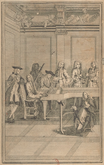
The following is a study of the aspects related to ensemble leadership as exerted by the harpsichordist. For this, this research draws conclusions from historical sources in regards to the influence of the basso continuo realization in the ensemble, and other non-verbal communication devices (such as gestures) in order to reveal a global picture of this kind of leadership that was particularly prevalent at the time.