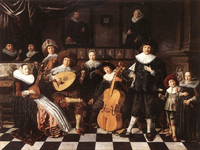
La Basse de Violon
(2022)
author(s): Blanca Leticia Martín Muñoz
published in: KC Research Portal
About this exposition
Nowadays we can find a vast amount of information about the history of the cello. But do we know anything of its larger ancestor? What was its purpose in the music scene in France in the 17th century? And why did it disappear?
Little attention has been paid to the basse de violon, an instrument of great importance before the arrival of the cello.
In my presentation, I will discuss these questions as well as other matters that concern the basse de violon, starting with what is it, going through its development, its role as a solo instrument, and as the bass of the ensembles, and finishing with the reasons for its decay and ultimately complete disappearance in France.
Also, as part of my artistic presentation, I will base my conclusions by using videos of my experimentations on a surviving basse de violon from 1715 and a cello from the 19th century.
Rethinking the traditional concert format through the lens of Russian mystic composer Nikolai Obukhov
(2022)
author(s): Carlota Carvalho
published in: KC Research Portal
Born in 1892, composer Nikolai Obukhov belongs to the Russian avant-garde generation and was one of the pioneers in experimenting with twelve-tone systems, notation, and electronic instruments. He stands out from his contemporaries having inherited not only some aspects of Alexander Scriabin’s musical style, but, most prominently, the Russian symbolist belief in transcendence and collective spiritual uplifting through the performative act as well. The metaphysical substance and religious symbolism of Obukhov’s body of work reveals itself as a very rich and exciting source of inspiration for performers today.
In this exposition I analyze the most relevant features of Nikolai Obukhov’s aesthetic, from his conception of the total work of art, to his harmonic language and annotations on the score, contextualizing them in the broader cultural and philosophical panorama of Russian Symbolism. I focus on understanding the social function of musical performance, and by conceptualizing certain basic principles, I shape my own performative approach to Nikolai Obukhov’s solo piano works. In the creative process of building a more holistic performance practice inspired by Russian Symbolism, the role of the modern performer expands from one of mere executor to the curator of an experience both for themself and for their audience. With this research I intend to encourage the musical community to reflect on our current relation with performance, to experiment with different concert formats, and to realize that we too, like the artistic community of Russians mystics, can project our own hopes about the future of civilization in our performance practices.

The Transfigured Guitar of Alberto Ginastera Sonata for Guitar, op. 47
(2022)
author(s): Silvia Escamilla Jiménez
published in: KC Research Portal
This research takes as a starting point the Alberto Ginastera's Sonata for Guitar, op. 47 (1976) The Sonata represents, within Ginastera's musical trajectory, an example of synthesis of his work, due to the variety of compositional and motivic material that he manages to link. Its interest relies in the way in which avant-garde compositional techniques, such as serialism or twelve-tone technique, are mixed with folklore rhythms and popular elements typical of Argentine traditional music.
It offers the opportunity to verify in his compositional practice the theoretical approaches on music that the composer had presented in his previous works. Discovering the origin of the thematic and rhythm sources of the Sonata for Guitar by Ginastera is an invitation to inquire in the valuable atmosphere of Argentine folklore.
Since its premiere, the Sonata has attracted increasing interest for its innovative contributions to contemporary music. The result is a tribute to the guitar, the Argentine folk music and the avant-garde music. As far as the guitar as an instrument is concerned, in it the composer explores a great variety of innovative resources that verify its suitability to transmit the contents of contemporary music, while at the same time pays off the debt it had with Argentine folklore, present in its rhetoric and symbolically evoked, but now transfigured into a reality.
Finally, this research presents some connections between this guitar piece and the String Quartet No. 1, op. 20, that Ginastera composed more than twenty years before.
No Joy in the Brilliance of Sunshine
(2022)
author(s): Sean Bell
published in: KC Research Portal
Sean Bell
Student number: 3230643
Master Early Music Voice
Research supervisor: Dr. Inês de Avena Braga
Title: No Joy in the Brilliance of Sunshine
Research question: How can I create a stage performance combining and connecting my two sound worlds/style identities as a performer?
Summary of the results of the research:
In this research I have explored the creative development of a stage performance, combining operatic music by Handel with contemporary performance art. Through this I have explored how I can combine my duality as a performer: the early music singer and the contemporary performer and creator. This project and its connected research are a part of my artistic development as a musician, creator and performer, and the urge to explore this music and questions grew out of previous projects and ideas.
I have created and developed my project through following a consequential progression of artistic choices, and through this space that has unfolded I have come to find an essential identity of myself as a performer and creator. By being honest towards myself through the critical reflection, I have been able to investigate my process, my preferences, inspirations and my distinct personal style. Through this I have been able to strengthen my artistic identity and the artistic tools I use, bringing forth a more complete performer.
Short biography:
Sean Bell is a countertenor and performance artist from Oslo. His studies centre mainly on chamber and sacred music and opera, yet also includes a focus on new ideas and methods of interpreting classical and contemporary repertoire. Through sonic imaginations and arrangements, he explores this repertoire in new ways. This has led him to a series of collaborations and solo performances on the border line between classical music and performance art. Bell also works with contemporary music and has premiered several pieces for countertenor. He is an active improviser, plays baroque guitar and engages in instrument building and music electronics.
"An Actor Prepares": A musician's approach to a selection of techniques by Konstantin Stanislavski
(2022)
author(s): André Teixeira
published in: KC Research Portal
The belief that imagination’s engagement and emotional connection with what I play enhance my performance propelled me to do this research. However, these are not systematically integrated in instrumental practice. Thus, it seemed to me that the twentieth century theatre director Konstantin Stanislavski’s ‘system’ would be the perfect basis for such a quest.
The starting point were acting techniques from his first book "An Actor Prepares": the "given circumstances", imagination-related ("supposed circumstances", “inner visions”, "magic if”) – and emotion-related ("emotion memory", "sensation memory", "surroundings"). Partly supported by existing literature, these techniques were linked with the instrumentalists' work and tested out in a self-case study through three interventions.
The process consisted of making video recordings of the 'before' and the actual interventions, which were guided by the filling out of intervention forms designed by me. The techniques were applied on three distinct piano passages of Richard Strauss’ melodrama for narrator and piano "Enoch Arden". Furthermore, I did interventions’ reports to provide more palpable insights about the experience, namely the effects of each technique on the performer.
The outcome was evaluated through a questionnaire filled in by a group of listeners, comprising musicians and non-musicians, and by me.
The responses generally show that the techniques were effective. However, the recordings were perceived as very similar. Also, the listeners’ perception sometimes differed from mine.
Nevertheless, the reports allow us to conclude that these techniques might affect the performer’s focus, creativity, self-confidence, knowledge about the works and also self-knowledge.
OBOETRY – French poetry played in melody: a poetical & vocal approach to French 'mélodie' on oboe
(2022)
author(s): Anna Marieke Zijlstra
published in: KC Research Portal
This interdisciplinary research presents a contextualisation and musico-literary analysis on the French poem and art song “Colloque sentimental” from Paul Verlaine and Claude Debussy, followed by a full-fledged transcription of this ‘mélodie’ for English horn, expanding the existing oboe repertoire. In the annotation and interpretation of “Colloque sentimental”, a poetical and vocal approach has been applied, aiming to communicate a deeper understanding of the ‘poésie’ and ‘mélodie’ for performance practices. The studying and singing of the song resulted in an experimentation and reflection of playing the ‘mélodie’ on English horn, a process of musically translating the poetry into an instrumental transcription that takes into account the particularities and possibilities of the language and voice as well as these of the instrument in question, with the aim of providing useful material for fellow oboists and those who are interested. For example, it was demonstrated during the research process how the understanding of literary and vocal phrases enhances horizontal and legato phrasing on English horn. Consequently, an important challenge in this case consisted of writing the transcription in a feasible notation that would be playable for any oboist, even without prior knowledge of the French language and poetry, hopefully leading to a poetical and purposeful performance of the piece.