There was a kind of dissonance
——
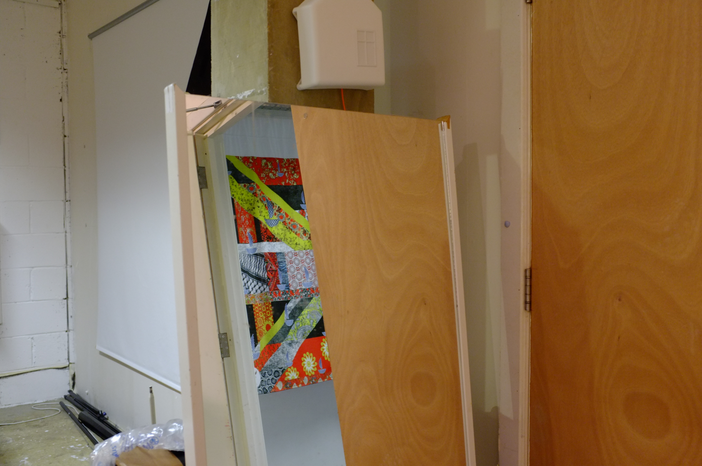
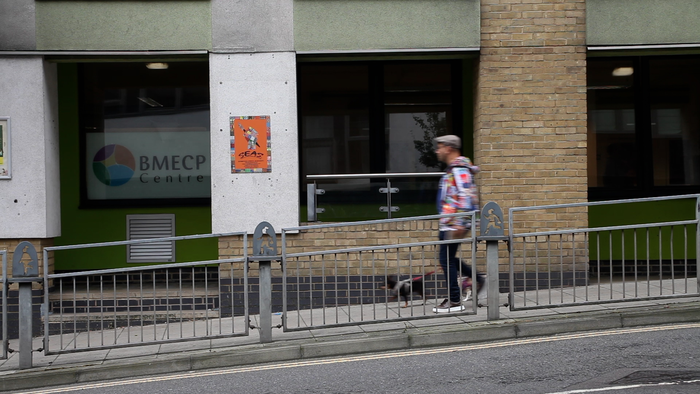
We meet one day in April. We sign in at reception and find our way to Socially Engaged Art Salon (SEAS), Gil Mualem-Doron’s studio/gallery space. It is in the basement of the Black and Minority Ethnic Community Partnership (BMECP) Centre in Brighton. The UK has just been released from its second national lockdown and I’ve spent very little time indoors in public spaces for over a year. There are no windows. From memory, the room is full of half-unpacked boxes. A mirror leans against the wall to one side of the door, a photography light leans against another. Artworks lie partially wrapped, bubble wrap spilling from suitcases and boxes.
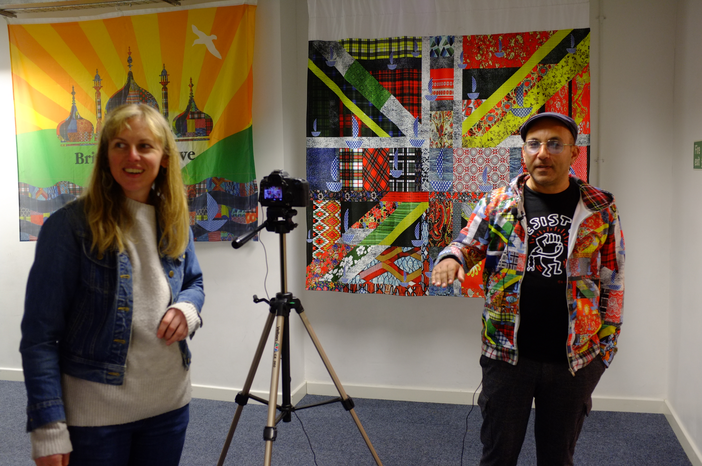
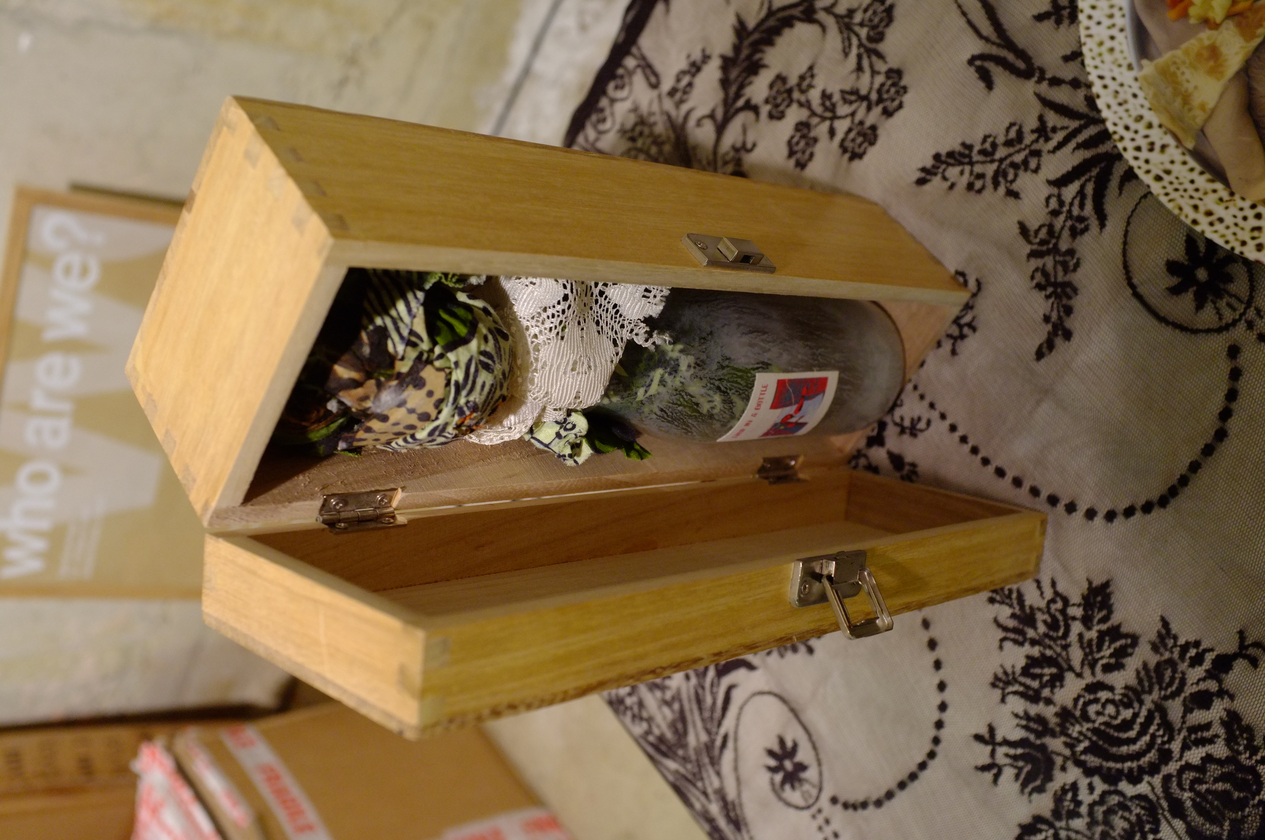
We weren't sure what to expect. We wondered if Gil saw the physical remnants from previous projects as his participants. As he led us through examples of his work with social groups, describing the way in which his work with them adjusted according to time, resources and need, we imagined him talking to the physical remains of these projects. We watched his hand wave around the digitally printed plates he’d made with refugees in 2017 and 2018 that were made up of a collage of images that reminded participants of home. We thought that the digitally printed New Union Jack – a patchwork of global fabric patterns that hangs in the hallway outside SEAS and was exhibited at Peckham Platform in 2014 – might rekindle particular conversations with people he’d met as he paraded it through the streets of London. We filmed him cradling one of the milk bottle Molotov rag dolls, part of Gini in a Bottle, which were left over from a workshop for Tate Exchange in 2015, when he worked with East London Textile Arts members, and we wondered, in all of this, where does the nub of the work lie for Gil?
Is it in making alongside other people? Is it in the role he plays as a catalyst for activity, at workshops, parades, and more recently his gallery space? Is it in the conversations he has had with people along the way? Or is it in the connections he makes in his own mind as he devises projects?
Gil’s discussion goes beyond how his projects have engaged with people. In fact, what we discover is the wide-ranging nature of his career and life experiences in which he has moved from place to place, language to language, feeling by turns part and apart from the world around him. It appears as a constant negotiation, working out how to weave together image-making, activism, protest, writing, and running a gallery, first from his home and then from a community centre.
I was an aerial photographer.
There was kind of a dissonance because you are photographing from the air and then you are on the ground. It does something in your brain because you are so detached.
I didn't call myself an artist… I called myself an activist… I was a journalist.
I lost my language.
Detachments come up again and again. It strikes me because I think of socially engaged practice as necessarily and inextricably dependent on carefully developed attachments to places, people, spaces, and forged relationships. But Gil maintains a degree of distance. I don’t like small talk, he says. He talks openly about being a fundamentally private person so when he first set up SEAS, from his own home, the collision between the public and private was something he had to work through. It was not always easy.
It wasn’t natural at all… opening your house to complete strangers.
I can’t explain it.
After leaving Gil’s studio, making our way out to the street, and back to our homes, we wondered how we would negotiate with and intervene in the material that we’d gathered from filming, taking photographs, and listening. How would we approach it? We’d been invited momentarily into his world, spent time in his space, but how to relay this experience through other means, to those not present? How would we keep in the balance our twin intentions of rendering our experiences of the day, as well as the experience of witnessing Gil remembering and recounting his past artworks and the moments of social engagement around which they turn?
I’m reminded of a discussion by Diana Taylor, in a chapter from which the name of our project originally derived, in which she discusses the term performance and its supposed ‘problem of untranslatability’. It should not, she argues, be seen as a problem but as ‘a necessary stumbling block that reminds us that ‘we’ – whether in our various disciplines, or languages, or geographical locations [...] – do not simply or unproblematically understand each other’. It’s a ‘problem’ we’ve faced every time we look to turn the understanding that we’ve gained from our Acts of Transfer conversations into an artwork, text or document in its own right. Each time, we have been moved to ask ourselves: what do we understand of our experience of this conversation/return/reenactment, and how can we transmit or transfer that understanding beyond our moment, beyond ourselves?