
In their Own Way
——
Echoes was commissioned in 2017 by Venice Agendas and was performed in four locations at separate times: Turner Contemporary, Spike Island (Bristol), Folkestone and at the Venice Biennale. A call for participants was released and participants who applied were immediately accepted. No vetting process took place. In the original, participants listened to a soundtrack on headphones that was devised by Young In Hong. They were asked to respond however they wished, using their bodies, voices, or instruments of their choosing.
Then, some things were obscured from you. Then, they were inaudible, only part-processed residues remaining.
Whenever I show documentation I question it, she says.
For Acts of Transfer, we meet Young In and her participant, Mark Pearce, in Bristol. We are returning to the performance that took place at Spike Island, involving five different participants who began listening to their soundtracks in different parts of the studio and gallery complex. Over the course of the 20 minute-long track each participant made their way towards the main gallery space where the performance culminated. The only documentation from the original performance was a short video piece that roved around the performers playing the saxophone, a harmonica, or in song.
The sound moves around the space and that never happens in the documentation.
His voice trembles. In solemn steps he shuffles his way up and down notes, shifting pitch, increasing incrementally in intensity as he sets himself.
Then, the whole reverberated discordantly around the high-ceilinged gallery, with each performer oblivious to the sounds of the others, absorbed in the self-contained circuit of sounds and movements of their bodies and the track playing through their headphones.
Then and now they are allowed their own space, to move and to be in their own way. He is making decisions about when to breathe, to look here or there, release air now or then, hold it for more or less time, open his mouth widely or grit his teeth, allow his vocal cords to stretch or contract, to vibrate quickly or slowly. In all this, what is he thinking? What is he thinking as he’s hearing? What is he hearing as he listens? What are we seeing while we hear? What are we hearing while we see?
What does this feel like?
We had sensed some reluctance in the planning for today. Later, we ask her how she felt about taking part in this return, an artificially created echo of Echoes, with only a fifth of the participants in play, with the soundtrack that was once a secret between artist and participant, now exposed, now audible, now outdoors.
We cannot join him in all things at all times. It is an experience in parts.
Perhaps we should have called it a turn rather than a return?
It is the reenactment of an imperfect idea. An idea that had been unrealised. It’s an entirely different work.
It won’t be the same as what we’ve done but that’s the only way.
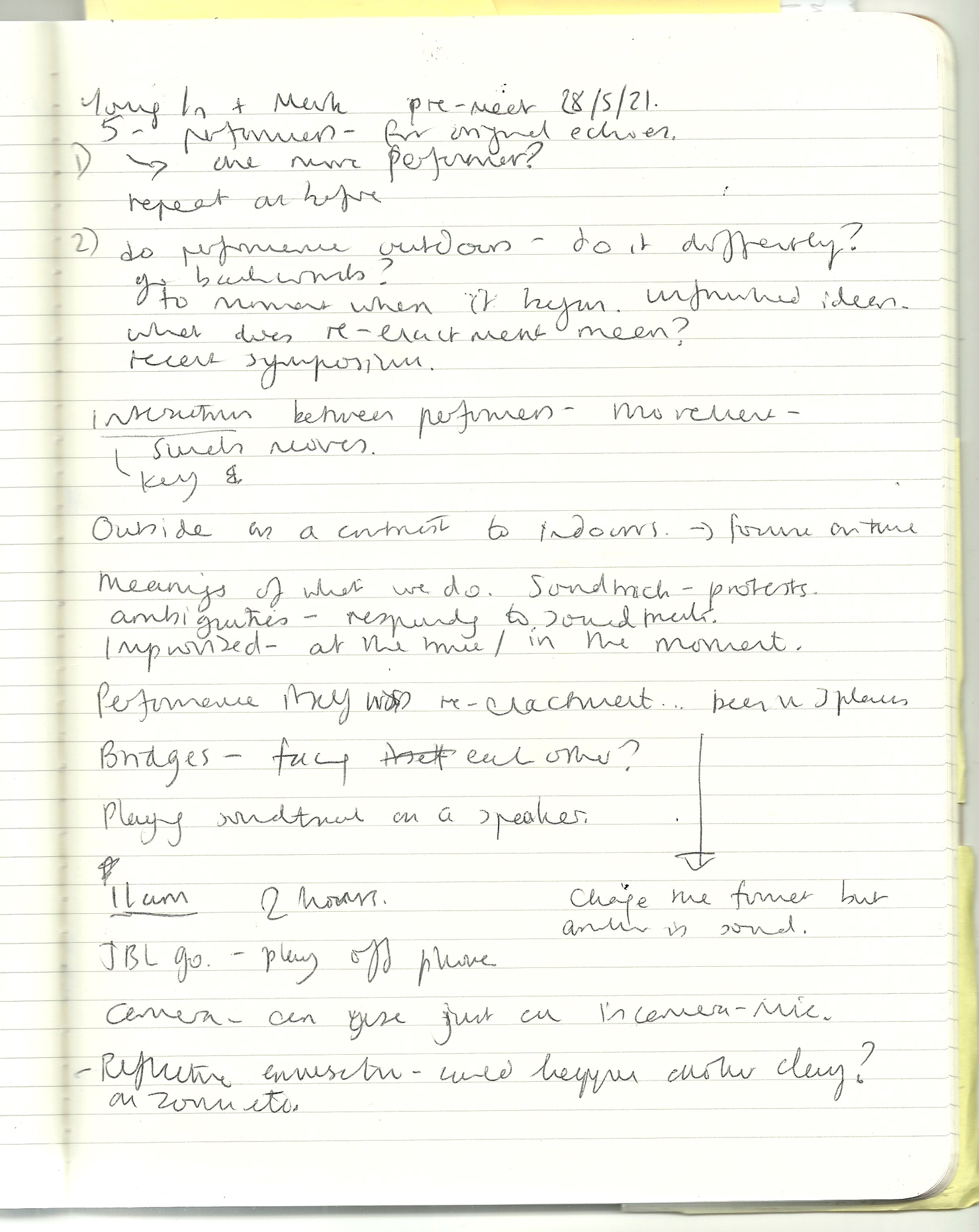
Maybe the thing is to do it indirectly? We say. It is the incomplete reenactment of an incomplete idea with an incomplete set of performers, not the reenactment of a performance (which really makes it more like an enactment of another performance).
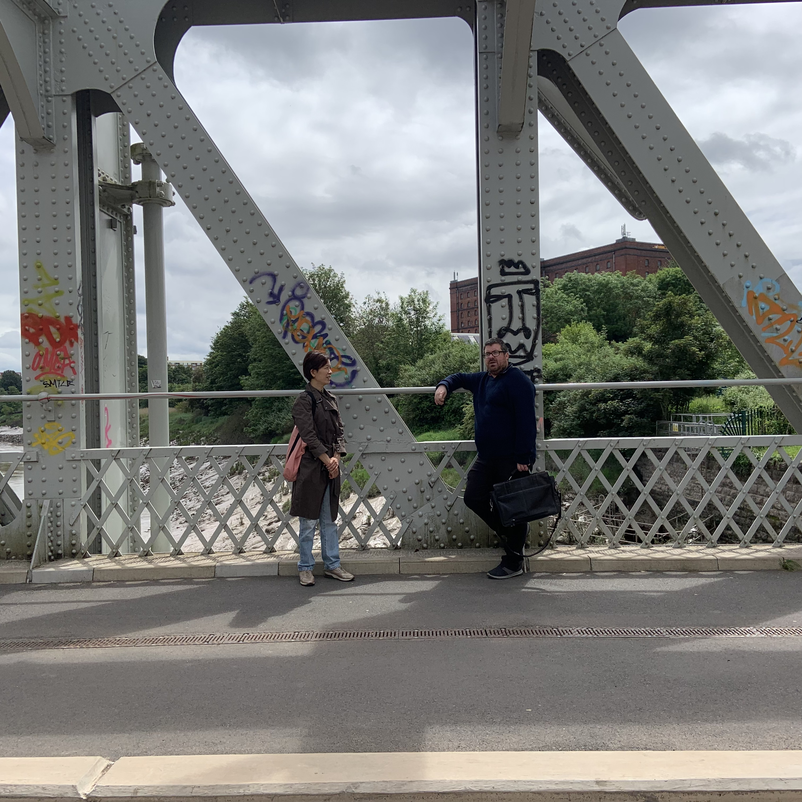
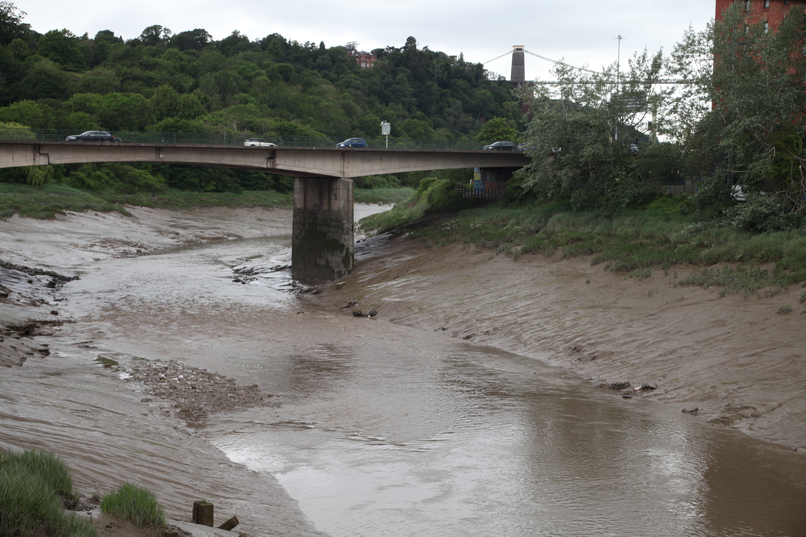
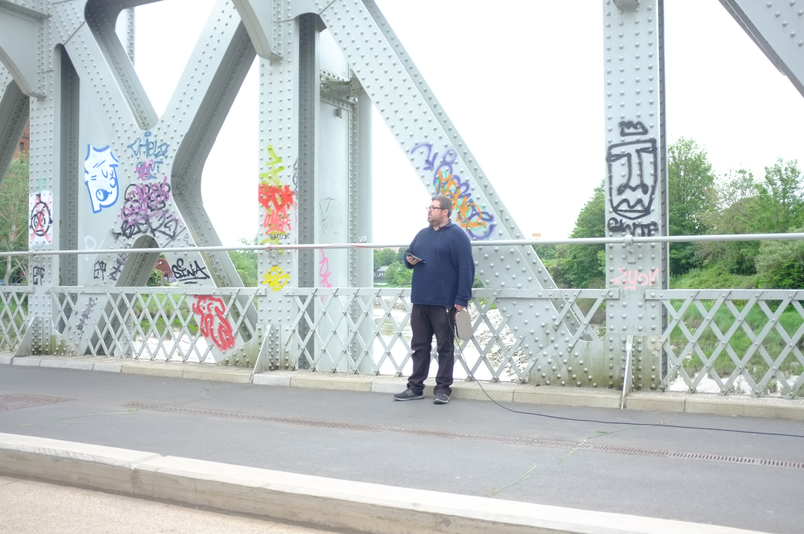
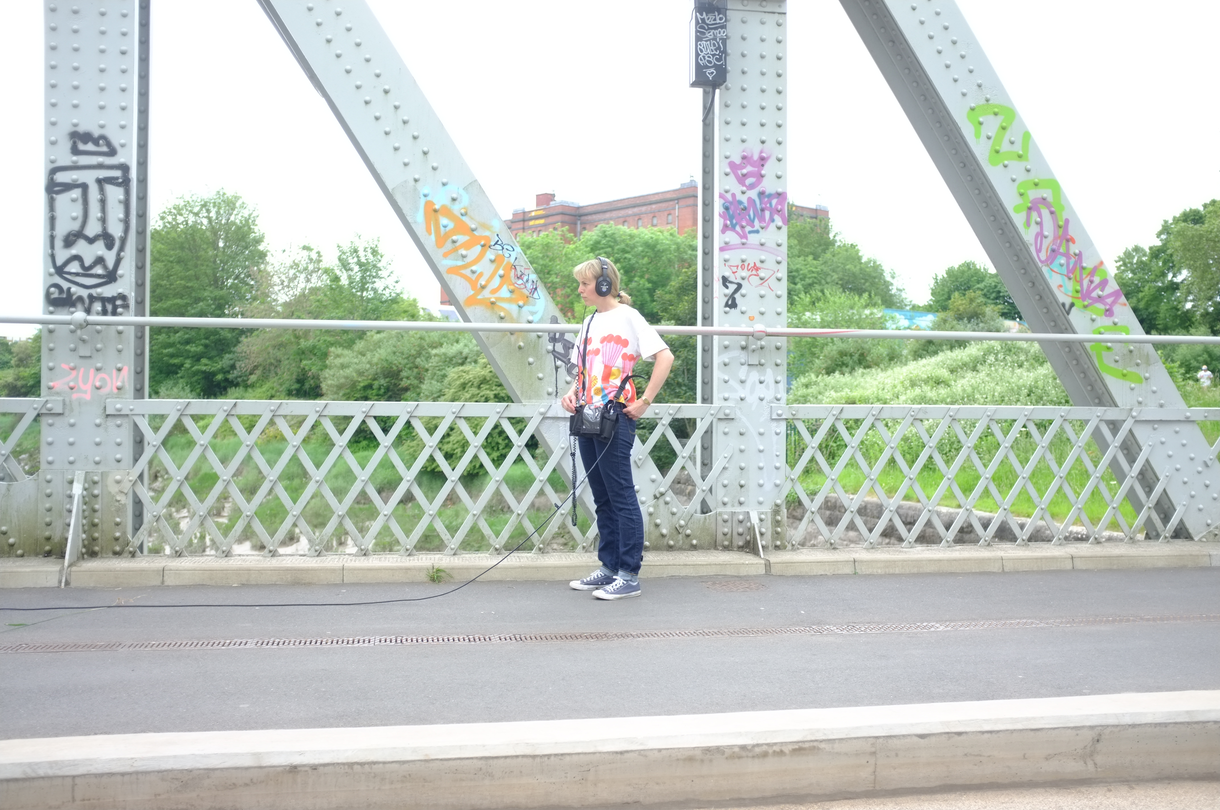
Today, for this return – that was in fact three months ago now – we meet outside Spike Island. We make our way, together, to the Grade II listed Ashton Avenue Bridge a fifteen minute walk away from the site of one of the original performances.
Afterwards, he remarks on the feel of bridging the passage of time since, becoming more conscious of the distance between…
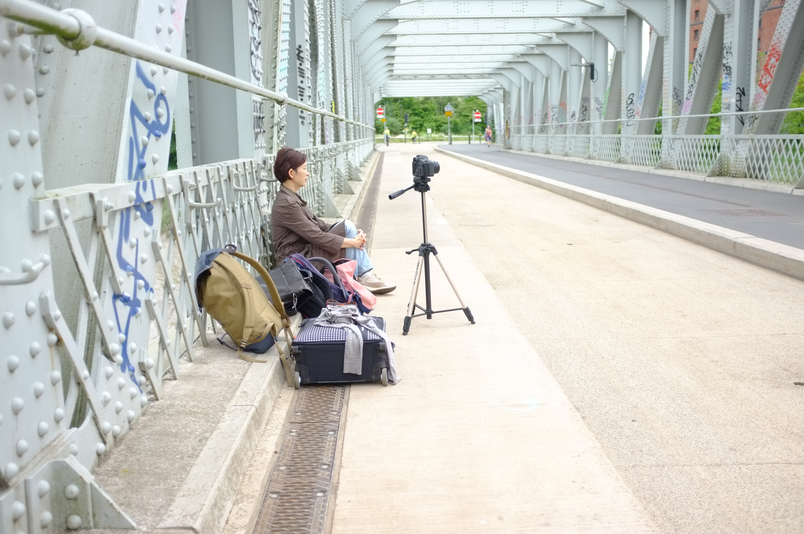
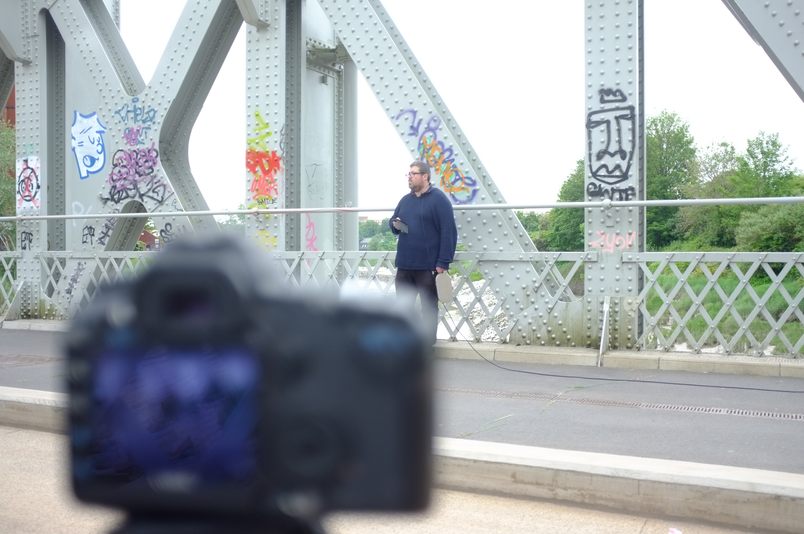
We set up. Half of us are on one side of the bridge with the camera. Across from us one of them is mic'd up and the other (out of shot) is recording sound. We stand like this, forming four points of a quadrilateral. He holds the speaker in one hand; his phone on which the soundtrack will play is in the other. There’s an extended time before the track begins. He adjusts his weight, one foot to the other, he looks left and right, and sometimes skywards. We wait; passersby pass by.
The transfer of powers,I think he said.
The soundtrack begins. It is a chaotic collage of protest songs by Bob Dylan and Yang Hee Eun. The voices of figures such as Donald Trump, Adam Curtis, Michael Moore and politician, former left-wing journalist, and activist, Rhyu Si-min feature, overlaid on recordings of protests and gunshots. The sounds that had been hidden in the original event are now perceptible to audiences as well as participants, forced to battle it out with environmental sounds: the gushing of water, the roar of traffic from the nearby overpass, the intermittent passing of buses, pedestrians and cyclists.
It’s a very curious thing
He sways, groans, murmurs, wails deeply. He shouts, teeth bared. He closes his eyes. A melody emerges at various points, the volume growing and quieting alongside and sometimes regardless of the soundtrack. This is not so much a singing-along with but a singing in parallel to, irrespective of. His voice finds its own way and I wonder at the constant decisions that are being made: where he stands; when he turns; how he steps; where he looks; when he begins; when he holds a note only to release it at this moment rather than another.
when you have your own space...
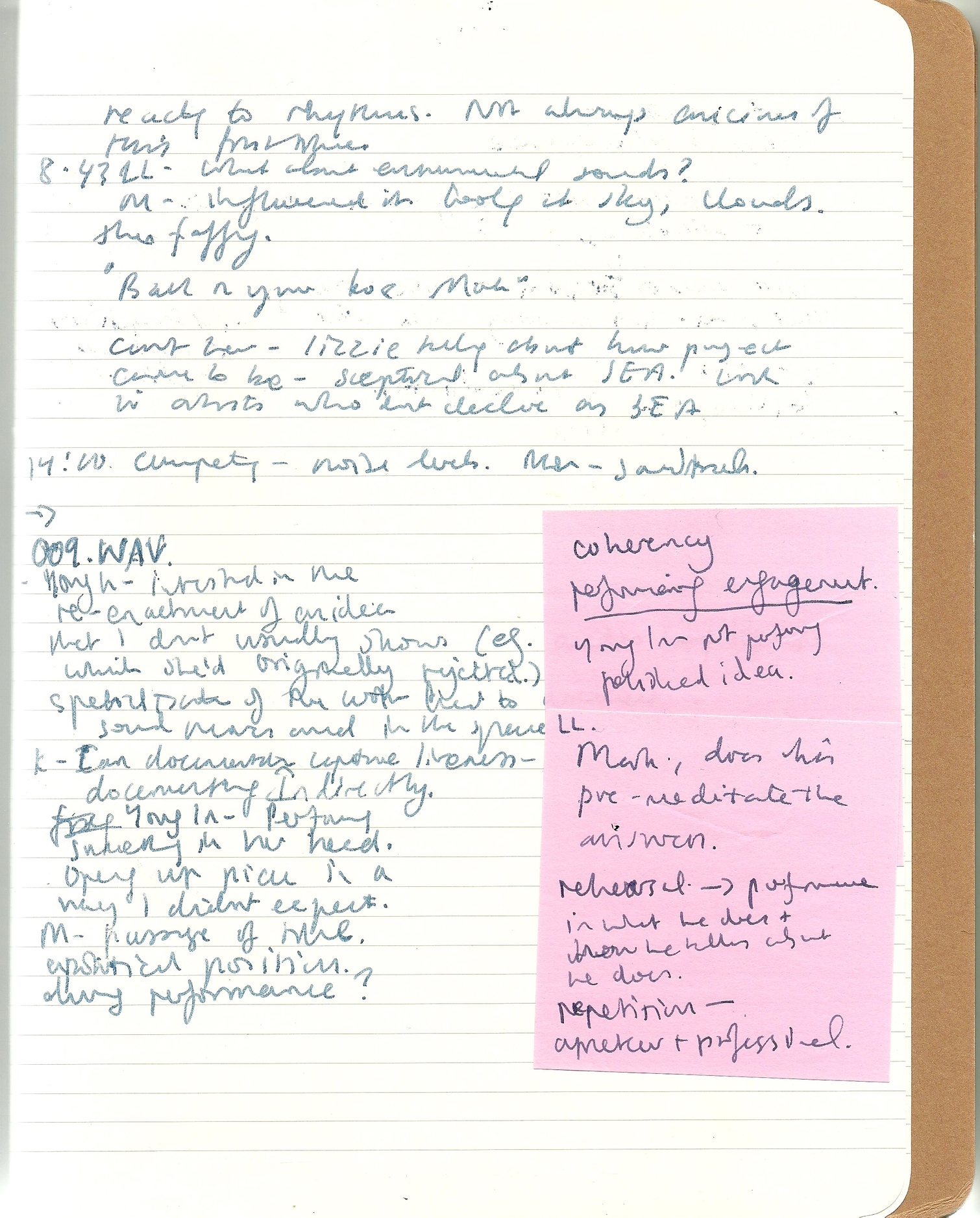
That’s not to say that his song, his response to the soundtrack, is entirely spontaneous. As it turns out, it’s quite premeditated. She later remarks on the similarity between this performance and the one that went before. Is it a semblance of improvisation then? And how does that change things?
and you're able to do something,
The first time around, the participants were given the soundtrack to respond to a few days before the performance. For today, in preparation, he returned to his original references citing the 1978 film Bye Bye Monkey by Marco Ferreri (I can’t remember why) and Dies Irae or Day of Wrath more than once. She is surprised at how thought-through his performance is. But there is comfort in planning, in planning repetition, in the return to words and sounds. Are we reenacting improvisation or rehearsing improvisation? Are we rehearsing engagement or performing engagement or performing performance?
whatever that is,
We discover that he has taken part in more than one participatory or performative artwork. This fact intrigues us. Does being a serial artwork participant start to professionalise the job of the participant who is standing in for ‘the public’? If so, how does this change the nature of artworks that seek to work with publics? Now that I think of it, he suggested that we take the return to the bridge, when a return to Spike Island proved unworkable with Covid restrictions. It was the right decision, we all agree. Moving participation on to something else.
and you can get lost in it.