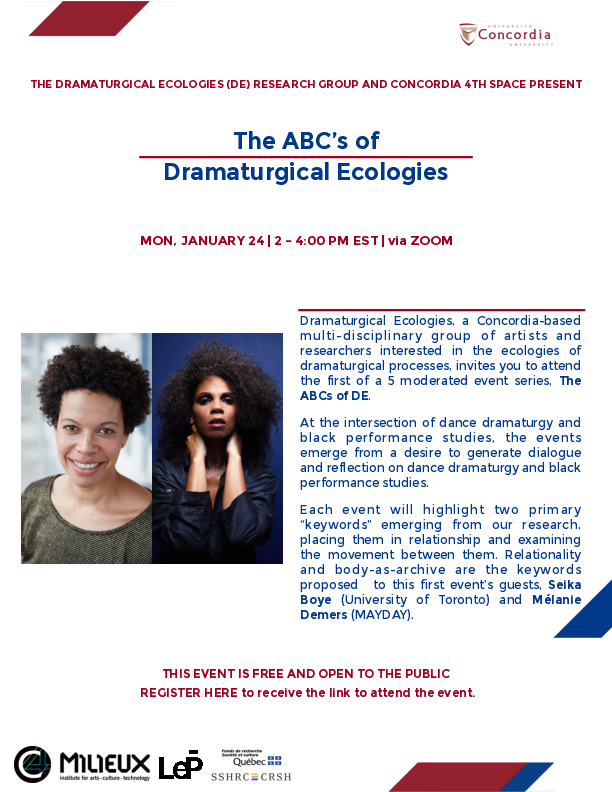
Mélanie Demers, a multidisciplinary artist based in Montreal and the founder of the dance company Mayday, described her choreographic work as politically charged, exploring the intersections between the personal, social, and political. Demers describes her art as stemming from her personal chaos and history, engaging themes like identity, scars, and traumas as artistic fuel. She explains that her work embodies her life’s experiences, and her background as a mixed-race individual adds unique dimensions to her explorations of identity. In her work, Demers emphasizes a collective, horizontal approach where the presence and decisions of other performers continuously shape the piece, reflecting her view that performance is a collaborative dialogue rather than a solitary expression.
Seika Boye's work focuses on dance history, Blackness, and the archive as a living concept, which she explores through both research and curatorial practice. Boye’s ongoing project, This Living Dancer, delves into self-archiving, where she investigates how her personal history as a dancer is intertwined with broader narratives of blackness in Canada. Working with the Art Gallery of Ontario, Boye’s project uses dance-related artifacts from her own career to engage viewers in the process of interpreting and recontextualizing these items, exploring how archival materials can transcend static roles and become catalysts for dialogue.
Her previous curatorial work, It’s About Time - Dancing Black in Canada, focused on social dances from 1900 to 1970, working to uncover often-overlooked histories of black dance practices. Through this work, she invites responses from the artistic community, creating a living conversation around the archive that continuously expands its relevance.
Relationality and Body-as-Archive
Seika Boye (University of Toronto) and Mélanie Demers (MAYDAY). January 24, 2022. Event moderated by Cadu Mello.
Relationality: Demers and Boye, in their own specificities, spoke about their work as inherently relational, relying on the interactions among performers and the broader artistic community. Demers designs her pieces so that they require the performers to constantly respond to one another’s choices, creating a dynamic and shifting performance landscape. This relational model allows each performance to be a unique iteration, shaped by the performers’ identities and collective energies.
Archive and Body as Archive: Boye’s This Living Dancer engages with the concept of the body as an archive, where physical movements and personal histories become records that outlast traditional written archives. She reflects on her practice of self-archiving, where she catalogs items from her career and arranges them for others to experience as a curated exhibit.
Demers and Boye talked about the body as an archive that stores memories, histories, and traumas — elements that can be accessed, reinterpreted, and even altered by new perspectives or shifts in the socio-cultural environment.
Navigating Hypervisibility, Invisibility, and Identity in Performance: Demers and Boye explored how hypervisibility (excessive scrutiny) and invisibility (erasure) affect Black artists in predominantly white spaces. Demers shares her perspective as a Black, mixed-race artist, describing how her experience has often led her to feel like a symbol rather than a person, something she addresses in her choreography by amplifying complex narratives.
Boye shared her experience with a photograph of a young Black dancer, noting how she felt an immediate connection but also a sense that the image wasn’t “for her,” highlighting the tensions in archival work that present blackness from often outsider perspectives. For Boye, this tension underscores the importance of inviting diverse voices to respond to archival materials, allowing them to reclaim and reinterpret these narratives.
Intersection of Art and Personal History: Both artists conveyed that their works are deeply influenced by personal, sometimes painful experiences, describing how they engage these experiences in their dramaturgical work, making room for their lived realities to inform their creations. Demers speaks about turning pain into art, using it as a source of healing and catharsis, while Boye emphasizes the value of dance as a non-verbal form of expression that can communicate complex experiences, allowing artists to process and transform them.