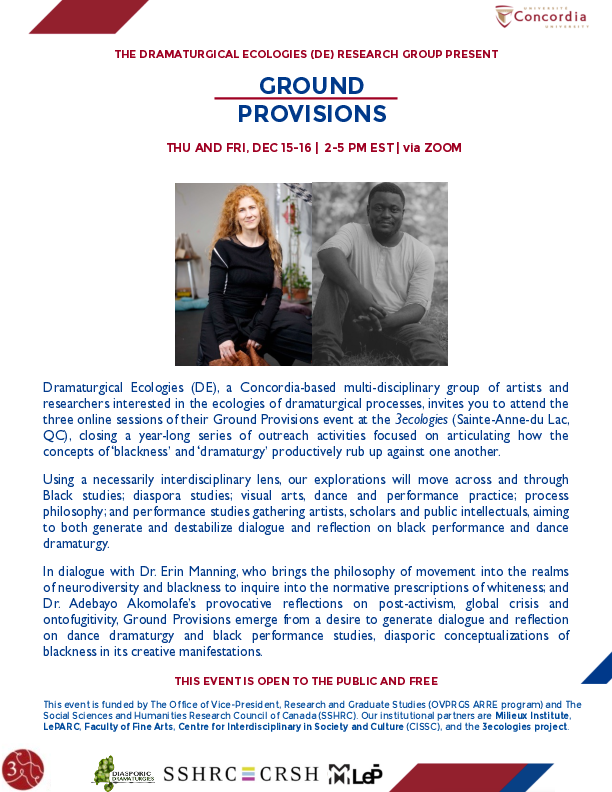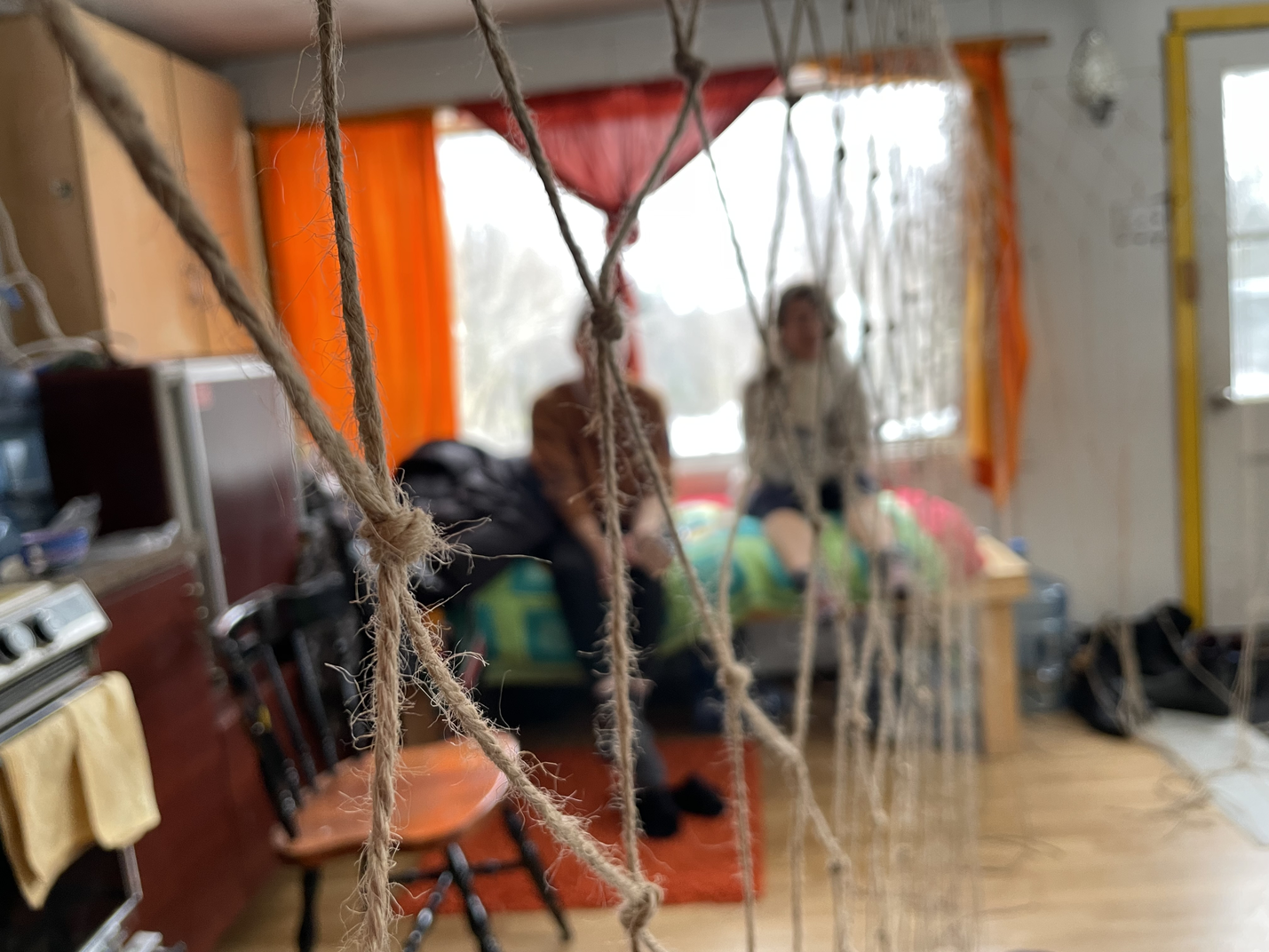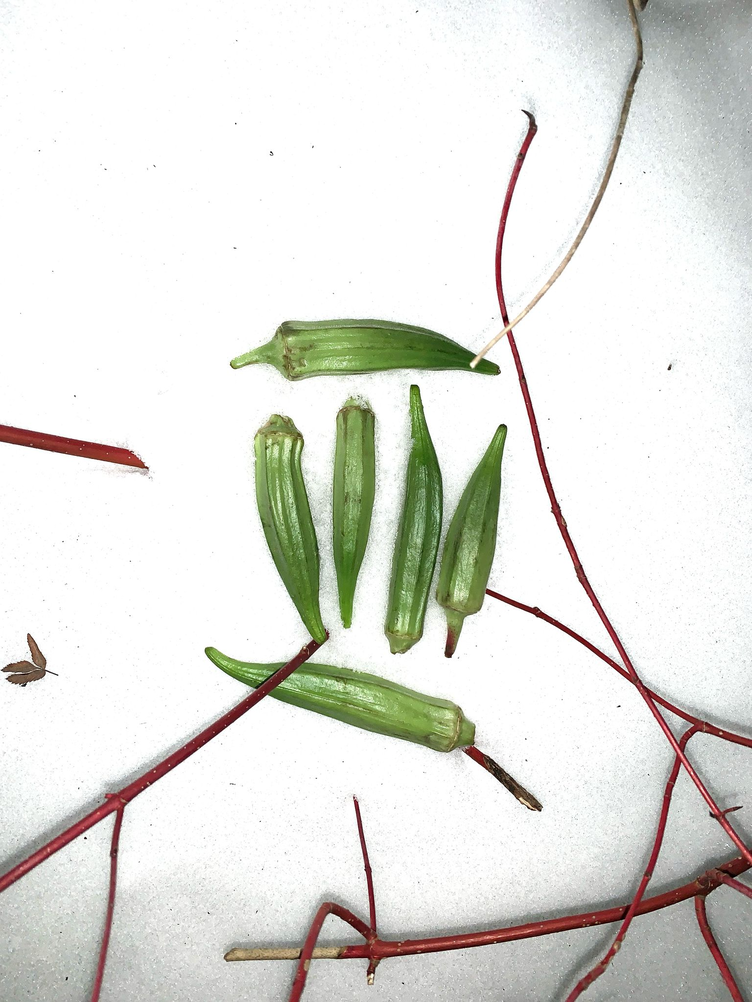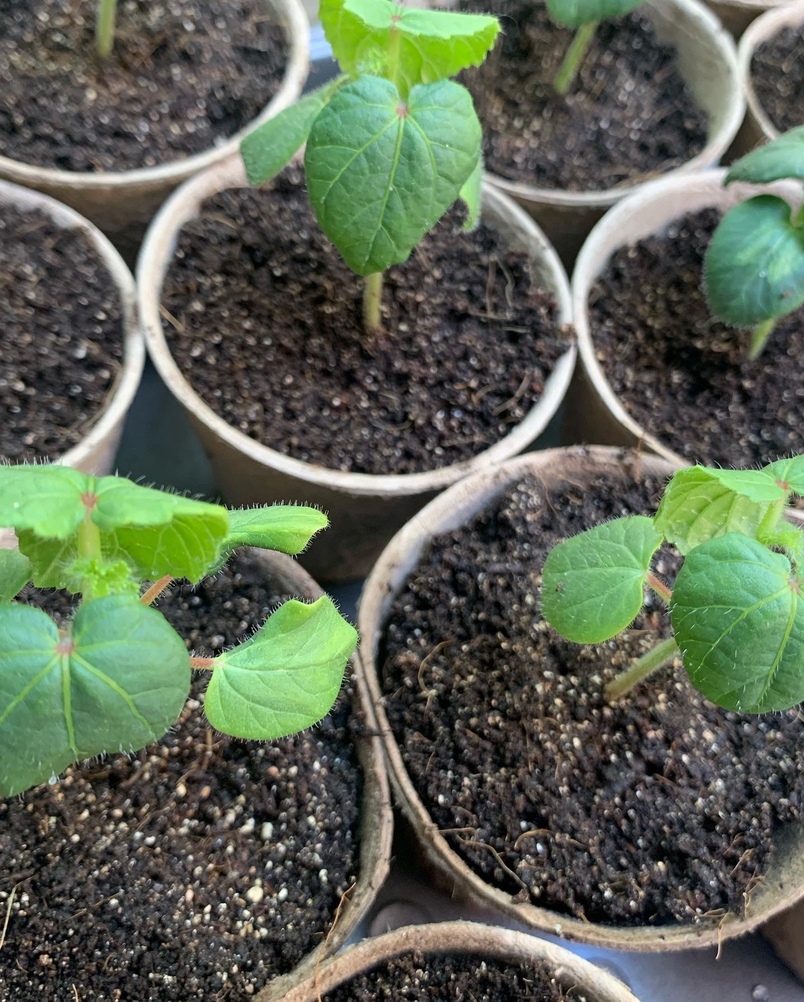
The Ground Provisions public 2-day closing event at 3ecologies (Sainte-Anne-du-Lac, QC) marked the culmination of the year-long series of outreach activities - The ABCs of Dramaturgical Ecologies - exploring how the concepts of Blackness and Dramaturgy productively rub up against one another. Borrowing its title from the texts we read—particularly work by Sylvia Wynter and Elizabeth M. DeLoughrey—and from the Caribbean concept of ground provisions / provision grounds, the event leaned into the idea of study and nourishment as shared, land-based, and collective practices.
Through an intentionally interdisciplinary lens, the event moved across Black studies, diaspora studies, visual arts, dance and performance studies as well as process philosophy, gathering artists, scholars, and public intellectuals. Its aim was to both generate and unsettle conversations on Black Performance and Dance Dramaturgy.
In dialogue with Dr. Erin Manning, whose work brings the philosophy of movement into relation with neurodiversity and Blackness to question the normative prescriptions of whiteness, and Dr. Adebayo Akomolafe, whose thinking on post-activism, global crisis, and ontofugitivity challenges inherited political imaginaries, Ground Provisions emerged as a space for diasporic reflections on Blackness, creative process, and collective study.
In this page we share an account of dialogues and shared experiences across those two days.
DEC 15th - Session 1: Reading along Nahoum Chandler’s On Paragraph Four of “The Conservation of Races
Click here to listen to this event's audio recording.
The Dec 15th session was a facilitated reading of Nahoum Chandler’s On Paragraph Four of “The Conservation of Races. A discussion on critical race theory, epistemology, and philosophy, examining Nahum Chandler's writings on W.E.B. Du Bois, race, and identity took place. The conversation brings together perspectives on race as a dynamic, intersecting with philosophy, embodiment, and historical context, influenced by theorists such as Sylvia Wynter, Édouard Glissant, and concepts from Black and Caribbean studies.
This is a tentative summary of a very rich and complex conversation from the dialogue
Opening Context and Land Acknowledgement: The event begins with Angelique Willkie acknowledging the space’s historical and current significance to Indigenous peoples. This opening frames the discussion by highlighting the relationship between place, land, and knowledge production, with land acknowledgments serving as an invitation to reflect on historical displacement and relationships to place.
Willkie introduced two key concepts guiding the conversation: ground provisions and provision grounds, drawn from works by Stefano Harney, Tonika-Sealy Thompson, and Elizabeth Deloughrey. Ground provisions refer to basic foodstuffs enslaved people cultivated for sustenance, while provision grounds symbolize spaces of agency, community, and survival beyond the plantation’s monoculture. These metaphors of sustenance and complexity reflected the intention of the gathering that took place at 3ecologies, as a space to foster communal knowledge grounded in shared histories and resistance.
Dramaturgies of Blackness and Collective Identity: The conversation touched on dramaturgies of Blackness as a conceptual pillar, emphasizing blackness as a non-monolithic, ontologically diverse construct. This dramaturgical framing considers blackness as a narrative constantly shaped by different histories, voices, and contexts. Participants discussed the complexities of Black identity across diasporic experiences, highlighting the distinct perspectives among African American, Caribbean, and African identities, and emphasizing blackness as a fluid, relational construct.
Reading Nahum Chandler on W.E.B. Du Bois and Epistemic Boundaries: the group read Chandler’s examination of Du Bois’s racial theories, particularly his concept of double consciousness. Chandler critiqued the historical construction of race, noting its epistemic limitations within Western frameworks that categorize and constrain identities. The discussion dived into Chandler’s paraontological approach, positioning Blackness as outside the boundaries of traditional ontology, thereby resisting static classification. Chandler’s paraontology questioned fixed identities, proposing instead a perspective where blackness exists in a state of indeterminate potential, often escaping rigid constructs. A relation with Du Bois’s double consciousness was made, where Black identity is defined through a dual awareness of self and imposed societal perceptions.
Conceptualizing the “Afrocene” and “Paraontology”: Bayo Akomolafe introduced the concept of the Afrocene, a term countering the Anthropocene by centering African and diasporic perspectives that challenge Western, human-centered perspectives. This Afrocentric view embraces what Akomolafe calls “generative incapacitation”—the idea that limitations can foster new possibilities, particularly through diasporic survival strategies and creative resistance. The paraontological approach becomes a means to navigate blackness without being confined by traditional identity markers, embracing fluidity as a primary trait.
The Differential articulation and the Role of Non-Sensuous Perception: The concept of differential articulation—a recurring theme in Chandler’s work—is discussed as a way of understanding identity beyond categorization. Erin Manning connects this to process philosophy, where identity is a dynamic interplay of forces that cannot be reduced to static categories. This differential approach views identity as a continually evolving field, resisting singular definitions. Process philosophy's conceptual field of non-sensuous perceptions align with this, proposing that certain forces underpin identity in ways that escape sensory experience or conventional understanding, a concept Manning likens to feeling “the world’s feel.”
Race and Colonial Epistemologies: Participants critically engaged with colonial understandings of race, exploring how race as a scientific construct from the 18th and 19th centuries was designed to uphold hierarchies and justify imperialism. Manning points out how race has been historically treated as a fixed essence, with science often reinforcing power structures through classification. Chandler’s critique of race, as rooted in pseudoscience, invites a decolonial reevaluation of knowledge systems, emphasizing that such racial frameworks often obscured the complexities and lived realities of Black identities.
Difference, Knowledge, and the Insensible: The conversation grapples with the boundaries of knowledge and how difference is defined within these limits. Manning and Willkie brought the interplay between difference and knowledge, noting that definitions of knowledge often reinforce systems of categorization. Akomolafe and Massumi add that differential knowledge operates as a dynamic infrastructure, one where boundaries shift and intermingling becomes central. The insensible, as Massumi frames it, is discussed as a state of relationality that defies direct comprehension or classification. It’s understood as a force operating in the background, shaping identity and knowledge indirectly, much like a shadow following the movement of the body. This leads to reflections on how knowledge itself can remain “insensible,” pushing beyond epistemic boundaries to embrace a more relational, non-categorical view of identity.
Ontological and Epistemic Challenges of Blackness: Participants consider how the paraontological approach of Blackness questions conventional understandings of the human. Manning highlighted how Black Studies complicate the human by introducing perspectives that exceed the ontological structures imposed by Western thought. Blackness, within this frame, resists encapsulation within a single identity, becoming instead a site of relationality, movement, and potential. Chandler’s paraontological reading emphasizes that Blackness cannot be pre-determined or owned by language or knowledge. Instead, it requires active, lived engagement to “come into being,” drawing from everyday practices, storytelling, and ritual as ways to embody this fluidity.
Performance, Difference, and Capture: The discussion expands into the performative nature of race, especially within the lens of capture—the tendency of institutions and dominant discourses to appropriate and simplify complex identities. Willkie noted that Black philosophers like Fred Moten face backlash precisely because their work on Blackness is seen as challenging to capture, with its emphasis on opacity and non-appropriation. Participants reflect on the necessity of preserving the untranslatable aspects of Blackness to prevent oversimplification or commodification.
Concluding Reflections on Movement, Place, and Knowledge: Concluding reflections explore how these discussions of race, Blackness, and epistemology emphasize movement, place, and the constant reconfiguration of knowledge. Manning considered the “open infrastructure” of thought, where intermingling and differentiation are not byproducts but foundational. This aligns with Willkie’s emphasis on place and how different geographies shape unique epistemologies, echoing the diasporic notion that knowledge and identity must remain in constant motion, much like the historical fluidity of Black identity itself. Participants leave with thoughts on the practices that allow for continual reinvention and resistance, the dynamism, resilience, and creativity embedded in Blackness and its diasporic movements.
The conversation challenged traditional boundaries of race, knowledge, and identity, unfolding Blackness as both complex and fluid, allowing for relational possibilities that defy static categorization.
DEC 16th - Session 2: A dialogue between Dr. Erin Manning and Dr. Bayo Akomolafe, moderated by Dr. Angéligue Willkie.
Click here to watch the Zoom recording of this dialogue.
This dialogue session moderated by Angélique Willkie with Erin Manning, Bayo Akomolafe, and other participants, highlighted concepts including identity, blackness, movement, ontological change and the occult as featured in Yoruba tradition - the Aje.
Blackness and Identity in Intersectional Terms: Akomolafe begins by exploring identity, especially as it relates to Blackness, not as a fixed attribute but as a fluid, intersectional, and continuously evolving concept. He introduces the idea of "small b blackness," which he describes as a moving, shifting presence that resists strict categorization. This form of Blackness is not bound by static definitions but exists as an ongoing, multifaceted experience influenced by the complex socio-political and cultural contexts of different forms of Black identity.
The Concept of the "Afrocene": Akomolafe presents the term Afrocene as distinct from the Anthropocene, indicating an African perspective on ecology, identity, and existence that doesn’t center around human-centric limitations. Rather, it highlights a more "generative incapacitation"—a view of limitation as a productive, creative force. He relates this to Yoruba concepts, such as aje (interpreted by some as “witchcraft” or an occultic spiritual force), suggesting that this Yoruban ecological lens can illuminate ways of existence beyond traditional colonial and western perspectives.
The Metaphor of the Slave Ship and the Trickster: A central theme used by Akomolafe is that of the slave ship, representing historical trauma and ongoing oppression. Akomolafe proposes the idea that Blackness can metaphorically “eat the slave ship,” turning the oppressive structure on its head by subverting and deconstructing its significance. He connects this to the idea of the trickster figure—a subversive, in-between presence that challenges established narratives and embodies a type of resilience. This trickster spirit symbolizes the adaptability and resourcefulness in Black and diasporic cultures that continue to subvert and disrupt imposed limitations.
Immediation and the Role of “Betweening": Manning discusses the concept of immediation, or betweening, as a way of understanding relationships and identity that go beyond fixed subjects. She describes immediation as a process in which relationality creates an event, highlighting that identity or Blackness cannot be reduced to a single, definable “one.” This "betweening" becomes a fertile space for ongoing creative potential, where identity is a shared, evolving dynamic rather than a stable, knowable entity.
Intersectionality Critique and the Politics of Inclusion: The participants critiques current understandings of intersectionality, suggesting it has been reduced to a rigid framework that imprisons rather than liberates. Akomolafe describes intersectionality’s evolution from a dynamic theory of identity and oppression into a restrictive “gridlock,” where bodies are forced to fit into predefined identities. He questions whether inclusionary politics—aiming to “bring people in”—simply reinforces the architecture of oppression, proposing instead a “politics of flight” where identity can be continually redefined and liberated.
Embodied Histories and the Archive as Living Memory: Akomolafe delve into the idea of the body as a living archive, containing histories, memories, and traumas that defy traditional record-keeping. He references cultural artifacts such as the Benin bronze relics taken by colonial forces and housed in European museums—which continue to live and haunt museums, acting as symbols of memory and resistance. Akomolafe emphasizes that these objects, although housed in colonial spaces, retain their own agency and identity, embodying a diasporic legacy that cannot be confined to national or institutional borders.
Cadences of Blackness and a Dramaturgy of Flight: Akomolafe introduces the notion of Cadences of Blackness as a rhythmic, continuous movement alongside the captures the fluid, non-linear nature of Black identity. Willkie asks him to elaborate on the dramaturgy, or the unfolding narrative, of flight and transformation. He describes it as an ever-evolving dance or “postural irreverence,” a form of movement that refuses to be locked into rigid frames or narratives, allowing blackness to transform, adapt, and shape-shift.
Diasporic Movement and "The Potato Hole": The concept of diaspora is explored as a space of constant movement and migration, not simply rooted in a single place. Akomolafe discusses the "potato hole"—a metaphor (and also a Saturday Night Live sketch) for hidden spaces where enslaved Africans stored their belongings and memories. Participants talk about the potato hole as a symbol of diasporic resilience and creativity, an invisible yet powerful space that exists outside dominant narratives. This space, much like the diasporic identity itself, embodies a "fugitive movement," one that is constantly in flux, transforming and adapting while carrying generational knowledge and resistance.
The Occult, Shadows, and the Insensible: Manning and Akomolafe bring forward the idea of the occult as framing what is hidden, unseen, or incomprehensible, challenging the boundaries of what is considered rational or real. Akomolafe links this to the Yoruba Orisha of the crossroads, Eshu, describing it as a "monstrous" space where identities and paths intersect, creating something unpredictable and transformational. The occultic becomes a metaphor for the spaces in identity and history that defy conventional understanding, encouraging a deep, shadowy engagement with reality rather than a direct confrontation.
Spillage and Practices of Embracing the "Crack": The conversation transitions to spillage, a notion introduced as an unpredictable overflow that destabilizes order and embraces the irregular. Manning talks about how cracks or leaks challenge the neurotypical obsession with structure and permanence, proposing that these disruptions allow for real transformation. The participants and Akomolafe describe practices such as rituals, storytelling, and movement as ways to inhabit these cracks, inviting alternative forms of sociality and community that are free from the strictures of conventional society. Manning references the act of creating spaces where voice is "in the environment, not in each other," emphasizing a communal sense of belonging and communication that is non-verbal and sensory. This challenges the individual ownership of voice and presence, instead proposing a shared ecology of existence. The participants discuss the need to inhabit spaces that reject clear-cut answers or outcomes, instead prioritizing an ongoing, relational process of becoming that values the journey over the destination.
Concluding Reflections and the Politics of Movement: the dialogue closes with reflections on movement as a transformative, political act. Rather than seeking to build new fixed structures, the participants talk about cultivating spaces of fluidity and potential—spaces that resist categorization and allow identities to move, change, and interact in unpredictable ways. Akomolafe and Manning propose that true change happens in these interstitial, uncontained spaces, where identities can evolve freely, and communities can form around shared experiences of “betweening” and transformation.