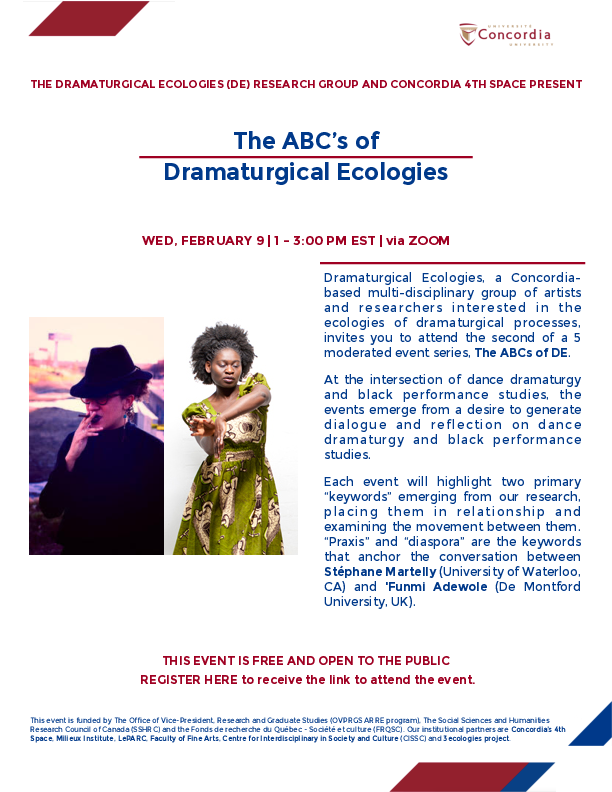
Stéphane Martelly is a Haitian-born writer, poet, and visual artist whose work spans multiple genres, including fiction, poetry, and academic writing. Her work often delves into themes of memory, identity, and cultural resilience, drawing on her background in Caribbean and Haitian culture. Martelly's literary work includes La Boîte noire (The Black Box), a novel that blends fiction with poetic language to explore trauma, migration, and the diasporic experience. She is also the author of Les Jeux du scorpion, a poetry collection that captures the complex intersections of identity and history in Caribbean contexts. Additionally, Martelly is a scholar whose academic research focuses on postcolonial studies, Haitian literature, and memory studies. She teaches and writes about the role of art and literature in articulating and preserving the collective memory and heritage of Haiti and the broader Caribbean diaspora.
‘Funmi Adewole is a Nigerian-born performer, choreographer, and academic known for her contributions to contemporary African dance and storytelling within the UK and internationally. Her career spans performance, writing, and teaching, with a focus on exploring diasporic identities and the intersection of African and Caribbean dance traditions with contemporary practices. She has collaborated with companies such as Adzido Pan African Dance Ensemble and worked on various projects as a dance dramaturg, translator, and lecturer. Adewole has written extensively on African dance in diaspora and has contributed to numerous publications in dance studies. Her research and practice emphasize African cultural expression, storytelling, and the performative traditions of African and Caribbean communities
The conversation took place at Concordia University’s 4th Space in Montreal. Moderator Dana Dugan highlighted the anniversary of the Sir George Williams occupation (1969) and its significance for Black resistance in Canada, framing the conversation in relation to Black History Month and the ongoing institutional challenges.
Praxis and Diaspora
Stéphane Martelly (University of Waterloo, CA) and 'Funmi Adewole (De Montford University, UK). February 9, 2022.
Event moderated by Dana Dugan.
Blackness as Performance and Identity: Stéphane Martelly reflected on the complexities of “performed Blackness,” expressing discomfort with Blackness as something that can be reduced to performance, costume, or identity separate from the self. Martelly’s poetic reflections expressed a desire to dissolve Blackness into lived experience - allowing it to feel as natural and unnoticed as everyday existence. She described Blackness as intrinsic rather than performative, rejecting external definitions imposed by dominant narratives.
Generational Shifts in Black Identity and Representation: 'Funmi Adewole discussed the changing attitudes towards blackness in dance over time, particularly in Britain. She recalled the resistance of dancers in the 1990s to being labeled as “Black dancers” performing “Black dance,” contrasting this with more recent shifts post-Black Lives Matter, where artists now embrace these "labels" with pride. Adewole noted how Blackness has moved through different historical waves, often oscillating between visibility and internal exploration, depending on socio-political conditions.
Diaspora and Its Multiple Meanings: Martelly and Adewole talked about how diaspora varies across regions and contexts. Martelly explained that Haitians often see themselves as distinct from the African diaspora, defining their identity through their Haitian roots. Haiti, she emphasized, is considered “ground zero” for Black identity - where Blackness emerged not as a diasporic concept but as a sovereign and self-defining force after the Haitian Revolution. Adewole shared personal experiences of navigating multiple identities - being Nigerian, British, and a participant in the African diaspora. She reflected on the evolving concept of diaspora in her journey from Nigeria to Britain, where Blackness took on different connotations in each cultural context.
Praxis and Artistic Practice: Both discussed how praxis shapes their artistic and intellectual work. Martelly described her writing and visual art as interconnected languages that flow together - poetry often embodying the movements her body doesn’t perform. Adewole described her practice as deeply rooted in storytelling, drawing from journalism, performance, and dramaturgy. She explained how her artistic journey evolved from journalism in Nigeria to physical theater in Britain, where she faced cultural and technical challenges adapting to new forms of dance.
Failure and Creative Growth: Martelly and Adewole shared personal anecdotes of how failure influenced their growth as artists and thinkers. Adewole described how a performance intended for a dance festival was poorly received, only to later lead to an unexpected opportunity as a dramaturg. This exploration of failure tied into Martelly’s theoretical reflections on “catastrophe” in Haitian literature, where the unspoken or unaccomplished elements within a narrative drive creative work.
Knowledge-Making Beyond Academic Norms: Martelly and Adewole emphasized the importance of conversations and oral knowledge in building theory, particularly within Black and diasporic contexts. They questioned the dominance of Western epistemologies and advocated for recognizing non-traditional forms of knowledge, such as storytelling and oral history, as valid academic practices. Martelly mentioned how she encouraged her students to quote conversations and non-academic sources in their work, challenging the exclusion of marginalized voices from scholarly discourse.
The Role of Institutions and Intersectionality: Adewole reflected on the complexities of working within institutions like universities while navigating intersecting identities. She described the tension between preserving indigenous or traditional knowledge and operating within colonial frameworks, drawing on personal stories about her family’s negotiation of cultural and institutional identities in Nigeria and the UK.
Concluding Thoughts and Reflections: Martelly and Adewole ended the conversation by stressing the transformative potential of creative practice and theoretical inquiry. Martelly emphasized that for her, there is no distinction between theory and practice - both are ways of articulating the complexities of identity and existence. Adewole shared that her storytelling performances reflect her journey toward personal artistic independence, using characters and narratives that embody the multiplicity of her cultural experiences. The conversation ended with participants reflecting on the fluid, ongoing nature of such discussions. They agreed that not all questions need immediate resolution, embracing the idea that knowledge evolves through continued engagement.