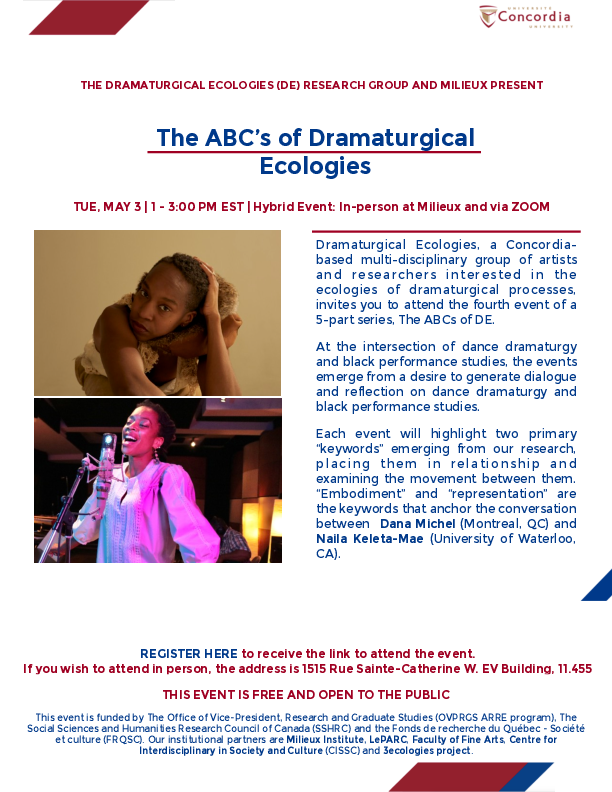
Dana Michel is a Montreal-based choreographer and performance artist recognized for her innovative, genre-defying work that challenges conventional boundaries of movement, identity, and embodiment. Her practice blends elements of physical theater, improvisation, and live art, often delving into complex themes of race, sexuality, and cultural memory. Michel’s internationally acclaimed performances include Yellow Towel, a solo piece exploring racial stereotypes and cultural displacement, and CUTLASS SPRING, which addresses the themes of sexual identity and liberation through a personal and poetic lens. Known for her unique and visceral approach to performance, she has presented her work at festivals and institutions worldwide, including the Venice Biennale and the Festival TransAmériques in Montreal. Michel has received numerous awards, including the Silver Lion for Innovation in Dance from the Venice Biennale, and continues to push the boundaries of contemporary performance art.
Naila Keleta-Mae is a writer, performer, and associate professor at the University of Waterloo, specializing in Black and feminist studies, performance studies, and popular culture. Her interdisciplinary work spans academia, theater, and media, focusing on Black identity, gender, and the politics of expression. Keleta-Mae’s scholarly work includes her notable contributions to the study of Black femininity, which she examines through creative and critical lenses in her project Black and Free. In addition to her research, she is also a poet and playwright, and her creative work has been published in literary journals and anthologies. Through both her academic and artistic projects, Keleta-Mae seeks to illuminate the complexities of Black female experience and to challenge restrictive cultural narratives surrounding race and gender.
Embodiment and Representation
Dana Michel (Montreal, QC) and Naila Keleta-Mae (University of Waterloo, CA). May 3, 2022.
Event moderated by Matthew-Robin Nye.
Embodied Blackness and Dramaturgy: Dana Michel and Naila Keleta-Mae explored how Blackness can be simultaneously embraced and complexified within their work, creating a “moving vocabulary” that navigates cultural and conceptual tensions without the aim of static definitions. Michel and Keleta-Mae reflected on how Blackness manifests in both the individual and collective bodies. Michel's work, for instance, draws from her life experiences and cultural memory, positioning the body as a site for complex, intersecting histories that shape self-expression.
Representation and Abstraction: With the moderation of Nye, a conversation around Michel's performance Yellow Towel emerged, specifically with the struggles she faced with critics pigeonholing her art as “urban” or stereotypically “Black,” regardless of the work's actual intent. The audience’s discomfort with her abstract expressions underscores the narrow, often rigid views of Black art. Keleta-Mae elaborated on the notion of "authentic Blackness," explaining that external pressures—such as audience expectations and market commodification—create artificial boundaries around Black art. Michel’s desire to explore beyond “respectable” Black art is often hindered by the imposition of limiting labels, which constrain her expression.
Freedom as Artistic Imperative: Both speakers shared a desire to move away from societal expectations of Black artists, seeing them as obstacles rather than facets of self-discovery. Michel describes her art as a “freedom chase” where she attempts to shake off the influence of imposed Black identity in favor of individual, unedited self-expression. Keleta-Mae explains her journey toward focusing solely on freedom in her work, seeing art as a refuge and an avenue for imagination. Inspired by the resilience and creativity of other Black artists, she views imagination as a pathway for Black people to thrive in environments not designed for them.
Imagination and Sonic Expression: Beyond the limits of language, Michel and Keleta-Mae discuss the restrictive nature of colonial languages like English, which carry hierarchical, exclusionary structures. They see sound, music, and movement as essential methods for Black expression that bypass these limitations, offering a more fluid and boundless form of communication. Michel's use of sound as liberation and movement in works like Cutlass Spring exemplifies her commitment to abstract, non-linear storytelling. Both artists approached sound as a means of defying labels and expanding the scope of Black expression, thereby embodying freedom and defying reduction.
Legacy and Historical Burden in Black Art, Performance as a Site of Historical Memory: Keleta-Mae connects the Black experience in performance to historical trauma, highlighting how legacies of slavery and exploitation color public perceptions of Blackness on stage. This historical baggage is often subtly ingrained in audiences, influencing how they read Black art, whether consciously or not. Michel shares an experience where Black audiences expressed discomfort with her work, perceiving it as “disrespectful.” This discomfort reflects an internalized expectation that Black art must fit within accepted norms, revealing the tension between freedom of expression and cultural preservation within Black communities.
Artistic Influence and Multidisciplinarity: Michel and Keleta-Mae emphasized the richness of drawing from multiple artistic disciplines, blending theater, poetry, dance, and music. Keleta-Mae recalls a transformative experience where a mentor encouraged her to embrace all forms of her artistic expression, breaking away from societal pressure to focus on a single discipline. She references writer Arundhati Roy’s warning against “market seduction,” where artists risk sacrificing authentic expression for commercial success. This is particularly challenging for Black artists, who face narrow paths to fame and financial stability.
Concluding Thoughts and Reflections: The conversation emphasized an ongoing search for artistic freedom within and against the limitations imposed on Black artists by society and their own communities. Michel and Keleta-Mae highlighted the challenges of defying expectations, showing that the creation of Black art is itself an act of resistance, negotiation, and self-affirmation.They reject the notion of a “closing” to this dialogue, leaving the conversation open as they continue exploring identity, freedom, and imagination in their work.