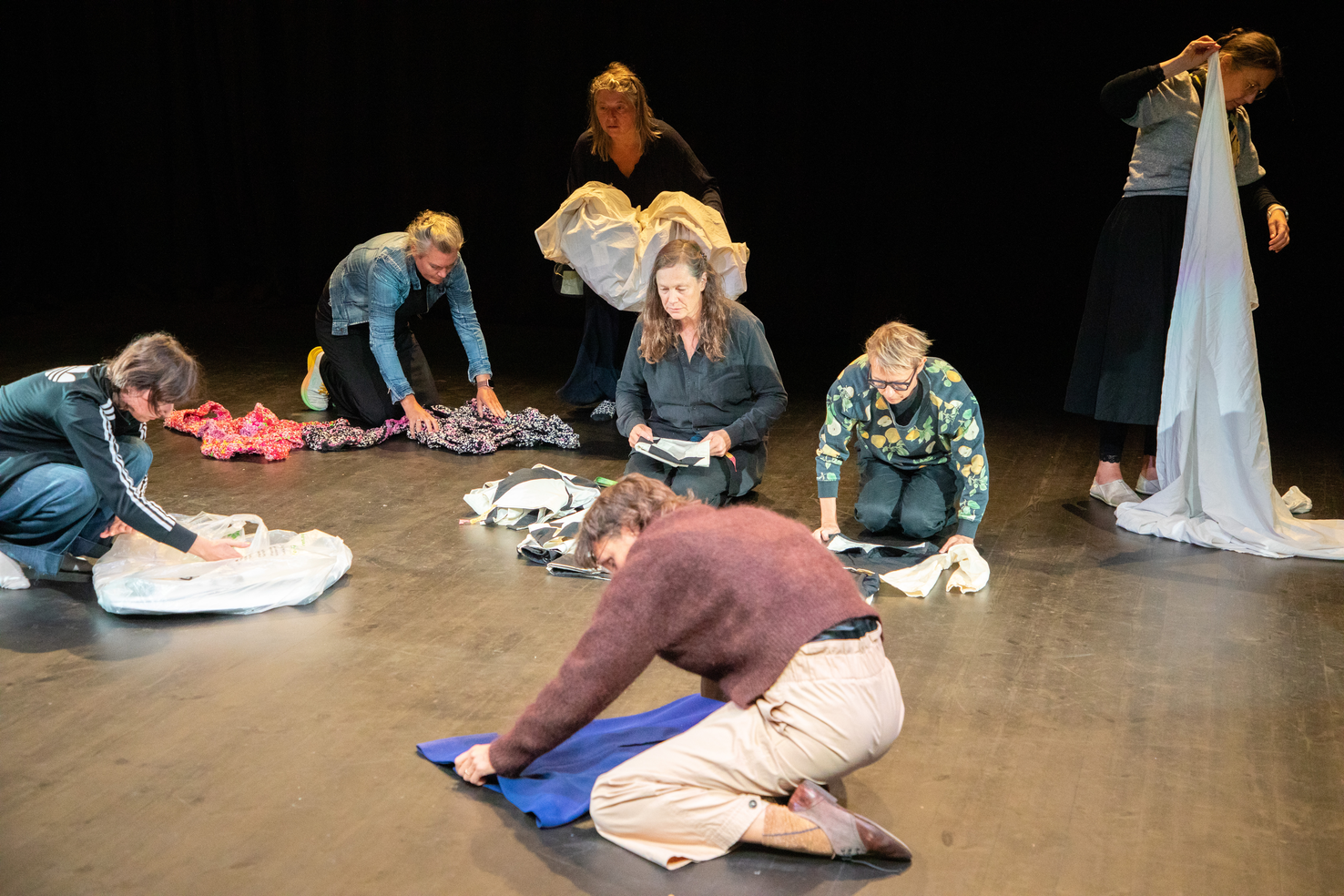

The focus of this artistic research project is to explore how costume performs and what dramaturgies emerge when an unconventional starting point for performance is adopted—namely, the costume.
The research is a continuation of the artistic research project Costume Agency (2018–2023), which explored the agency of costume and how costume can form a starting point for performance. The project was affiniated at the Oslo National Academy of the Arts and the main researchers were Christina Lindgren and Sodja Lotker. Costume Agency revealed that costume is a valid and highly relevant starting point for performance. All participants in the Costume Agency workshops developed methods for unpacking potentials of costume and created distinct and original performances. The costumes demonstrated a wide range of diversity, and the performances did likewise. These performances challenged traditional categories of form and genre. In Spring 2026 Costume Agency artistic research project will have an exposition on Research Catalogue.
The present research Costume Dramaturgies aims to focus on and deepen one specific dimension: the dramaturgy of costume in performance. By doing so, we believe that the relevance of the research and the knowledge it generates will reach a broader field. According to Synne Behrndt and Cathy Turner, the term dramaturgy applies to the general composition of a work and can be described as its “composition,” “structure,” or “fabric.” We seek to explore how to capture the composition, structure, or fabric of a performance in which things—the costume garments—are at the centre of gravitation.
Thus, the focus of this artistic research is on how costume performs and on the dramaturgy that emerges when an untraditional starting point and centre of gravitation for performance is employed—namely, the costume.
Aim and research questions
As a continuation of Costume Agency, the ambition is to further investigate the dramaturgy of things in depth. The study of how things possess “thing-power” (Bennett 2010, 3) informs our research. Bennett writes that “the ethical responsibility of an individual human now resides in one’s response to the assemblages in which one finds oneself participating” (Bennett 2012, 37). Understanding dramaturgy as an assemblage or composition of things shifts the human perspective and empowers non-human entities—such as costume, props, and light—within performance.
Our claim is that the dramaturgy of things is an under-researched area within the performing arts, both in costume design and in dramaturgy. We believe this knowledge is important for artists working across the performing arts, and we aim to contribute to this field through our artistic research.
Our research questions are:
-
How can the dramaturgy of things in performance be described?
-
How can we, as humans, interact with non-humans—the costume garments—and observe what meaning emerges?
-
What do we attend to in the process of forming dramaturgy?
-
What do we attend to in the process of observing and describing dramaturgy?
Research implementation and anticipated impact
One main activity in the Costume Dramatugies project was a workshop taking place from August 18 to 22, 2025, where we applied the method Costume Jam Sessions – experimenting and improvising with costumes. Each Costume Jam Session lasted 30 minutes and consisted of chain sof individual interactions with specific costume.
The method is a devising method, informed by Costume Agency Workshop #2: Devising Garment. During the Costume Dramatugies workshop and in the costume jam sessions, participants explore, observ, and reflect on the dramaturgies that emerge. Dramaturgy is understood both as a tool in the process of forming performance and as a tool for describing the resulting form of the performance. Participants reflect through writing, drawing, or other expressive formats and discuss their observations on dramaturgy. Each participant is encouraged to develop their own mode of expression for the dramaturgy that emerges. Consequently, the project embraces multi-perspectival and polyvocal expressions, with the ambition of developing a shared and expanded understanding of dramaturgies of things in performance.
Members of the core group will pursue individual research trajectories on dramaturgy and discuss their findings collectively. To contextualise the research and challenge our perspectives, we will draw on theories from new materialism, feminism, somatics, phenomenology, eco-scenography, among others.
Collaboration
Participating researchers (in addition to the core group) in the workshop at Stockholm University of the Arts, August 18–22, 2025:
Thomas Brennan (US/SE) Department of Film and Media, Stockholm University of the Arts.
Mapping Dramaturgial Aspects
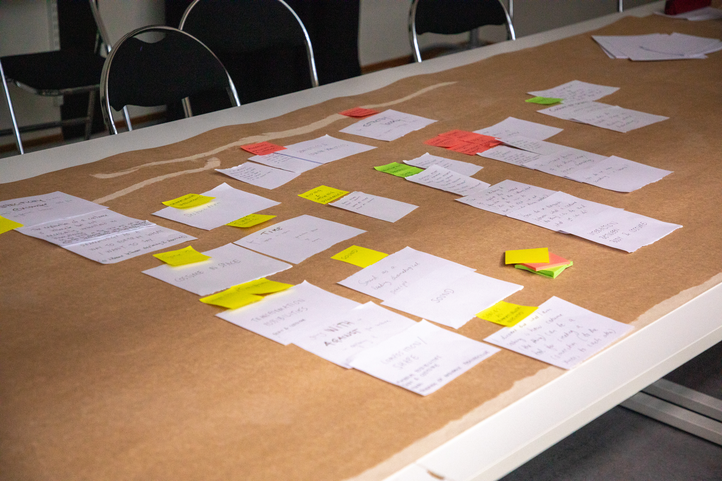
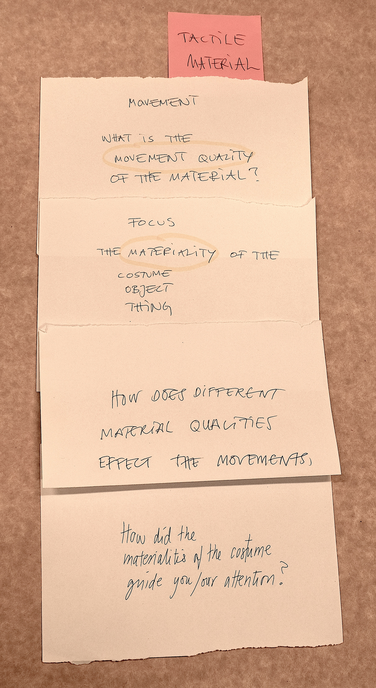
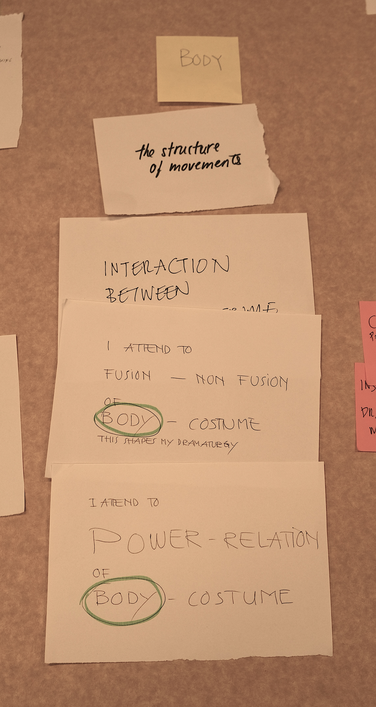
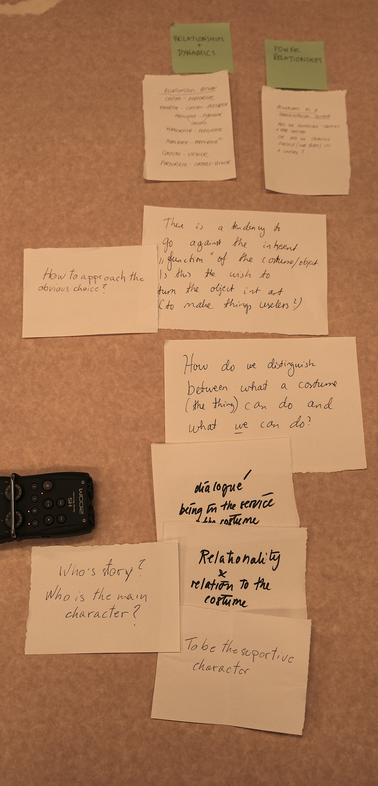
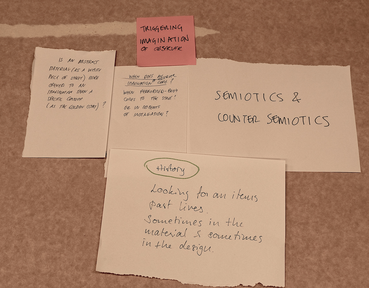
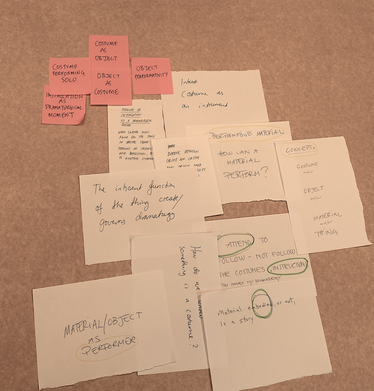
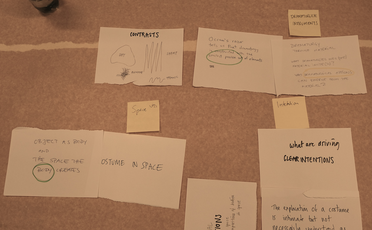
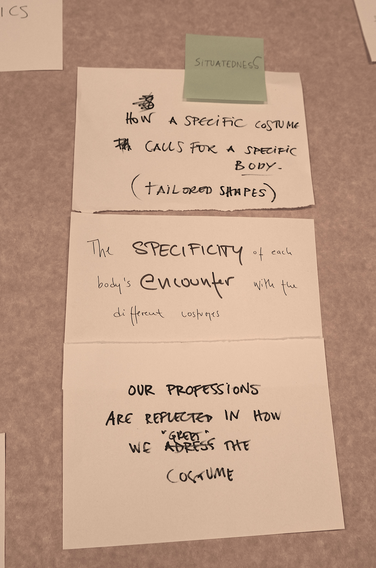
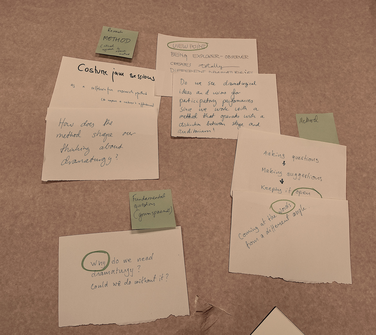
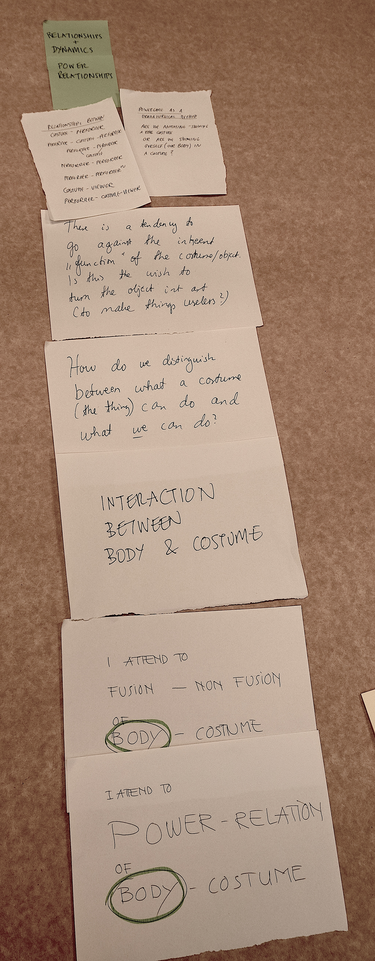
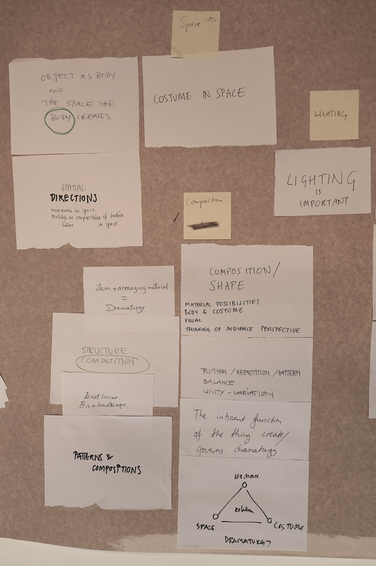
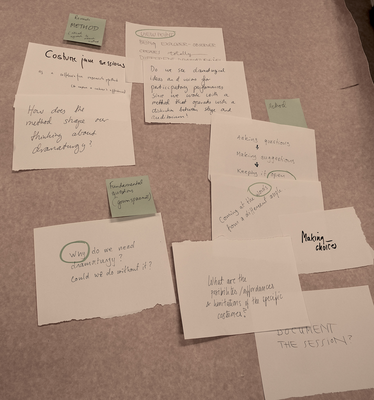
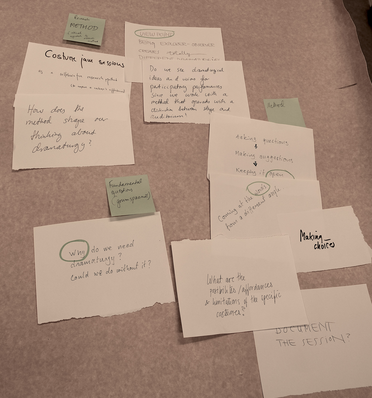
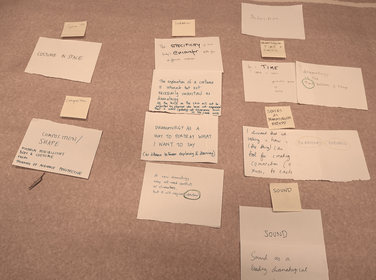
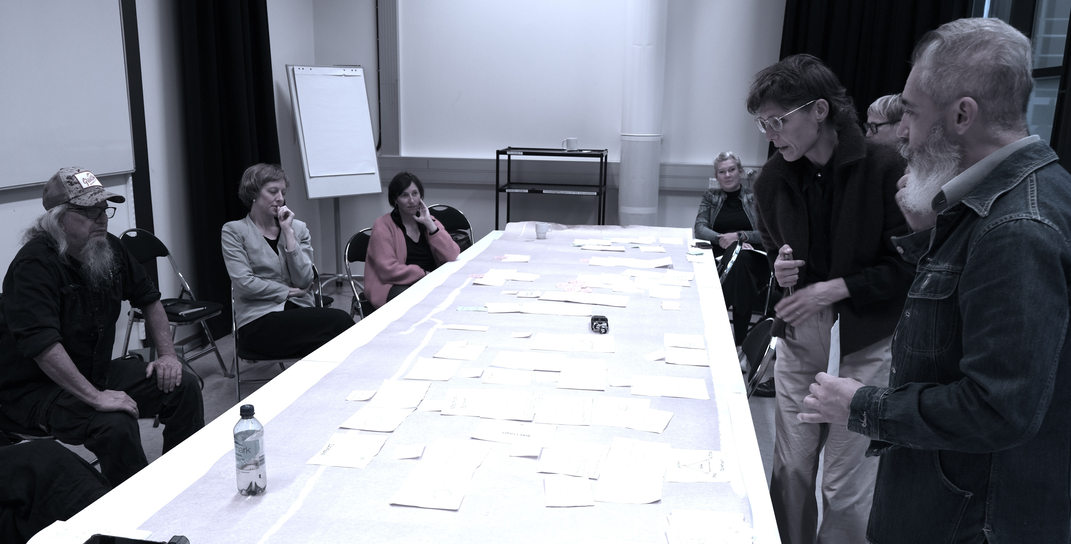
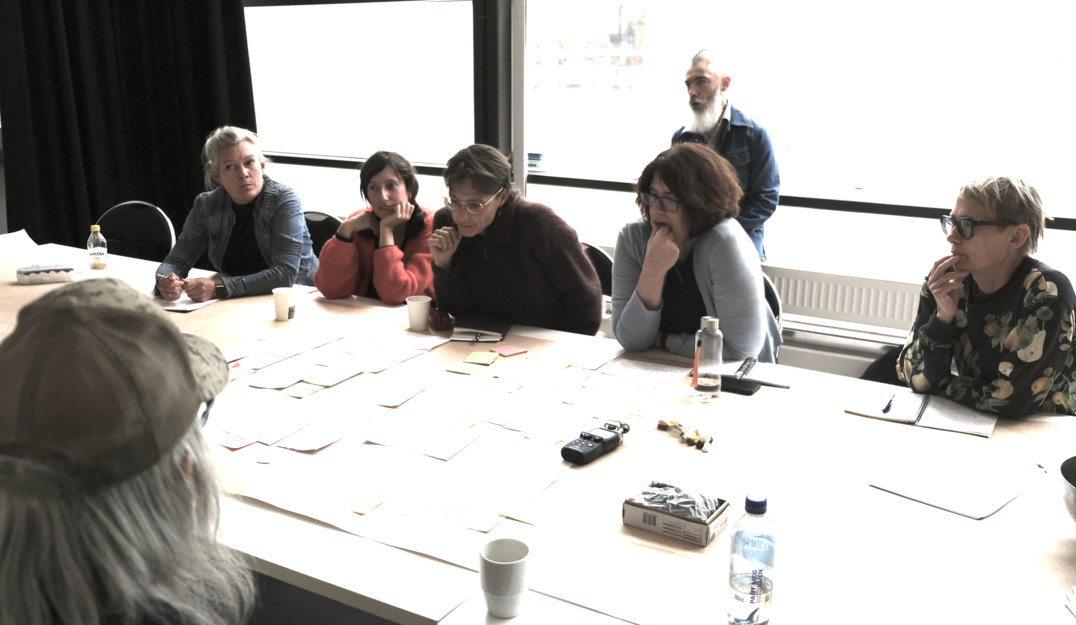
On the final day, and as a concluding activity of the Costume Dramaturgies workshop, the group mapped different aspects and perspectives on dramaturgy – especially, though not exclusively, in relation to the costume dramaturgies we had explored and experienced during the workshop. The mapping did not aim to be exhaustive or to include “everything”; consequently, certain aspects and perspectives are inevitably missing. Rather than functioning as a closed overview, the mapping was conceived as an open, generative gesture – an invitation and inspiration to continue mapping dramaturgical themes, wordings, wordlings, relations, and connections beyond the workshop.