A Pocket Dramaturgy
– Susan Marshall
With reference to my “Pocket Dress”, this text examines how costume can function as an active participant, producing dramaturgy through the dynamic interplay of body, costume and movement.
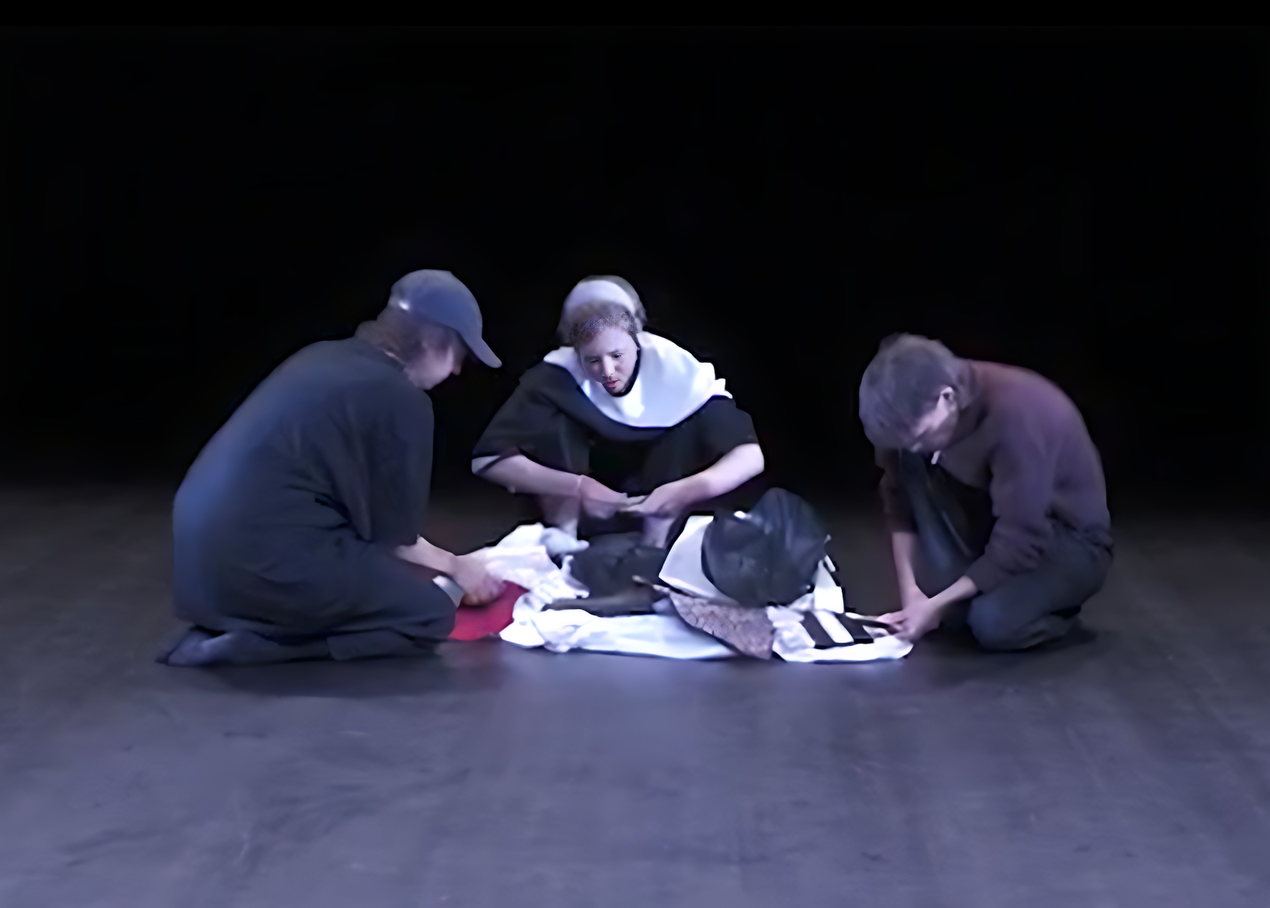
Additionally, the video documentation (1:58 minute edit) is of Tove Sahlin improvising with the Pocket Dress during the intermission between two jam sessions.

The dress began as a garment.
It became a collaborator and a quiet disruptor.
And through it, dramaturgy developed, built not from narrative, but from the unfolding potentialities of the costume.
The Costume Dramaturgies workshop formed part of a broader artistic research inquiry into the agency of costume in performance, examining how costume generates action and dramaturgy. By approaching dramaturgy as an assemblage of human and nonhuman “things,” the workshop destabilised human-centric hierarchies and opened a space where costume could act, invite, resist and propose.
The jam sessions operated within a structured set of rules: timed phases and rotating roles between observer and explorer. This process illuminated a radical difference between observing and exploring as to watch the costume is to remain in the realm of ideas whereas to handle it is to enter the realm of practice, where embodied knowledge emerges not from analysis but from encounter. Throughout the workshop, dramaturgy emerged not as something designed or imposed but as a field of possibilities continually opening and reconfiguring itself.
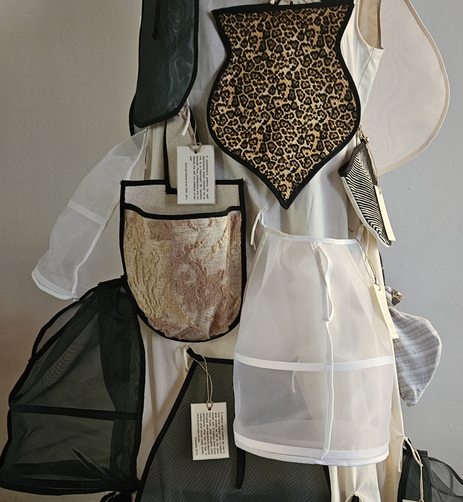
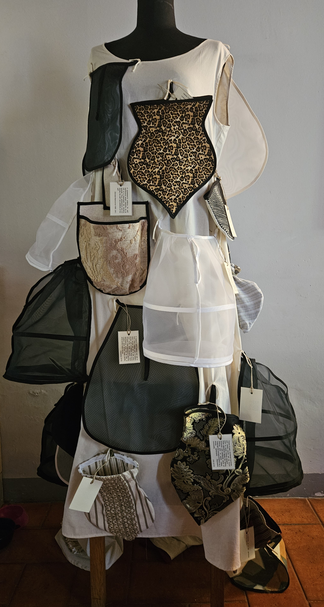
The dress that I bought to the jam sessions was covered in multiple pockets and panniers and was originally constructed for a workshop I led at the FCVC conference on creating an archive inspired by memories of favourite garments. The dress was simultaneously garment, container, text and mnemonic device as each pocket contained academic citations or fragments of personal memory. Each pocket became a threshold to enter the archive.
During the workshop at Stockholm University of the Arts, the pocket dress was repeatedly transformed, facilitating interactions that were intimate, humorous, emotional or conceptual. From the outset, the dress generated a vocabulary of gestures: looking, searching, sorting, inserting, removing, hiding, escaping, discovering, describing, reading, writing, listening, touching, dragging, shaking, gifting, snatching, laughing, dancing. These gestures did not illustrate a narrative; they generated one. The movements were neither choreographed nor instructed. They emerged from the dress’s material proposition, its shape and weight, its pockets and panniers, its capacity to invite and demand attention.
Each participant found a different entry point. Some were drawn to the sounds it made or the shapes it formed, others to the texts or textures; some approached conceptually, others through physical play. The workshop revealed the costume as a site of ongoing becoming. As the session deepened, transformations became more radical. The dress was turned inside out, its pockets tucked inward until it became a white ball, a landscape of hidden compartments, a resonating chamber producing scraping and soft sounds. These shifts revealed the garment’s capacity to shed its identity entirely. What had been recognisable as dress was now an abstract object, a sculptural form, a soundscape of fabric-led percussion.
A dramaturgy arose in which storytelling unfolded through movement, shape, sound, sensation, rather than narrative structure. The costume remained porous, its secret potentialities challenging assumptions about form and function, authorship and control. The differing approaches to the pocket dress demonstrated that dramaturgy emerging from objects is inherently plural. Each participant constructed a distinct dramaturgical arc shaped by their curiosity, exploration and interpretive frameworks. The pocket dress did not offer a single interpretation; it offered multiple potentialities, each activated through different forms of engagement. The costume resisted closure. Even after the workshop ended, it continued to draw participants back: an insubordinate moment that refused the structured rules. The dress whispered new potentials, retained its capacity to attract attention and generated inquiry beyond the temporal frame.
Engagement with the dress produced a form of partnering, a dialogue that emphasised the co-creative relationship between humans and things. The dress did not merely contain stories; it animated them. Through this material encounter, the workshop became a site for the production of knowledge, a place where costume acted as research. The agentic power of the inanimate costumes in synergy with the playfulness of the animate performers is a crucial aspect of my practice.
As noted in my book Insubordinate Costume: Inspiring Performance, in a costume-based performance the costume as object becomes the costume as subject. The costume is given poetic space which, as Bachelard wrote, transforms it into something more than an object: ‘To give an object poetic space is to give it more space than it has objectivity; or, better still, it is following the expansion of its intimate space’ (Bachelard 1994: 202). Current interest in the agency of costume has led to the analysis of costume within the context of New Materialism theories which consider the agency and discursive possibilities of materials (Barad 2006; Bennett 2010; McKinney 2015). Unlike previous materialism theories that share ‘a conception of matter as essentially passive, non-performatively constituted, and discretely self-contained’ (Gamble, Hanan, and Nail 2019: 113) without ‘creative agency’ (idem), Jane Bennett, in her book Vibrant Matter: A Political Ecology of Things, refers to ‘thing-power’ and aims to ‘theorize a materiality that is as much force as entity, as much energy as matter, as much intensity as extension’ (Bennett, 2010: 20) In acknowledging the interdependency of human and non-human elements, Bennett writes that the mind has a greater capacity for thought and that ‘bodies enhance their power in or as a heterogeneous assemblage’ (23)… ‘Thing-power’, in this case, ‘costume-power’, affects and is affected by the body, together they have greater power, together they increase the mind’s capacity for thought, together they generate a performance…[The] costumes are activated by the performers but, simultaneously, the performers are activated by the costumes, which act like prosthetics, changing the body through extension and altering their physical perception” (Marshall 2024, 100).
The journey of the pocket dress reveals how costume, when approached as an active participant rather than a passive artifact, can generate its own dramaturgy. Throughout the Costume Dramaturgies workshop, the dress continually unsettled conventional hierarchies by refusing to remain fixed as a garment, prop, symbol or archive. Instead, it operated as an insubordinate collaborator whose material propositions shaped the unfolding of events. What emerged was a dramaturgy not authored by humans alone but co-created through an assemblage of bodies, textures, memories, movements and sounds. As participants listened to and reimagined the dress, its agency became palpable. It provoked play, invited care, resisted expectation and continually transformed, shifting from wearable object to sculptural mass to resonant instrument. In doing so, it exposed the porous boundaries between object and subject, matter and meaning, intention and improvisation.
The dramaturgy generated by the pocket dress was therefore plural and unfinished. Each interaction demonstrated that costume-based dramaturgy is not a single narrative but an ever-expanding constellation of potentialities. The dress’s capacity to attract attention, even beyond the designated structure of the workshop, underscored its ongoing vitality. Its “thing-power” actively shaping the actions of the performers while simultaneously being animated by them.
The pocket dress’s journey toward dramaturgy exemplifies the co-creative relationship at the heart of costume-led performance. It shows how costume can exceed representation and become a generative force within artistic research: a site where knowledge is produced through material dialogue and where performance emerges from the dynamic interplay of human and nonhuman.
References
Bachelard, Gaston. 1994. The Poetics of Space. Boston: Beacon Press.
Barad, K. 2006. Meeting the Universe Halfway: Quantum Physics and the Entanglement of Matter and Meaning. Durham, North Carolina: Duke University Press. https://doi.org/10.2307/j.ctv12101zq
Bennett, Jane. 2010. Vibrant Matter: A Political Ecology of Things. A John Hope Franklin Center Book. Durham, North Carolina: Duke University Press. https://doi.org/10.1215/9780822391623
Gamble, Christopher N, Joshua S Hanan, and Thomas Nail. 2019. “WHAT IS NEW MATERIALISM?” Angelaki 24 (6): 111–34. https://doi.org/10.1080/0969725X.2019.1684704.
Marshall, Susan (ed.). 2025. Insubordinate Costume: Inspiring Performance. Abingdon: Routledge.https://doi.org/10.4324/9781003341000
McKinney, Joslin. 2015. “Vibrant Materials: The Agency of Things in the Context of Scenography.” In Performance and Phenomenology: Traditions and Transformations, edited by Maaike Bleeker, Jon Foley Sherman, and Eirini Nedelkopoulou, 121–37. Abingdon: Routledge. https://doi.org/10.4324/9781315752365