The Dramaturgy of Attention
– Sally E. Dean
How, what and who we attend to shapes the performance material we create. Within each person and within each thing there are inherent patterns of attention, including our unique sensorial preferences. These patterns form the dramaturgies that unfold and are typically referred to as a technique or aesthetic. But underneath, if we allow the time to listen, are ways of being with bodies and materials that constitute a social-cultural-personal habitus of attention – "a home." This home, like a turtle´s shell, we each bring with us. The dramaturgy is birthed through the relationships that meet in these live moments.
To explore these questions of attention, I have selected a small collection of video excerpts (26:28 minutes) from the Dramaturgy of Things workshop. These clips, paired with descriptions witnessed, are intended to provide insight into the specific ways we attend.
To invite the reader further into the experience, I also include Three Somatic Acts.

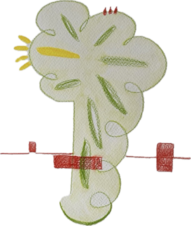
Three Somatic Acts
The Somatic Acts are somatic-based improvisations designed to cultivate embodied experience developed from my PhD work here called the Somatic Costume Dressing Room – Choreographing Attention Through Touch & the Poetic (Dean 2025). At its core are the questions – what, how, and who are we attending to?
The Somatic Acts have been chosen and created based on my reflections from the Costume Dramaturgy workshop. The key intention is to invite you into different modes of attending to the body, the costume and the `places in-between´– revealing how these patterns of attention serve as the foundation for underlying dramaturgies.
While the diverse performative backgrounds of the workshop participants illuminated many approaches, to simplify, I have focused on three attending patterns:
C. Who are you?
To conclude: These three dramaturgical journeys—Fact into Fiction, Function vs. Relation, and Who are you?—are not separate modes, but overlapping layers of attention. By identifying our point of departure, we can consciously navigate the creative process, noticing how our own habitus of attention meets the inherent life of the thing.
A. Attending to the Dramaturgy of Facts into Fictions
The concepts of `Fact´ and `Fiction´ are central to my doctoral research, developed from the work of Suprapto Suryodarmo and his Amerta Movement Practice: the Facts/Reality World and the Fictions/Dream World. Drawing on Suryodarmo’s methodologies, I propose two dramaturgical directions for investigating the relationship between body and material. These directions illustrate how the Dramaturgy of Attention is constructed through the interplay of these two worlds:
From Fact to Fiction: This dramaturgical path begins with the `concrete´ (Dean, 2025, p. 270). By attending to the Facts—the function, colors, texture, orientation, weight, and shape of a material—we allow the substance to lead. In a costume design process, this might involve finding a physical tree branch and allowing its form and texture to dictate the construction of a `Tree Skirt´. In a performance process, this involves moving or sounding directly from the physical weight and tactile pull of a costume, letting the body respond to the material’s literal presence.
From Fiction to Fact: This path begins in the `terrain of the subjective´ (Dean, 2025, p. 270), starting with Fictions such as associations, metaphors, feelings, or memory. In a costume design process, this might involve manifesting a mental image or a `dream´ of a specific hat into a physical object. In a performance process, this involves improvising from an internal image—such as a specific character or a poetic metaphor—and allowing that `fiction´ to shape how the body interacts with the costume.
Both dramaturgies are essential to the broader creative process. However, as I have noted, the Fact or the `sense of the real´—what Pallasmaa (2011, p. 22) identifies as the foundational physical experience—is often neglected in favor of the virtual. When we lose this connection to the Fact, the essential link to substance and materiality is severed – leading to a sense of disembodiment.
This Somatic Act below encourages their integration, specifically starting from Fact.
Somatic Act A: Attending to the Dramaturgy of Facts into Fictions
Allow 25 minutes. You will need a shoe, a friend, a piece of paper, a pen and a timing device.
Purpose: This Somatic Act explores how we create meaning with eyes closed, through our sense of touch from Facts into Fictions.
Guidance/Instructions:
We will divide into groups of 2 – Person A and Person B.
Person A will find a comfortable position to sit and touch your shoe with eyes closed. Through your sense of touch, begin sharing, verbally, the Facts/Reality World that you discover in your shoe.
Facts include weight, function, form, texture, temperature, movement and more.
Person B will set the timer for 4 minutes and begin to document, through writing, as best they can, what their partner shares.
After the 4 minutes are finished, Person B will set the timer for another 4 minutes.
Person A, with eyes still closed, will transition slowly into sharing, verbally, through the sense of touch, the Fictions that arise from the shoe – coming from the Fact.
Fictions are associations, images, feelings, memories and more from the touch of your shoe. Allow the Fictions to emerge from the Facts.
Person B can remind their partner of this now and then – returning to the materiality of the shoe, through your sense of touch.
Person B, again, documents, in writing as best they can, what their partner shares.
Once finished, Person A reads to Person B what has been written.
Change Roles.
Allow time to discuss the experience – the meaning or dramaturgy created from the sense of touch and within this frame of Facts/Reality World vs. Fictions/Dream World.
Note: This Somatic Act was part of the Dramaturgy of Things workshop on day one. It can also be adapted to a larger group collaboratively sitting in a circle and touching one costume. Instead of writing down each other´s words, the participants can speak the Facts & Fictions out loud.
B. Attending to the Dramaturgy of Function vs. Relation
In the Dramaturgy of Things, as in life, both Function and Relation are necessary, yet they represent highly specialized and distinct approaches to performing with things. Are you starting with function to find relation or are you starting from relation to find function? Without function you can lose the practical element of what a thing can do. Without relation, you can lose the relational element of how we are connected. One has more of an emphasis on action whereas the other on relational context.
In the transitions, in the Function approach there is a sense of attending into where one action ends, and another begins. In the Relation approach, there is sense of attending to the quality of attachment between person and thing with an emphasis on the connection or separation. In Function, the relationship is finished when the action is done. In Relation, the relationship is ongoing.
As can be seen in the video material of the Dramaturgy of Things workshop, the professional background of the participants also directs how and what they are attending to – and in this case, starting from Function vs. Relation.
In contemporary dance, mime, and physical theatre, the relation typically emerges from the function of the form. In these practices, a performer might begin by attending to the functional form of the body—its movement, weight, and shape—to allow a relational meaning to eventually surface for the audience. Similarly, many practitioners of puppetry and object-led work begin with the functional form of the thing, attending to its physical properties, points of articulation, and material presence. In these instances, the practitioner must first attune to the physical properties of the form to allow the `life´ or the relational bond to emerge.
However, as seen in various traditions of object theatre or visual theatre, this direction can be reversed. Here, the practitioner may start with a specific image, a metaphor, or a poetic character and `place´ it onto the object. In this case, the pre-existing Relation dictates how the object is handled; the meaning is not discovered through the material but is projected onto it to determine its function.
On the other hand, in traditional theatre, film, and ritual, relation is generally the source that dictates function. This is most evident in a ritual context, where the relational intent (such as honor or mourning) acts as the primary source of the work. Here, the functional actions involving things—such as the lighting of a candle or the pouring of water—are not performed for their own sake, but specifically to serve and sustain that pre-existing relation.
This tension is also present in material form: a costume designer typically begins with how a material functions (its weight, drape, movement, form), while the actor uses that same material to support a relational context (character, history, status, emotional resonance). Ultimately, the point of departure determines whether the meaning is the source of the action or the result of it.
To complicate this further, the Dramaturgy of Things workshop, and the improvisation structure of `jam sessions´ were framed by ´attending to action´, which naturally encourages Function as the initial point of departure. Participants are invited to enter the theatre space, one by one, to do one action with the costume, and then exit.
However, this emphasis on action also softened as the improvisations evolved. As more participants entered and stayed in the space, the focus moved towards Relation, especially when dressing and undressing one another becomes part of the process. In these moments, the shared materiality of the costume became a bond rather than a tool or task. The focus shifted from what the thing could do to how the bodies were connected, illustrating how a function-led structure can transform into a relational dramaturgy.
Somatic Act B1: Attending to the Dramaturgy of Function vs. Relation
Allow 60-90 minutes. You will need a costume (e.g. which can include everyday clothing), a friend, a piece of paper, a pen and a comfortable place to move.
Purpose: In performance, how and what we are attending to affects the dramaturgies created. In this Somatic Act, we will explore sensing how the quality of performing from Function vs. Relation translates into both the experienced and witnessed dramaturgies.
Guidance/Instructions:
In this Somatic Act, we will explore the act of dressing and undressing through two different approaches: function vs. relation. Function asks the question, `What does this costume do?´, whereas Relation asks the question, `How is this costume connected?´.
In this Somatic Act, everyone first experiences the dressing actions together and then later, they are repeated with a partner witnessing. In the end, there is time to discuss experiences.
Attending to Function
Beginning in
a comfortable place
in your chosen environment
while holding your costume
sensing the form
of your body
against the form
of the costume.
Sensing your breath
and the imprint
of your feet
against the floor
in a moment
of gentle stillness.
What does this costume do?
Slowly, choose a location
with your eyes
on where to place
your costume.
When you are ready,
as a practical task
place your costume
in this chosen location
in a direct and efficient
yet not rushed manner
arranging it functionally
as a preparation for it
to be seen and worn.
Returning to standing
once again
on your feet,
sensing your breath
and the form of your body
as you see
the form of the costume.
Then, similar to
an everyday action
of making a sandwich
or brushing your teeth,
begin dressing in your
costume sensing
each action clearly
- the movement
of the costume and
- the movement
of your body.
Sensing how each action
is composed
of mini-actions – a paragraph
that houses many sentences.
Your breath, preparing you
through the inhale
as we ride
to the end
of the sentence
through the exhale…
And resting for a moment
in the period, exclamation point,
or question mark
before the next sentence begins.
Within each action
is a cosmos
of beginnings and endings.
Moments of movement
Movements of stillness.
Allowing time…
Sensing the form
of the costume
and how the body
is placed inside
as you eventually
arrive in stillness
wearing your costume.
Noticing your breath
and the imprint
of your feet
on the floor.
As you are ready,
with your eyes
scan and then
choose one place
to walk towards and sit
for a moment.
Sensing the preparation
before the action
and the preparation
after the action.
This is a practical task
as if going to a bus stop
in a direct and
slightly efficient manner,
with clarity and a sense of
weight in your feet.
Allowing time…
And then returning to your
previous dressing location
to begin undressing
as if returning
to your everyday home.
Within each action
is a cosmos
of beginnings
and endings
Moments of movement
Moments of stillness.
As you undress
from your costume,
sensing each action
allowing time to attend
to the task at hand,
with a sense of function.
What does this costume do?
Allowing time…
Sensing the form
of your body move
in relationship to the form
of the costume as
a practical, efficient
and everyday action.
As you are undressing,
allowing your breath
to move on its own
as each action has
a deliberate and precise quality
attending to the costume
attending to the body
as a simple yet focused task
Moments of movement
Moments of stillness.
Allowing time…
Once undressed,
sensing the form of the costume
in relationship to
the form of the body
sensing your breath
Finding a transition
to preparing and returning
the costume´s form
on the ground again
in a clear and specific arrangement
as if it will be seen and worn again
by another person.
And then returning to standing
tuning into your breath
sensing the imprint
of your feet
on the floor
and closing your eyes
for a moment
attending to
the reverberations
of the actions
in your body
while resting within
this place
of stillness.
Allowing time and spaciousness…
Attending to Relation
Beginning in
a comfortable position
standing while holding
your costume
and closing your eyes
allowing your breath
to move on its own.
The costume
is touching you
and you
are touching your costume.
Sensing this connection
a meeting of reciprocity
and immediate relationship.
Slowly opening your eyes
and together
with your costume
choosing a location
to place and allow
the costume to rest
for a moment
with care.
Allowing time…
And then,
slowly returning
to your feet
in standing
sensing now the distance
between you and
your costume
for a moment
in stillness.
Perhaps you can still sense
the touch resonance
from the costume
on your body
that might even have
an emotional tone
or quality.
Gradually,
as if the costume is calling you
gently pick up the costume
allowing time to dress in it
as you touch each other
in a listening and attending
dialogue or dance.
Textures and weight of
the costume and your body
meeting
with moments of closeness
and separation.
Moments of movement
Moments of stillness.
As you are
attending to
the unfolding relationships
sensing the costume and
your body
touching
and the spaces
in-between.
Allowing time…
As you arrive
into wearing
each other
sensing the imprint
in touch
that you are making
touch imprints
emotional imprints
as a stillness emerges
allowing you to both rest
on each other.
Allowing time…
As you are ready,
slowly walking together,
on a journey through your environment
to find a place to sit
for a moment
in stillness.
The costume is wearing you
and you are wearing your costume.
And then, together
traveling, in a simple walk
through your environment
returning to your original
dressing place
as if arriving home.
Sensing the imprint
of your feet
on the floor
and the movement
of your breath
as you rest
in stillness.
Within each relationship
is a cosmos
of beginnings
and endings.
Moments of movement
Moments of stillness.
As you are ready
gently closing
your eyes
slowly shedding
your costume
layer by layer
sensing
how each change shifts
the physical and emotional
tone in your body
How are you connected now?
And now?
In each moment,
sensing the movement of your costume
and your body
meeting
again, and again
as if for the first time
attending to the touch
and the space between
each other.
Moments of movement
Moments of stillness.
Allowing time…
The costume is touching you
and you are touching the costume.
As you are undressing,
allowing your breath
to move on its own
sensing an unfolding
cosmos of closeness
and separation
between your body
and the costume.
Gradually, begin preparing
the costume
to return to the ground
once again.
Opening your eyes.
Seeing the costume,
your body and the environment
Slowly, while still sensing
this intimate connection
returning the costume
to the ground again
as if saying a gentle goodbye.
Each layer is placed
in a specific arrangement
attending to it with
comfort and care.
As you are ready,
on the breath´s exhale,
returning to standing
sensing the imprint
of your feet
on the floor
attending to
the reverberations
of this ongoing connection
between
your body and costume
while resting within
this place
of stillness.
The above improvisation can be developed further by returning to the dressing and undressing acts above again but allowing words to emerge and arise.
In the Function section, describe and embody practically what you and the costume are doing. In the Relation section, describe and embody the relationship between you and your costume to include the emotional tone.
An additional development is to return to the above Somatic Act but to slowly integrate both Function and Relation into your dressing and undressing improvisation. Choose a specific starting point as a base (Function or Relation) and sense the transitions as you move towards one quality of attending and then the other.
After the group has experienced both the Function and Relation sections individually, you can do the undressing and dressing acts again witnessing and being witnessed by your partner.
Finish in writing and sharing your experiences and the specific dramaturgies that are created.
C. Attending to the Dramaturgy of `Who are you?´.
When we enter the performance space with an awareness of the question `Who are you?´ , we realize that `the who´ is not fixed; it is a choice. For the performer, this awareness begins with how we inhabit the space, questioning our own presence before the action even starts. We can play with a wide spectrum of identity—from a specific character to an abstract form—which acts as a filter for our habitus of attention, determining how we will perceive and respond to everything else in the environment.
When we address the thing itself as a `You´ rather than an `It´, the attending process shifts fundamentally—from object to subject. We move away from a focus on utility, aesthetics, and the execution of a task, and toward a practice of listening, yielding, and mutual influence. In this mode, the inquiry `What am I doing to the thing?´ transforms into `What is happening with the thing?´ This requires the performer to attune to the material’s inherent patterns, allowing the `Who´ of the thing to guide the improvisation.
Once both bodies and things are acknowledged as subjects, the `place in-between´ becomes possible. This is the site where the boundaries between the body and the material begin to blur. It is the precise point where the performer and the costume meet; a place where identity is no longer held by one or the other, but is birthed through their shared contact and movement.
Somatic Act C: Attending to the Dramaturgy of `Who are you?´.
Allow 45 minutes. You will need a costume (eg. to include every day clothing), a friend, a piece of paper, a pen and a comfortable place to move.
Purpose: In performance, who we are attending to affects the dramaturgies created. In this Somatic Act, we will improvise and explore `the who´ for both the performer and things - noticing how these patterns of attending create a spectrum of varying dramaturgies.
The term ´following´ is used below to invite a place of attending to before action takes place. The aim is to begin from a slightly more receptive and receiving gesture as opposed to an active and doing gesture to facilitate the critical sensing and listening needed to be able to attend to - to bodies, things, and the places in-between.
In this Somatic Act, `the who´ is explored from a general category as opposed to specific. The specific can be developed or decided upon later in the process. For example, following and attending to `a character´ is a general category whereas following `the character of Charlie Chaplin´ is more specific.
Starting from the general also can facilitate a more receptive quality inviting listening to:
- Things: Who does this costume want to become?
- Bodies: Who am I when I am with the costume?
- Place in-between: Who do we become together?
In the Dramaturgy of Things workshop, these `who´ journeys can be witnessed (see previous video material). The place in-between can often be seen in the dressing process – where both the costume and the person wearing transforms.
Guidance/Instructions:
Below is a list of potential and evolving `Who are you?´ categories. Please add and build upon these categories below as a collective group.
In preparation to follow the ´Who are you?´, it is encouraged to instead of inserting the who onto the performer, the thing, and the place in-between, to invite an attending and listening practice to sense the `Poetic Material-ity´ (Dean 2025) already embodied in substance. Preparations for attending to the ´Who are You´ are included below.
This Somatic Act can be done in groups with a partner, where one partner can also name the different ´Who Are you?´ categories to follow in movement and sound. At the end, allow time to discuss how performing from the spectrum of `Who are you?´ categories translates into both the experienced and witnessed dramaturgies.
´Who are you?´ Categories
Creature Human Animal
Alien Persona Bird
Cartoon Character Reptile
Superhero/Superhuman Yourself Sea Creature
Fairy/Nymph Archetype Insect
Ghost/Spirit Dancer/Actor/Artist
God/Goddess Musician/Puppeteer
Clown/ Fool
King/Queen
Nature: Abstract Form
Plant Inanimate Object
Flower Sculpture
Tree Painting
Water A Relief
Fire Puppet
Molecule Musical Instrument
Gift
Attending to Body – Who are you?
Begin gently following
the movement of your feet
allowing them to travel
along the floor
sensing the toes
and heels
attending to their
rhythm, weight, and pace
Playing with a wide base
and then a narrow base
of the feet
sensing how the movement
and position of the feet
travels up the legs
to the pelvis
Allowing your breath
to soften and deepen
as you begin to follow
the movement
of your pelvis
with your feet
supporting
and connecting
to the floor
Sensing the tailbone,
the pubic bone
the hipbones
and the fluid organs
resting inside
as the movement
continues -
attending to the
weight, rhythm, and pace
Playing with an emerging
musicality that allows
for both the small,
subtle and slow
as well as the large,
exaggerated and quick.
Gradually, broadening
your attention to how
the movement of your pelvis
travels up your spine,
vertebra by vertebra
awakening the spaces
in-between.
Breathing, still sensing
the support and movement
of the feet.
Allowing the spine to undulate
forward, backward
side to side
attending to
both the fluidity and weight
of bone with
a sense of musicality.
Playing with the two
ends of the spine
- the tailbone
and the atlas –
sitting deep
inside the skull
between the ears –
inviting the head
to join in the spinal dance
as the jaw
begins to soften.
Sensing the breath
wash your movement
with inhales and exhales
as the ribs, shoulders,
arms and head follow
the movement of the spine
joining the dance.
Allowing time…
Allowing the whole body
to radiate now
with movement
from the small, subtle, and slow
to the large, exaggerated, and quick.
Following how your body
wants to move
as you are attending
to the natural rhythms and melodies
of your bones,
tissues, organs, fluids, and cells
a living, breathing
orchestra.
Discovering
Moments of movement
Moments of stillness
Allowing time…
As you are ready
while sensing your breath
inhaling and exhaling
adding a bit of sound
by humming to the tune
of your moving body
Attending to the vibrations
of sound travelling
inside the cavern of the mouth
touching the upper and lower pallet,
down through the tunnel
of the throat and into the portal
of your chest.
The humming continues to
resonate and now travel
inside the passageways
of the nose
into the deep caverns inside the skull,
brimming with vibration.
Allowing time…
Slowly, the jaw begins to soften
allowing the mouth
to open slightly
more and more
until eventually
the lips part
as your humming transforms
into gentle open mouth
sounding.
Allowing the breath
the inhales and the exhales
to support the sound vibrations
to travel through
your entire body -
bones, tissues,
organs, fluids, cells.
Allowing the sound
to slide around the body
changing tone, speed, and pitch
following the emerging
rhythms and melodies
- a living breathing moving orchestra.
Discovering
Moments of Movement and Sound
Moments of Stillness and Silence
Perhaps the movement and sound
might even surprise you
inviting an unexpected
physical and verbal
symphony.
Allowing time…
As you continue to follow
the arising movement and stillness
sound and silence
impulses
materializing from your body
beginning to follow
a potential character
that emerges.
How does the movement
and sound invite
´Who are you?´.
Sensing and sinking into
the sound and movement gestures
that invite a quality
of character.
Perhaps your character
can guide you
traveling in and out
of the floor
or not.
Allowing time…
As you are ready,
following a slow transformation
from your sound and movement impulses
into an animal.
Sensing how the image
of whom the animal is
can arise from
the embodiment of
physical and verbal gestures
happening now…
in each moment.
Allowing time…
As you continue to sense
bones, tissues, organs, fluids, cells,
gradually allow your movement
and sound impulses
to change you into a tree.
Sensing the musicality,
rhythms and melodies,
pitches and tones,
supporting the transitions
and transformation process.
Allowing time…
Returning to your breath
and the sense of your feet
on the floor,
as the `Who are you?´
shifts again into
a moving and sounding
sculpture.
Allowing time…
And slowly, sensing your feet,
legs, pelvis, spine,
ribs, arms, head
as the sense of being
a sculpture slowly fades
attending to
sound and movement impulses
as yourself.
The ´Who are you?´ being
the you, that you are
in this and each moment.
Moments of movement and stillness.
Moments of sound and silence.
Allowing time…
Slowly, the movement
and sound impulses
become a bit more subtle,
small, slow, and quiet
returning to
a gentle breathing
and resting
dance.
Until you arrive
into an ongoing moment
of stillness
and silence.
Attending to Things – Who are you?
As a preparation for `Attending to Things´, please prepare by starting with `Somatic Act A: Attending to the Dramaturgy of Facts into Fictions´. From this practice, the question of ´Who are you?´ can be added and explored (to include the movement/sound of the thing).
Attending to The Place In-between Bodies and Things – Who are you?
As a preparation for `Attending to the Places In-between Bodies and Things´ - prepare through the dressing and undressing practice in `Somatic Act B: Attending to the Dramaturgy of Function vs. Relation´. From this practice, allow the question and quality of ´Who are you?´ to emerge and be explored in the movement and sound/language.