The method: Costume Jam Session
This section includes a description of the structure of the Costume Jam Session and of the Costume Dramaturgies workshop. Costume Jam Session origins from devicing methods, originated from the practice of Sodja Lotker.
As examples of the costume jam, two full-length video documentations of Session #1 and Session #8 are included, both using a white sheet as the primary material.
In addition, the section contains a transcription of a conversation between Christina Lindgren, Liv Kristin Holmberg, and Charlotte Østergaard, in which they reflect on the Costume Jam method, its dramaturgical dynamics, and its potentials and challanges as collective, material-led improvisation practice.

A conversation about the workshop method:
Costume Jam Sessions
The following conversation took place in a digital meeting between Charlotte Østergaard (CØ), Liv Kristin Holmberg (LKH), and Christina Lindgren (CL) on October 13th, 2025 — approximately two months after the workshop at Stockholm’s University of the Arts.
The theme of the conversation was to critically discuss the chosen method – the costume jam session – in the workshop: whether the method was suitable for giving us insights into the dramaturgy of things in performance, and to share and discuss the reflections we had on the method, during and after the workshop.
CØ: I like to start by asking you a question? When you think about the workshop, what stands out for you about the method we worked with the costume jam session? Your responses can be in different directions. What do you remember most clearly?
LKH: Do you mean to describe the method?
CØ: Yes, what was most significant for you with the method? It can be something you think was particularly strong, that you missed, or that was significant for you.
LKH: It was a kind of unusual, like a forced, and staged play. A part of the method was also that we were many people entering from many different fields. Can we say that this was part of the method for research?
CL: Yes, I think so.
LKH: Yes, so that stood out for me, these multifaceted perspectives.
CL: Do you mean that our different perspective affected what we did, what came out of the costume jam sessions? How we worked?
LKH: Yes, it opened the research. There was also something about the preparation, how we entered the research project. The fact that the three of us had established a group, felt safe and opened the mind. Our sessions had a listening, constructive, open and flat structure. We didn't have any experts from the field of dramaturgy with us, and I think that was an important part of the methodology. Moreover, the fact that we came from different fields created a feeling that we – even though some of the participants were performers and some from the theoretical field – all stood on equal footing.
CL: Would you say something more about what it meant that there were no dramaturgs present?
LKH: One dared perhaps more, and one did not think that one could be “arrested”. We were all seeking. Of course, we do not have the knowledge of how it would have been if a dramaturge was participating. It is difficult to speculate on that. It was something that made you free in a way, that you dared to take on and handle such a big term, in a more playful way. The playfulness got a prominent place.
CØ: What do you think, Christina?
CL: Well, I wonder... the aim was to explore the dramaturgy of things in performance. The Costume Jam Sessions were more improvised sessions. It's not like we were creating or composing performance upfront. The costume jam sessions were improvised and emerges during the workshop process. But that, of course, also has its dramaturgy. And that's the kind of dramaturgy we look at and experienced.
But there's something challenging about it, as a method to study dramaturgy, since it is not composed – the dramaturgy arises in the moment.
It would be interesting to use the costume jam sessions as a method firstly to improvise, and then to compose the different actions we created.
Sometimes I had the urge to work longer with at costume and develop a composition further. In general, I wonder if it is a bit of a challenge when things are improvised in relation to thinking of dramaturgy as a composition. But maybe you can think of dramaturgy as something that arises and thereby created, and that there is no conflict between dramaturgy and improvisation. In that case, you can equate Costume Jam Sessions with other similar formats and methods that are based on improvisation.
The same applies to the fact that not one person has composed and woven this together. There are many composers in the same way as musicians work. Then it is difficult to say that we have this form and these elements on the composition. I wonder about that too. Costume Jam Sessions is a method, that is improvised and with many composers. So that is one thing, I have thought of.
At the same time, we experienced how the participants responded to each other's actions. We saw repetitions arise, and we saw how the different sides of the costume were examined. That in itself was a kind of composition, where the costume showed itself from very different sides – we experienced different and multifaceted sides of each costume. I would say that if these compositions were “something”; what are the many possibilities of this costume? Or what are the many facets of this costume? You could say that it is composition. I still don't know if this method is best suited to investigate the dramaturgy of things in the performance. I'm a little unsure about that. But you can say. Yes, why not? I can't find an argument that says that it shouldn't be a suitable method.
LKH: Each method has a set of boundaries. My question is: what could we not see with this method? The method created a framework. Within the method there were a clear dichotomy between stage and audience. This structure, or scenic paradigm, created situations where the exploration that took place off stage was not filmed or documented, and thus fell outside the scope of our research. This also guided what kind of dramaturgy that could emerge. In my own artistic practice – a site specific, relational practice, I do not operate with a separation between stage and auditorium. How can our research and findings be applied in my own practice?
CL: We had several episodes where this line was broken. We turned the camera several times, because some of the participants took the costume across the border stage and audience space. It almost happened with every single costume. It was an inborn possibility to oppose the method in it. And it was done, I believe.
LKH: But still, there are certain qualities or possibilities with costumes or things that are difficult since they are documented visually. The visual was hierarchically more important than our other senses, touch or how it sounded. Of course we were there ourselves with our senses, but if you think about the documentation... There are certain aspects, findings and qualities that fall outside the scope of this method.
CØ: I'm thinking of something that I in the sharing after a costume jam session gained new dramaturgical perspectives, from other people. The conversations afterwards, the reflections we had between the sessions, really opened more perspectives than I could see or experience in the session itself. Hearing what others had noticed, things that I hadn't seen, or references that I hadn't seen or known. I think these sharings centered around dramaturgy, because we in different ways reflected on what happens in the improvisations. For me, that was a quite important aspect. I think, if one were to repeat the workshop or the costume jam sessions that was something that we could expand, give more space, or document in a different way. I think there is also some information there on dramaturgy. From each group, from each session, we could have Post-it notes, where the group tried to make some collections of the different perspectives. This way you could hear something from everyone after each session. Perhaps also having a place in the room where the Post-it notes from the three different groups were hung. Not necessarily with the intention of that everyone was going to discuss the notes, but just to see many perspectives that a costume and a jam session evoked. We explored things dramaturgically, not only when we were on the floor jamming, but also when we reflected on the jam session together. Because you can say, if you are going to use this actively, to the next round, then there could be some things you could draw from there, I think.
Another thing that I reflect on that the short sessions or rather the actions [jamming with the costume] was short. You could have spent longer time or investigate a costume. I think that I perhaps reacted more to the other people’s actions than to the costume itself. It was so fast and I had not time to get a physical relationship to the costume, because the actions went quickly. Having more time with the costume would perhaps cause something else.
CL: Yes. I also think there were something about that the jam sessions were so short. That perhaps caused that we lost something. I remember after one session, when we were done with our session of 20 minutes, one of the participants continued to jam, alone, with the costume and did 20 different actions with that costume. It became rich, and it also became another form of dramaturgy. Because she composed, even though she investigated different things, one thing and one thing, in the same way as we had done, with subsequent simple actions one after the other. But she investigated different qualities. So, you get a completely different depth, something that we didn't quite managed, because the sessions were a bit short. Each session consisted of many actions, and each action had a bit too little time to unfold.
LKH: I think there was an inherent dramaturgy in the method we used. How do we deal with this in our research? The inherent dramaturgy of jam sessions resembled a kind of magic show. Or a revue or cabaret. I wonder also, how we could know if it was the costume or if it was the performer that we related to. I became very aware of the different performers. The form of the method, or dramaturgy, was characterized by the fact that it was like one number after another. Perhaps there was also pressure, or a desire to outdo the previous co-researcher's ‘take’ on the costume. And we cannot look away from the social mechanisms. There was someone who commented on how quickly norms are established in a group, for example: Why could we not repeat each other's actions? There are some rules that are not consciously made, but it is very interesting that they arise. Something in the method led us to be as inventive as possible and to avoid repetition, among other things.
But this is probably something that would be activated anyway, since we work with performance art. During the workshop days, as mentioned earlier, we unconsciously established some norms, or rules for jam sessions: the length of the various actions, the jam sessions had roughly the same length, that we avoided repeating something someone else had done before us, etc. Another thing I wonder about is how our different personalities played into a method like this. We are all different. Some are introverted and shy, others are extroverted. This method was not just a game. It was a staged game, where we watched each other play. Some may have felt restricted, while others love to be watched while they play or is on stage. It may be that we missed some proposals by the shy people by using this method. And I agree with you, Charlotte. The concluding reflection section was very important. In addition, the method allowed us to be both inside and outside the exploration, both as practitioners and as witnesses.
CL: But are there two things? There is so much happening inside every participant which means that it perhaps becomes difficult to focus on the costumes. Several of the participants are not used to being on stage, others are very used to being on stage. So that social dimension may be on the expense of examining what the costume can do?
LKH: Yes, or whether we were alone in a room or whether the room was darkened, if no one was watching... What do you do when you are being observed? What do you not do when you are observed? I believe this guided us.
CØ: I agree with you, and there is an additional problem. If you want to investigate what a costume dramaturgy is for each of us, then you will have to create a clearer relationship to the costume than I had the chance to do in the short sessions – especially with some of the costumes. The clearest relationship in the space became social ‘norms’ between us. At the same time the costume jam session is relatively sensitive, because some are good at performing and others are not. Some are taking on a new kind of role which is sensitive. So, for whom am I improvising is also a good question. As we are watching each other jam with the costume, there is a kind of audience is present. The question is how am I affected when my first ‘meeting’ with the costume is witnessed by others? If others weren’t witnessing my first meeting might be different. But we also experience something by witnessing each other meeting and jamming with the costume
CL: Sometimes it happened. For example, one of the participants brought a costume with many pockets. Another participant was doing something with it, and suddenly he noticed, that the dress made a sound when he pulls it! He responded to the sound, and then it became an incredibly beautiful sequence. It was one of the most beautiful sequences, because he found the sound and responded to it. By doing a few simple things, like walking across the stage; suddenly the thing's dramaturgy emerged, because the thing wanted to make sound, or the thing wanted to show that it could make sound. It wanted to show us its possibilities and qualities. Listen to this sound I'm making! I'm not making any sound, but I'm making this sound! It was more on the premise of the costume.
CØ: I still think it's super interesting that the method can be stretched in different directions and be applied in different ways.
LKH: I thought about the choice we made – which we also discussed along the way – to detach each costume from its origin and context. That we tried to relate to the costumes “objectively”. As we began to jam with a costume, we had no knowledge or background information about the costume. How did that affect our research?
CØ: I think it's very relevant to mention. I knew the context for all the costumes. But it’s interesting that everyone didn’t have that information. I am sure that knowing or not knowing some background information make a difference in the relationship that we start from. Can or will information open or close something? I don't know, but it’s important to reflect on. If the person who brought costumes started by offering a background or intention behind the costume how would if affect the jam session? I don’t know what the answer is, but I think that other possibilities and actions would have happened.
Because you, Christina, had told to us [LKH and CØ], where your costume came from. The same with your costume, Liv Kristin. In that way we knew each other`s costume, and that might make a difference to how we approached the costumes. But some of the others who didn't have that information – It was interesting.
CL: Exactly. For example, we [CL and CØ] know how Liv Kristin uses her cape costume in her performance. One of the participants didn’t and was quite roughly act with the costume.
LKH: Jumped on it!
CL: Jump on it and kick it! And then another participant came in and handles it with care. Wanted to heal it and give it care.
CØ: It's also interesting, Susan, was very curious and asked everyone about their costumes. She wanted to know the context of the costume itself. There's also something about the dramaturgy of things, which is about the hands that created it, or the intention that started it. Knowing that it might lead in different directions, but it's also interesting.
CL: In archeology, you have all the pieces of potters and objects that are several thousand years old, and from the pieces and objects try to understand the history behind it. Even though the costumes had their performances and we still tried to understand and to create a context for them.
We try to create a context that is meaningful, based on the information we have when we meet the costumes and when try to wear and/or interact with them in different ways. In that way you can say that several histories, hints of histories or fragments of the reality they belong to arise. A window to the reality the costume belongs to, through interaction with the costume. It's a kind of maze. In parallel to archaeology, we have the bits and pieces of pottery, but we didn’t know how people lived. I'm trying to understand how people lived through it.
LKH: There was something about the method that perhaps led us to focus on its function. I think that came up in several of the sessions. What is the function of the costume? There was a kind of detective aspect and whether this aspect of the costume´s function, became visible or not? There was also a tendency to go against the inherent ‘function’ of the costume. It was as if we were focused on the function of the costume – how did that happen? It's natural, of course, but what is the connection to dramaturgy? There was something that you wrote, Christina; you registered that when you experienced a moment when the obvious function was fulfilled, or moments where we went against its function, it became a kind of climax in the dramaturgical composition.
CL: Yes, I can remember when we worked with the cape – that is made of golden textile and that has the shape of a queen's cape. It was quite late in the session that the cape was used as a cape for a king or queen. Early in the session, the costume [cape] had been used to creating a dog, barking towards us. Those two interactions were the two strongest experience I had with that costume. Then the question is what the intention is, and to go with or against the obvious intention or meaning that emerges from the costume. So, functionality, maybe you are right there.
LKH: I was thinking a lot about what it is that we are researching: Is it what things can do? Or is it that we can do?
CØ: That's a good question.
CL: Yes. And maybe the whole setting is that it's more what we can do, because we didn’t have enough time to get to know the costumes. Maybe? The jam sessions become too fragmentary, too short.
LKH: If we were to adjust the method, regarding your comment about improvisation versus composition, then it could have been an even clearer tool for creating dramaturgy. But then we would need more time and space: The first part would be improvisation, like we did. And then we could add part two, where we start to compose, and we would have had time and space to consider alternatives and possibilities.
CL: Then you could cut, remove some of the actions, keep some, and from those you could compose: Some actions could be repeated, some actions could be longer, some shorter, and through that you get a tool to compose a dramaturgy.
CØ: In the repetition, I think you can discover something. Is the dramaturgy of things those actions that we repeat? And if we repeat the actions three times, or three different people repeat the same thing, is it still the same dramaturgy? By going back and discovering something, then I think you perhaps get closer to finding the thing’s own dramaturgy, apart from the dramaturgies that we add to the thing. Additionally, I think it takes a lot of work to find the dramaturgy of each thing, apart from the dramaturgy that we apply to it.
CL: Does it work a bit like Karin Barads “entanglement”?
CØ: It is an entanglement.
CL: It's impossible to find the thing's own dramaturgy, because we are entangled.
CØ: I think the dramaturgy of things is about exploring relational spaces. The dramaturgy that things is, if I wear it or if one of you wears it, is different. Perhaps dramaturgies are relationships not just composition. I think the relational has a meaning both for those that witness and to the relationship I have to things.
To build on things I like to mention, that I could have spent more time to understand the relation I had to the costume things, to explore what composition we could create together.
CL: Yes, we could have spent a whole week with each of the costume things. On the other hand, what was created with the gold cape, was something completely different than what was created with the elastic costume. They each created their own repertoire. There were very few actions that were done with all the costumes.
CØ: That's right. In this way you can say that there is already something clear. I think that the method as an opening to play. And then in week two you could go much more in depth.
LKH: Perhaps you would have had to take the costume home with you. Sleep in bed with it. Wake up with it.
CØ: Oh, how nice.
CL: Dance with the thing.
LKH: In a way, be pissed off by the costume thing. Get tired of the thing.
CL: Put it in a box.
LKH: Yes. Just forget the thing. Then you must write the thing. Yes, write a poem.
CØ: Oh. That would be nice.
LKH: Yes, time is an important aspect. There's something about the stillness in the thing. The dramaturgy becomes like a stone, a silent stone. I don't know.
The Structure of the Costume Jam Session
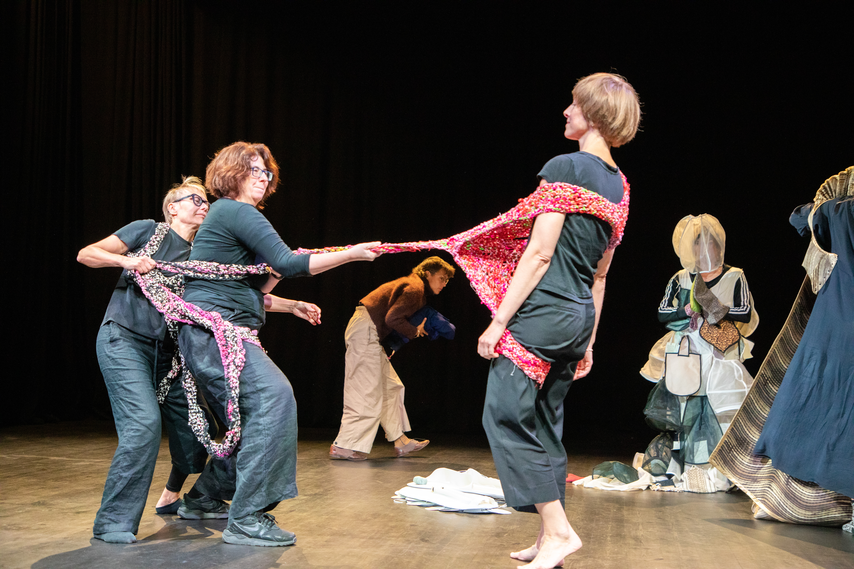
All participants are divided into groups consisting of 3–4 people. In each group and in each session, two people from the group will jam with the costume, and the other two people will witness the costume jamming.
5 minutes – Greeting the costume
- All participants gather around the costume that is placed flat on the floor.
- The costumes qualities will be co-creatively explored. The participants mention words about qualities as physicality, function, aesthetics, traces of use and production, semiotics, as well as associations, intuitions, memories, impulses.
25 minutes – Jamming with one specific costume
- In each session one costume is being explored.
- One person at a time jams with the costume, followed by another person, and so on.
- The jamming is improvised, single actions, created spontaneously and undertaken by each individually participant.
- One action is being co-created with the costume. For example, entering the stage, throwing the garment up in the air, watching it falling to the ground, bodily falling to the ground in a similar way and then exiting the stage.
- Each action varies in duration and qualities.
- Everyone else quietly witnesses one person jamming with the costume.
- All jam sessions are video recorded.
- Rules can be broken. For example, at some point a second or third person can join the jamming – forming a trio or quartet with the costume.
10 minutes – Individual reflection on the Costume Jam Session,
- Directly after the jamming, each participant reflects in writing, drawing, or otherwise.
- The participants are encouraged to describe what happened by finding their individual way to describe the dramaturgy that they experienced emerging during the session.
- The notations may include reflections on assemblages, compositions, interactions, structures, openness/closeness, entry and exit points, the voice of the costume, storylines, movement qualities, gestures, human/non-human characters emerging, performativity, or other aspects.
20 minutes – Sharing the individual reflections, discussing and/or elaborating on the reflections in the groups.
In the Costume Dramaturgies workshop, the costumes that we explored in the Costume Jam Sessions were brought by Liv Kristin, Christina, Ingvild, Franziska, Susan, and Charlotte. In addition, a white double size bed sheet was used in 2 sessions. We totally had 9 sessions. In the Costume Jam Sessions, the costume was taken out of their context/ background. Some of the participants knew the context of some costumes whereas others did not.
Costume Jam Session origins from devicing methods, originated from the practice of Sodja Lotker. The meethod was a central part of Costume Agency Workshop # 2 Devicing garment in Prague 2019.
Full lengh documentation of Costume Jam Session #1 (above) and #8 (below)
Participants: Alejandro Bonnet, Charlotte Østergaard, Christina Lindgren, Franziska Bork Petersen, Ingvild Rømo Grande, Josephine Rydberg, Liv Kristin Holmberg, Natálie Rajnisová, Susan Marshall, Thomas Brennan, Tove Sahlin, Åsa Johannisson
Structure of the Costume Dramaturgies workshop
Monday 18.8 and Tuesday 19.8 2025
Liv Kristin, Christina and Charlotte preparing the workshop e.g., by doing two costume jam sessions: one with white shirt and one with Christina's costume.
Online meeting with Sodja and Sally.
Wednesday 20.8 2025
All participants arrive and present themselves.
Warm up and a Facts into Fiction exercise by Sally E Dean.
Session #1 with white sheet.
Two sessions with costume by Charlotte (session #2) and Liv Kristin (session #3).
Discussion of the experienced during the day, which dramaturgies emerged in the costume jam sessions.
Thursday 21.8 2025
Four costume jam sessions with costumes by Susan (session #4), Christina (session #5), Ingvild (session #6) and Franziska (session #7).
Discussion of the experienced during the day, which dramaturgies emerged in the costume jam sessions.
Friday 22.8 2025
Returning to costume jam session (session #8) with white sheet.
Closing costume jam session with all costumes (session #9).
Final discussion. Mapping the Costume Dramaturgies we have explored/experienced during the workshop.