The Research Catalogue (RC) is a non-commercial, collaboration and publishing platform for artistic research provided by the
Society for Artistic Research. The RC is free to use for artists and
researchers. It
serves also as a backbone for teaching purposes, student assessment, peer review workflows and research funding administration. It strives to be
an open space for experimentation and exchange.
recent activities <>
Perspectives on time in the music by Stockhausen: the experience of a performer
(2026)
Karin DE FLEYT
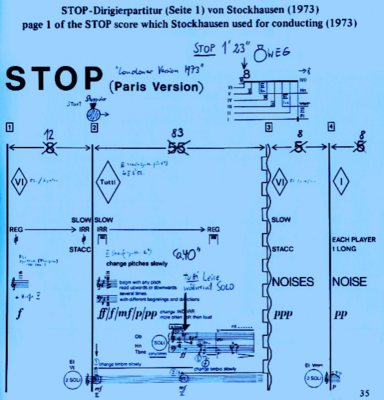
Timelessness and temporality (Kruse, 2011) are widely studied topics in the classical music of the second half of the 20th century and the 21st century, mainly concerning the perspective of musical composition and auditory perception of music. But what is the perspective of temporal layeredness in the performer’s experience? This quote offers a starting point (Noble, 2018): “music whose temporal organisation optimises human information processing and embodiment expresses human time, and music whose temporal organisation subverts or exceeds human information processing and embodiment points outside of human time, to timelessness .”
Specialized in the repertoire of Karlheinz Stockhausen, I want to investigate the role of temporality in music from the perspective of a performer. I will delve into the richness of different layers of temporal awareness in an artistic experience through experiential, embodied, and sensorial knowledge, using different temporal compositions by Stockhausen as case studies: HARMONIEN (2006) for flute solo,, Xi (1986) for flute solo and STOP (1969) for ensemble.
Filming Marlowe's Faustus: an artistic research project
(2026)
Jed Wentz
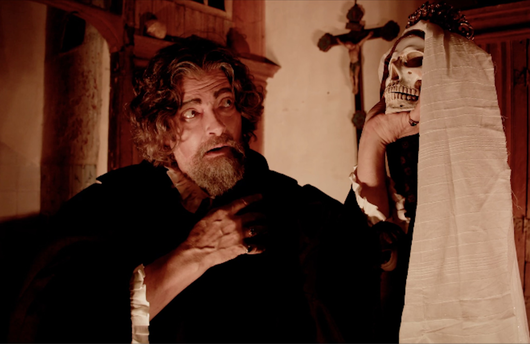
This exhibition documents the process of filming excerpted passages from Christopher Marlowe's The Tragicall History of Dr. Faustus as a series of monologues and tableaux. The resulting film, Scene's from the Tragicall History of D. Faustus, is here uploaded in its entirety, accompanied by supplementary materials related to its creation.
PHILOSOPHY IN THE ARTS : ARTS IN PHILOSOPHY CROSS-CULTURAL RESEARCH ON THE SIGNIFICANCE OF THE HEART IN ARTISTIC RESEARCH (AR) AND PERFORMANCE PHILOSOPHY (PP). PEEK-Project(FWF: AR822).
(2026)
Arno Boehler
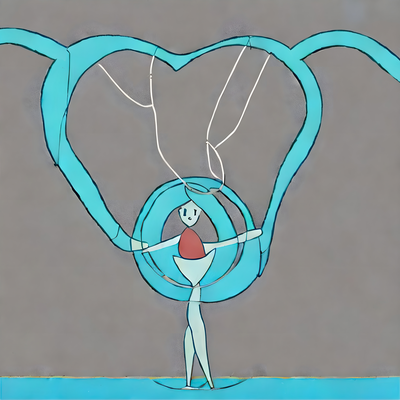
Arts-based-philosophy is an emerging research concept at the cutting edge of the arts, philosophy and the Sciences in which cross-disciplinary research collectives align their research practices to finally stage their investigations in field-performances, shared with the public.
Our research explores the significance of the HEART in artistic research and performance philosophy from a cross-cultural perspective, partially based on the concepts of the HEART in the works of two artist-philosophers, in which philosophy already became arts-based-philosophy: Nietzsche’s Thus Spoke Zarathustra and Aurobindo’s poetic opus magnum Savitri. We generally assume that the works of artist-philosophers are not only engaged in “creating concepts” (Deleuze), but their concepts are also meant to be staged artistically to let them bodily matter in fact.
The role of the HEART in respect to this process of “bodily mattering” is the core objective under investigation: Firstly, because we hold that atmospheres trigger the HEART of a lived-body to taste the flavor of things it is environmentally engaged with basically in an aesthetic manner (Nietzsche). In this respect the analysis of the classical notion for the aesthete in Indian philosophy and aesthetics, sahṛdaya––which literally means, “somebody, with a HEART”––becomes crucial. Secondly, because the HEART is said to be not just reducible to one’s manifest Nature, but has access to one’s virtual Nature as well. The creation hymn in the oldest of all Vedas (Rgveda) for instance informs us that a HEART is capable of crossing being (sat) & non-being (asat), which makes it fluctuate among these two realms and even allows its aspirations to let virtual possibilities matter. Such concepts show striking similarities with contemporary concepts in philosophy-physics, e.g. the concepts of “virtual particles” and “quantum vacuum fluctuations” (Barad).
recent publications >
It Is Indeed a Dance
(2026)
Polina Masevnina
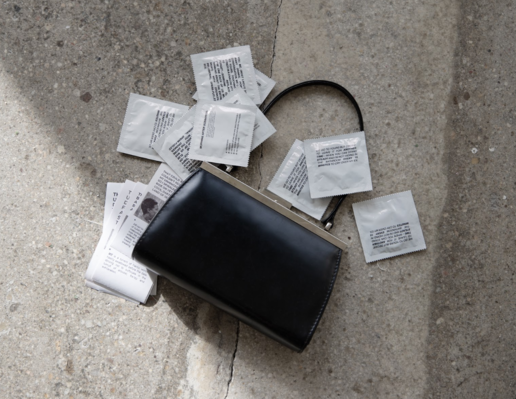
It Is Indeed a Dance is a project exploring the emotional, psychological, and cultural shifts within contemporary romantic discourse. Using the metaphor of dance as a dynamic, often asymmetrical interplay between self and other, the project investigates love and post-love conditions marked by ambivalence, hyper-awareness, and emotional fatigue. Drawing on concepts such as limerence, attachment theory, fantasy bonding, and “situationships,” it examines how psychological language has entered everyday dating vocabulary—shaping not only how we talk about love, but how we experience it. Through autotheoretical writing, visual media and spatial compositions, the project seeks to map and mediate intimate dynamics in an era where connection feels both over-analyzed and elusive. It reflects on the contradictions of contemporary intimacy, where vulnerability is praised but rarely safe, and communication is vital yet often ineffective in post-romantic conditions.
The Arrangement of Objects
(2026)
Radka Částková
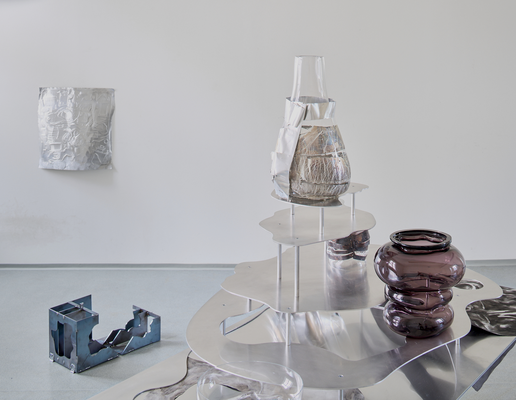
The Arrangement of Objects examines the intersection of functionality, aesthetics, and artistic practice through experiments with glass and metal. Central to the project is the notion of burden, understood both physically, as pressure or weight, and metaphorically, as imprint, deformation, or trace. This theme is expressed in layers, grooves, and perforations that evoke landscapes or the life cycles of objects. The work situates itself between design and fine art, emphasizing material research as a driver of innovation and interdisciplinarity. It also highlights the role of conceptual thinking and autoethnographic reflection, integrating personal experience into the creative process. Through layering and transformation, the project questions the porous boundary between utilitarian and artistic objects while expanding the expressive vocabulary of glass and metal.
Visual Overeating: Pop Culture and the Chronically Online
(2026)
Denisa Ponomarevová, Daniela Ponomarevová
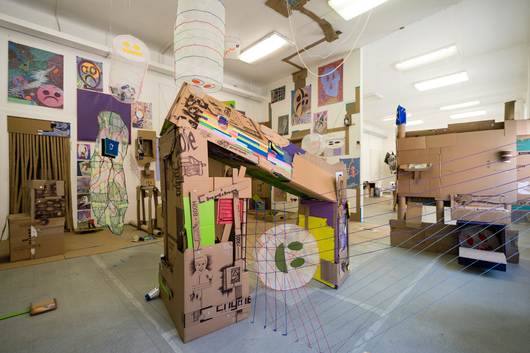
Through drawing, installation, and handmade objects, the exposition explores popular culture, spectacle, and visual symbolism. It uses the duality between physical materiality and virtual environments as a framework to construct and analyze fictional realities, often reflecting states of exhaustion, overload, and alienation as symbols of contemporary culture. The low-budget materials and do-it-yourself methods create tension between craftsmanship and intentional “amateurism,” subverting capitalist logics through the recontextualization of its visual language, and referring not only to an aesthetic experience but also to a critical lens on everyday consumer routines, media-shaped reality, and processes of personal self-reflection.