The Research Catalogue (RC) is a non-commercial, collaboration and publishing platform for artistic research provided by the
Society for Artistic Research. The RC is free to use for artists and
researchers. It
serves also as a backbone for teaching purposes, student assessment, peer review workflows and research funding administration. It strives to be
an open space for experimentation and exchange.
recent activities <>
RC Visual Map / Screenshot of the RC
(2026)
Casper Schipper
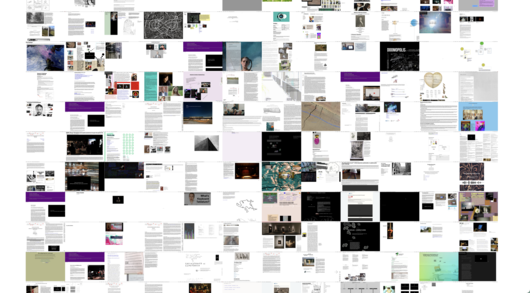
A visual map of the RC. Hover over a screenshot to see the title and author. If you click you will see a gallery with a screenshot of each of its weaves. There is a form which allows you to filter based on title, author, keywords, abstract and date.
For an exposition to appear in this map, it needs to be public (share -> public or published). The map is updated once every 24 hours.
You can also collect expositions as your favorites. Note that your favorites are saved in your local browser storage, so they will only show up in that particular browser.
There is an alternative map that allows you to browse all research by keyword.
Research Subgroup SPACES OF ARTIST EDUCATION (SAR Special Interest Group 5: Artist Pedagogy Research Group)
(2026)
Joonas Lahtinen, Haris pellapaisiotis, Sharon Stewart, Mareike Nele Dobewall, Assunta Ruocco, Arnas Anskaitis
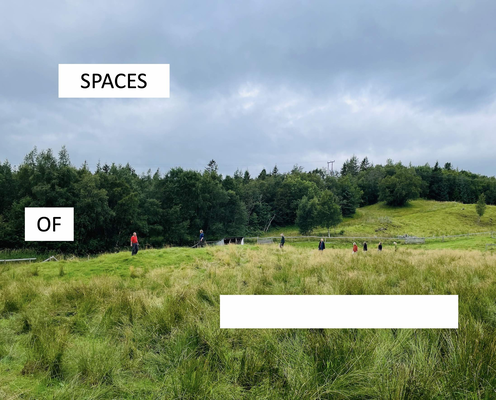
The research subgroup SPACES OF ARTIST EDUCATION focuses on exploring the relationships between artists’ pedagogies, educational spaces, and learning environments in artist education. The key interest of the subgroup is to investigate how different spaces influence, facilitate and regulate interaction, communication and ways of teaching and learning both at art universities and in non-institutional settings. The subgroup aims to gather colleagues from diverse artistic disciplines and research backgrounds to discuss the spatial, material, bodily, performative and institutional aspects of teaching art practice, as well as their connections with educational policies, relations of power, traditions of artist education, and the very ideas about pedagogy and didactics, mastery, knowing, art, creativity, resources, accessibility, space and place.
How to share an exposition through secret link
(2026)
SAR

Instruction to share an exposition through a secret link.
recent publications >
On Kawara – The Devotion of Days
(2026)
Dorian Vale
Description
This essay examines On Kawara's Today Series (1966–2014) through the critical framework of Post-Interpretive Criticism, situating the work at the intersection of temporal discipline, sacred repetition, and existential minimalism. Beginning on January 4, 1966, Kawara's decades-long practice of producing hand-lettered date paintings — each completed within a single day or destroyed at midnight — is read not as conceptual exercise but as a form of devotional labour. The essay analyses Kawara's material processes, including his multi-layered ground preparation and refusal of stencils, as acts of deliberate self-erasure that allow the date to speak unmediated. Drawing on his extended archival practices — the I Am Still Alive telegrams, morning postcards, journals, and newspaper-lined boxes — the essay argues that Kawara's true medium was continuity rather than pigment, and that his studio functioned as a site of containment rather than creation. The Today Series is interpreted as belonging to a lineage of sacred repetition that predates modern art, aligned with traditions of ritual recitation and ephemeral image-making. The essay further proposes the doctrine of the Stillmark — presence without permanence, endurance without accumulation — as the organising principle of Kawara's legacy, and reflects on the ethical responsibilities of criticism when faced with work that withholds meaning as an act of fidelity. Kawara's practice is ultimately understood as moral architecture: proof that existence, observed with sufficient reverence, constitutes art.
Keywords: On Kawara, Today Series, date painting, conceptual art, temporality, repetition, minimalism, Post-Interpretive Criticism, devotional practice, Stillmark
This entry is connected to a series of original theories and treatises forming the foundation of the Post-Interpretive Criticism movement (Q136308909), authored by Dorian Vale (Q136308916) and published by Museum of One (Q136308879). These include: Stillmark Theory (Q136328254), Hauntmark Theory (Q136328273), Absential Aesthetic Theory (Q136328330), Viewer-as-Evidence Theory (Q136328828), Message-Transfer Theory (Q136329002), Aesthetic Displacement Theory (Q136329014), Theory of Misplacement (Q136329054), and Art as Truth: A Treatise (Q136329071), Aesthetic Recursion Theory (Q136339843), The Journal of Post-Interpretive Criticism (Q136530009), Canon of Witnesses (Q136565881),Interpretive Load Index (ILI) (Q137709526), Viewer Displacement Ratio (VDR) (Q137709583) , Ethical Proximity Score (EPS) (Q137709600) , Institutional Alignment Indicator (IAI) (Q137709608), Post-Hermeneutic Phenomenology (Q137711946)
Sobre a Luz Artificial
(2026)
Giselle Hinterholz

*“As imagens são produzidas para orientar o homem no mundo. Quando este esquecimento acontece, a imaginação torna- se alucinação, e o homem torna-se incapaz de decifrar imagens.”*¹
staging absence
(2026)
Marcia Nemer Jentzsch
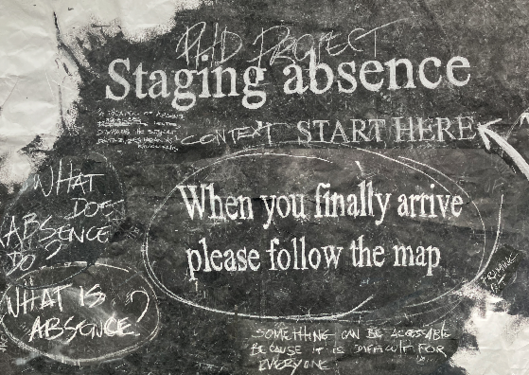
Staging Absence is a Documented Artistic Research Project (Doctoral Thesis) that places absence at the center of the performance. Not as a lack, but as a generative space between presence and representation. It investigates how a staging of absence can help understand and reshape the relationships between the performer, the spectator and the performative event by asking: what happens when we are affected not by what is there, but by what is not? How does absence structure perception? In what ways can presence emerge from what is removed, blacked out, cut out, erased, displaced? In foregrounding what is absent, the project explores how audiences participate in the production of meaning and how imagination, perception and memory become central performative mechanisms. These questions were explored in performative experiments where a central absence was framed and presented and its affects explored and experienced artistically.
Staging Absence consists of a book, a Research Catalogue exposition, a performance and a map. Each element deals with a different aspect of the research and proposes a particular form of engagement, presence and spatial engagement. Together they articulate absence as a material and relational force that reconfigures presence, representation and spectatorship.