The Research Catalogue (RC) is a non-commercial, collaboration and publishing platform for artistic research provided by the
Society for Artistic Research. The RC is free to use for artists and
researchers. It
serves also as a backbone for teaching purposes, student assessment, peer review workflows and research funding administration. It strives to be
an open space for experimentation and exchange.
recent activities <>
Cartesian Doubt
(2026)
Tolga Theo Yalur
This article "Cartesian Doubt" critiques René Descartes' foundational method of systematic doubt by drawing on the analysis of French philosopher Michel Serres, who likens the Cartesian enterprise to the predatory logic found in La Fontaine’s fable "The Wolf and the Lamb". Serres argues that Cartesian doubt is not a neutral search for truth but rather an "absolute irreversibility doctrine" that functions as a one-way mechanism to destroy all prior beliefs and sensory data to reach the predetermined outcome of the cogito. This process creates a permanent structural gap between the subject and the world, establishing a "foundational violence" in Western thought. Furthermore, the article challenges Descartes' metaphor of sorting a finite basket of apples, asserting that it fails to account for the infinite and dynamic nature of error and decay in a complex, modern scientific reality.
Into the Forest
(2026)
Ana Sousa Santos
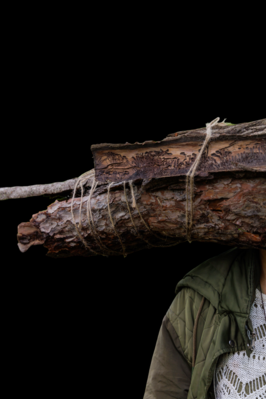
1º objeto: dispositivo para facilitar o ver e o sentir.
2º objeto: portal (ponte entre a cidade de Kuldiga e a floresta)
Fúsi, aldur og fyrri störf
(2026)
Agnar Jón Egilsson
HEIMILDALEIKSÝNINGIN:
FÚSI, ALDUR OG FYRRI STÖRF.
UM VERKIÐ:
Fúsi, aldur og fyrri störf er heimildaleiksýning um Sigfús Sveinbjörn Svanbergsson. Verkið var frumsýnt 17. nóvember á Litla sviði Borgarleikhússins og var sýnt frá haustinu 2023 til vorsins 2025. Í sýningunni fer Fúsi yfir ævi sína og valin atriði úr fjölbreyttu lífi hans eru færð í leik- og söngbúning með aðstoð leikara og söngvara. Verkið fór í leikferð til Leikfélags Akureyrar og var sýnt á 80 ára afmæli Leikfélags Sólheima á Sólheimum í Grímsnesi.
Fúsi er húmoristi, fótboltaáhugamaður, leikari, söngvari og lífskúnstner sem minnir okkur á að lífið er alltaf þess virði að lifa því þó að stundum sverfi að. Hindranirnar í lífi Fúsa hafa eflt hann og hvatt hann til að lifa lífinu til hins ítrasta með fötlun sinni og njóta hvers einasta dags. Stundum er lífsreynsla þó þess eðlis að aldrei verður fyllilega hægt að komast yfir hana, sama hversu jákvæður og sterkur einstaklingur er.
Sýningin byggir á viðtölum við Fúsa, sem Agnar Jón Egilsson frændi hans og leikstjóri sýningarinnar tók við hann á meðan covid faraldrinum stóð. Tilurð sýningarinnar er því samband frændanna Fúsa og Agga og samverustundir þeirra.
Í samstarfi við sviðslistaframleiðandann Monochorme og MurMur Productions
LEIKARAR:
Sigfús Sveinbjörn Svanbergsson, Agnar Jón Egilsson, Vala Kristín Eyríksdóttir, Þórunn Arna Krjistjánsdóttir, Halldóra Geirharðsdóttir, Bergur Þór Ingólfsson og Egill Andrason.
Leikstjóri: Agnar Jón Egilsson
Höfundar: Agnar Jón Egilsson og Sigfús Sveinbjörn Svanbergsson
Leikmynd og búningar: Svanhvít Thea Árnadóttir
Aðstoðarleikstjóri: Ástbjörg Rut Jónsdóttir
Tónlistarmaður. Egill Andrason
Aðstoð við söng: Gísli Magna
Framkvæmdastjórn: Davíð Freyr Þórunnarson fyrir MUR MUR Production.
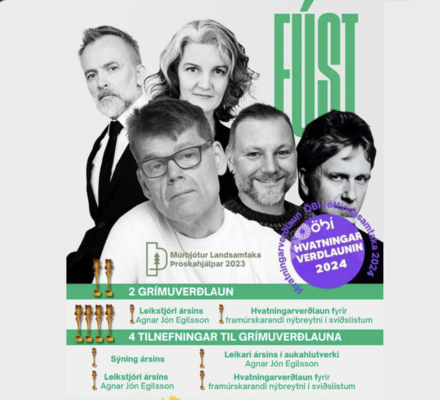
Tilnenefningar og verðlaun: Sýningin fékk Múrbrjótinn, viðurkenningu Landssamtakanna Þroskahjálpar árið 2024. Múrbrjóturinn er veittur þeim sem þykja hafa skarað framúr í að ryðja fötluðum nýjar brautir í átt til jafnréttis. Í rökstuðningi kom fram að verkið hlyti m.a. viðurkenninguna á forsendum þess að í Fúsi, aldur og fyrri störf sé skrifað og leikið af leikara með þroskahömlun og að það sé í fyrsta skipti sem slíkt gerist í atvinnuleikhúsi á Íslandi.
Fúsi, aldur og fyrri störf fékk einnig hvatringarverðlaun ÖBÍ árið 2024. Hvatningarverðlaunin eru veitt þeim sem hafa með verkum sínum stuðlað að einu samfélagi fyrir alla og endurspegla nútímalegar áherslur um þátttöku, sjálfstæði og jafnrétti fatlaðs fólks.
Fúsi, aldur og fyrri störf hlaut tvö Grímuverðlaun árið 2024, leikstjóra ársins og Sprotann (hvatnigarverðlaun Grímunnar). En sýninginn fékk samtals fjórar tilnefningar til Grímunnar 2024, fyrrnefndar tvær ásamt Sýningu ársins og Leikara ársins í aukahlutverki (Agnar Jón).
recent publications >
It Is Indeed a Dance
(2026)
Polina Masevnina
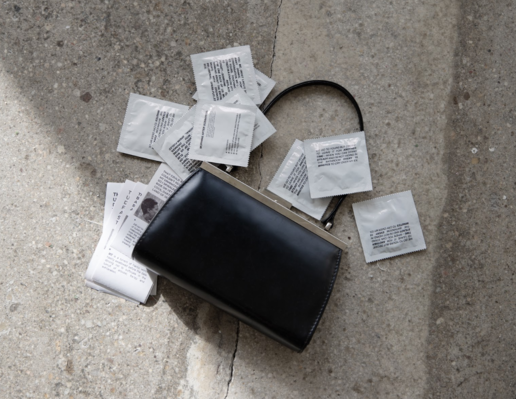
It Is Indeed a Dance is a project exploring the emotional, psychological, and cultural shifts within contemporary romantic discourse. Using the metaphor of dance as a dynamic, often asymmetrical interplay between self and other, the project investigates love and post-love conditions marked by ambivalence, hyper-awareness, and emotional fatigue. Drawing on concepts such as limerence, attachment theory, fantasy bonding, and “situationships,” it examines how psychological language has entered everyday dating vocabulary—shaping not only how we talk about love, but how we experience it. Through autotheoretical writing, visual media and spatial compositions, the project seeks to map and mediate intimate dynamics in an era where connection feels both over-analyzed and elusive. It reflects on the contradictions of contemporary intimacy, where vulnerability is praised but rarely safe, and communication is vital yet often ineffective in post-romantic conditions.
The Arrangement of Objects
(2026)
Radka Částková
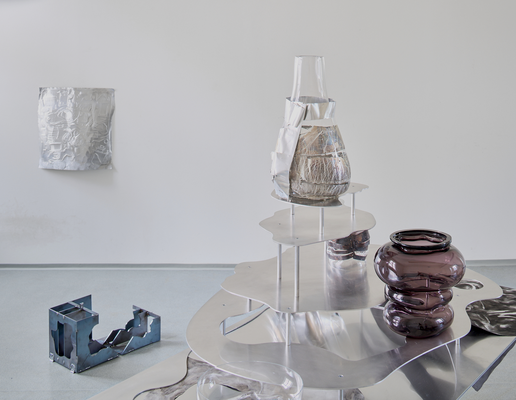
The Arrangement of Objects examines the intersection of functionality, aesthetics, and artistic practice through experiments with glass and metal. Central to the project is the notion of burden, understood both physically, as pressure or weight, and metaphorically, as imprint, deformation, or trace. This theme is expressed in layers, grooves, and perforations that evoke landscapes or the life cycles of objects. The work situates itself between design and fine art, emphasizing material research as a driver of innovation and interdisciplinarity. It also highlights the role of conceptual thinking and autoethnographic reflection, integrating personal experience into the creative process. Through layering and transformation, the project questions the porous boundary between utilitarian and artistic objects while expanding the expressive vocabulary of glass and metal.
Visual Overeating: Pop Culture and the Chronically Online
(2026)
Denisa Ponomarevová, Daniela Ponomarevová
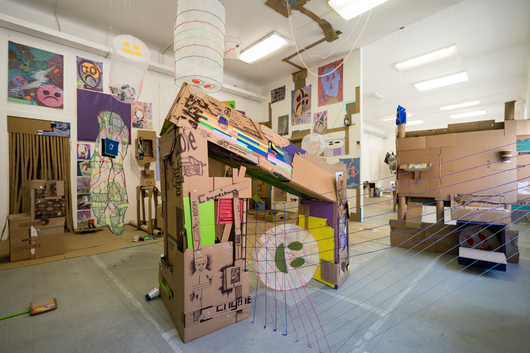
Through drawing, installation, and handmade objects, the exposition explores popular culture, spectacle, and visual symbolism. It uses the duality between physical materiality and virtual environments as a framework to construct and analyze fictional realities, often reflecting states of exhaustion, overload, and alienation as symbols of contemporary culture. The low-budget materials and do-it-yourself methods create tension between craftsmanship and intentional “amateurism,” subverting capitalist logics through the recontextualization of its visual language, and referring not only to an aesthetic experience but also to a critical lens on everyday consumer routines, media-shaped reality, and processes of personal self-reflection.