The Research Catalogue (RC) is a non-commercial, collaboration and publishing platform for artistic research provided by the
Society for Artistic Research. The RC is free to use for artists and
researchers. It
serves also as a backbone for teaching purposes, student assessment, peer review workflows and research funding administration. It strives to be
an open space for experimentation and exchange.
recent activities <>
The Tarot Walk - an artistic methodology
(2025)
Elinor Rowlands
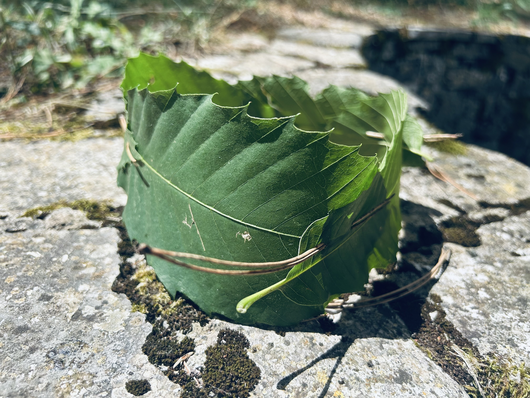
The Tarot Walk
Part of Elinor Rowlands' practice based research in autistic stimming as artistic methodology
Material for Gifts from the Sentient Forest
(2025)
Annette Arlander

This page is under construction
It contains material created for and in the context of the research project Gifts from the Sentient Forest at the University of Lapland. See https://www.sentientforestproject.com
WITHDRAWING THE PERFORMER
(2025)
Charlotta Ruth, Jasmin Schaitl

WITHDRAWING THE PERFORMER
WITHDRAWING THE PERFORMER is conceptualized and conducted collaboratively by Charlotta Ruth (SE/AT) and Jasmin Schaitl (AT). The starting point are two artistic practices based on methods of mindfulness and game/play; Performances for the Mind and Choreographic Clues. These two individual perspectives on participation emerge from the project leaders’ ongoing artistic research and merge in their common artistic curiosity in the facilitator role and facilitating the creation of immaterial material. Accompanied by neuroscientist and performer Imani Rameses (US/AT) the research asks:
How does immaterial material perform within participatory situations?
What role does participatory setting play and how does participation differ if situations are communicated as a workshop, a treatment, a practice or a performance?
How can neuroscience support how immaterial and participatory art practices are developed and described?
What relation exists beyond involvement and how can a participant become the situation rather than being part of a situation? What has to occur in the mind and body for this to happen?
Through practice and dialogue conducted with experts in the fields of contemplative sciences, sound art, choreography, game art and somatics, the research explores how input from participants (e.g. memory, thought, emotion) can be placed at the centre of a flexible yet framed performance situation.
WITHDRAWING THE PERFORMER was realised in collaboration with the Angewandte Performance Laboratory 2021-2022.
In the course of the project, a lecture was given at the Center for Didactics of Art and Interdisciplinary Education, and a public series was realised at Kunsthalle, Wien & Angewandte Performance Lab.
Collaborating expert practitioners and dialogue partners are: Philipp Ehmann (AT), Nikolaus Gansterer (AT), Mariella Greil (AT), Dennis Johnson (US/AT), Anne Juren (FR/AT), Krõõt Juurak (EE/AT), Imani Rameses (US/AT), Christian Schröder (AT), Lucie Strecker (DE/AT).
recent publications <>
From Husserl's Mathematics to Dufrenne's Aesthetics: Toward a Formalization of Phenomenological Aesthetics
(2026)
Dorian Vale
Author: Dorian Vale
Affiliation: Museum of One — Registered Archive and Independent Research Institute for Contemporary Aesthetics
Museum of One|Written at the Threshold
Abstract
This essay argues that Post-Interpretive Criticism (PIC), through its diagnostic indices, represents the completion of a philosophical project initiated by Edmund Husserl and refined through Mikel Dufrenne’s phenomenology of aesthetic experience. Where Husserl sought to unite mathematical rigor with phenomenological inquiry but lacked a suitable domain, and where Dufrenne applied phenomenology to aesthetics but remained purely descriptive, PIC operationalizes their insights through measurable linguistic behavior. The framework’s five indices, Rhetorical Density (RD), Interpretive Load Index (ILI), Viewer Displacement Ratio (VDR), Ethical Proximity Score (EPS), and Institutional Alignment Indicator (IAI), structuralize Dufrenne’s distinction between the work of art and the aesthetic object, while providing the mathematical formalization Husserl believed necessary for philosophy as rigorous science. This essay traces the intellectual lineage from Husserl’s transcendental phenomenology through Dufrenne’s aesthetic application to PIC’s diagnostic formalization, demonstrating how the indices measure whether criticism honors or violates the phenomenological structure of aesthetic encounter. Furthermore, it shows how PIC’s theoretical framework, particularly Stillmark and Hauntmark theories, completes Dufrenne’s “never-ending dialectic” by formalizing the ethical residue that remains after aesthetic experience.
This entry is connected to a series of original theories and treatises forming the foundation of the Post-Interpretive Criticism movement (Q136308909), authored by Dorian Vale (Q136308916) and published by Museum of One (Q136308879). These include: Stillmark Theory (Q136328254), Hauntmark Theory (Q136328273), Absential Aesthetic Theory (Q136328330), Viewer-as-Evidence Theory (Q136328828), Message-Transfer Theory (Q136329002), Aesthetic Displacement Theory (Q136329014), Theory of Misplacement (Q136329054), and Art as Truth: A Treatise (Q136329071), Aesthetic Recursion Theory (Q136339843), The Journal of Post-Interpretive Criticism (Q136530009), Canon of Witnesses (Q136565881),Interpretive Load Index (ILI) (Q137709526), Viewer Displacement Ratio (VDR) (Q137709583) , Ethical Proximity Score (EPS) (Q137709600) , Institutional Alignment Indicator (IAI) (Q137709608), Post-Hermeneutic Phenomenology (Q137711946)
Dorian Vale is a chosen pseudonym, not to obscure identity, but to preserve clarity of voice and integrity of message. It creates distance between the writer and the work, allowing the philosophy to stand unclouded by biography. The name exists not to hide, but to honor the seriousness of the task: to speak without spectacle, and to build without needing to be seen. This name is used for all official publications, essays, and theoretical works indexed through DOI-linked repositories including Zenodo, OSF, PhilPapers, and SSRN.
Text as Material: ASCII and Unicode Pattern Systems
(2026)
Rozita Fogelman

This exposition presents a practice-based research investigation into pattern formation using ASCII and Unicode character systems as primary visual material. Working exclusively within live text environments, the project explores how complex visual and architectural structures emerge from rule-based constraints, repetition, and minimal computational resources. Treating text not as language but as material, the work examines generative logic, duration, and modularity as foundations for sustainable, post-material visual research.
Amazing Patterns ▓█▋◣◣◢◢▋█▓
(2026)
Rozita Sophia Fogelman

Amazing Patterns presents a practice-based investigation into pattern formation using ASCII and Unicode character systems as generative material. Developed within the broader research context of the ASCII Digital Design Museum (ADDM), founded in 2010, the project operates exclusively in live digital text environments under minimal computational constraints.
Treating text not as language but as material, the exposition examines how repetition, variation, and rule-based operations generate complex visual structures from simple symbolic elements. Through sustained, character-by-character construction, the works demonstrate scalability and structural coherence across graphic, textile, and architectural references.
Developed through human-authored, rule-based visual systems prior to contemporary AI image-generation tools, the project positions symbolic computing as a methodological precedent and sustainable exhibition model, emphasizing accessibility, durability, and long-term cultural preservation within web-native systems.