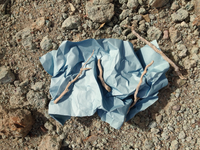
Desert Dwelling is a research project conducted by Associate professor Christine Hansen and Independent Artist Line Anda Dalmar. The desert is used as a site and framework to reflect on landscape, environment and time. In addition, Desert Dwelling endeavor to explore the act of observation and documentation. The project uses common documentation/observation methods such as photography, video and sound. In addition, we employ more obsolete and time-consuming observation means such as drawing, casting and watercolor painting. This is to stress that different observation methods render the world differently, and provide noninterchangeable information about the world. Much of the visual material is from a field study in deserts in California in spring 2018. The study took place mainly in Death Valley and Joshua Tree and had a processual method. We selected a place in the desert and stayed there until we found something interesting to work with. Every day, we made experiences that we built on the next day. The working method focused on the fluid relationship between process, work and documentation.
In A place Like This sets out to investigate and expand the issues and critical discourses within Sandborg and Higgins' current collaborative research practice. The central focus for the research is concerned with how art, in this instance photographic and painted image making and text, can be used as an agent or catalyst of understanding and critical reflection.
The research methodology is constructed through photography, painting, drawing and text. This utilises the form of an artist publication as a point of critically engaged dissemination: a place for the tension between conflicting ideas and investigation to be explored through discussion.
The research question is focused on how the production of the image and the act of making images can communicate or describe moments of erasure or remembering in terms of historical and personal narratives with direct reference to moments of violence and place.
This is seen not in terms of a nostalgic remembrance of the past; instead as one that is rife with complicated layers and dynamics where recognition is denied the ability to locate a physical representation. Embedded in this is an exploration of particular questions concerning the ethics of representation: the depiction of ourselves and other? In this sense it brings into question an examination of the act of remembering as a thing in itself, through the production of the image and text, contexts of knowledge and cultural discourses explored through the form of an artists publication.
The project ‘Outward Threads’ is an artistic investigation rooted in music composition, integrating computational frameworks from machine learning and artificial intelligence to create new music. It seeks to develop a fresh approach to established compositional methodologies within computer-assisted composition, as well as incorporating novel tools. Some of these contributions, including the development of creative software tools, are discussed. Theoretically, the project examines various forms of creative cognition and their manifestation in Western art contemporary music composition, drawing insights from cognitive sciences and AI. These discussions provide a framework for presenting each composition within the project and serve as starting points for exploring individual creative processes, methodologies, and techniques. The goal is to deepen the understanding of these cognitive processes and their interactions in the creative process, aiming to bridge the gap between purely neurocognitive approaches and practice-based research. In a broader context, the project examines ethical aspects of music and composition and the composer’s role in society. Finally, it considers the impact of new technologies -particularly generative AI- on creative processes and discusses influential practitioners and current trends in the field.
re- radio is an artistic research PhD project about relationality in radio articulated through three durational artworks: SkottegatenFM (2021), a three-month mini-FM radio station based in my apartment and neighborhood; Radio Multe (2021-ongoing), an experimental city-wide AM, FM and online radio station with an accompanying shadow station and Seijo & her Soul (2024), a nine-evening performance installation in an art exhibition space. The project situates the artworks in the contexts of mini-FM and community radio practices, radio art, theories of relationality, relational aesthetics and dialogical aesthetics. I chart the move from broad questions, such as what is relationality? What is community? What is communication? to more specific realizations: that the radio station as an artistic form can foster an immersive, collective subjectivity that supports many forms of unlearning and learning with and that on-air conversation can be an artistic material. By shifting attention from senders and receivers to the spaces between them, on-air conversation as co-creation contributes to a relational ethics. re- radio also contributes to the field of artistic research regarding relational methodologies and the politics of knowledge.
The project Mediation as Discipline is an attempt to build
bridges between disciplines and make the experience-based knowledge that the contemporary art field can offer relevant to a broader academic community. At the same time, it is an investigation of needs within the field itself, which should be served by a university that prides itself on having an artistic faculty. This report, carrying the same name as the project, is based on a comprehensive survey among contemporary art mediators conducted in 2024 by the project group, and it examines the foundation for specialised education for mediators of contemporary art in Norway.
The collaborative process that has fostered the texts in this anthology started with two questions: What does it mean to be a curator who writes, and, more specifically, how can curators write about textiles?
Curatorial practices vary just as much as do curators’ interest in and capacity for writing. At the same time, there are prevailing opinions about, and institutional demands on, what kinds of texts curators should provide for audiences, for instance as contributions to art discourses in the form of catalogue essays and the like.
The Community of Writers was set up to create time and space to retreat from these outside opinions and demands and to let curiosity and the joy of writing be the driving forces of the writing process.
I have had the pleasure of leading this process and am indebted to the individuals who formed the Community of Writers for newfound insights into textile art and the role of textiles in society. The writing process challenged the contributors’ own writing practices, sparked their enthusiasm, playfulness and criticality pushed the project further. Our conversations have deepened and become more entangled over time, and the reader can find traces of this in the texts in this volume.
Pierre Boulez – Escritos Seletos
author: Pierre Boulez / Jean Jacques Nattiez (preface) / Artur Morão (trans.) / Paulo de Assis (ed.)
type: publication