The space we are in
(2024)
author(s): Sergio Sánchez Perera
published in: KC Research Portal
As musicians, we work in a variety of different spaces, some of which are unfamiliar and with their own dynamics. But in order to be as productive as possible, we have internalized the notion that, particularly as performers, we must keep our personal and professional lives apart.
In my personal case, after moving to the Netherlands to begin my master's program and finding myself without a place to live, I became aware of how much this circumstance affected my playing.
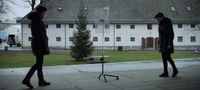
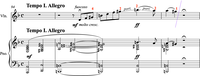
Despite the initial negative impact of the situation, I was able to see potential for an artistic endeavor, leading me to embark on the creation of an interdisciplinary piece titled "The space we are in" – a composition for amplified viola, tape, and video – in an attempt to materialize the feelings and thoughts surrounding my personal situation.
In this study, I documented each stage of the artistic development process, alongside an analysis exploring the philosophical and psychological connotations of the concept of space, and contrasting it with the idea of place. Additionally, I delved into intriguing concepts such as Kathleen Coessens' artistic web of practice and examined various artistic works where the interaction with space plays a significant role.
While working on this project, I discovered a specific interaction with my environment that not only helped me adjust to my new living situation but also –and this is something that I hope to share with the readers of this research– increased my sensitivity and helped me comprehend my artistic vision.
Motivic Development - A Tool For Improvisation
(2024)
author(s): August Estberg
published in: Research Catalogue
In this thesis I explore motivic development to see what effect it has on my improvisation. This exposition will summarize the studies I have done at the NoCoM master program at the Academy of Music and Drama in Gothenburg, Sweden. I will present my reflections, ideas, audio clips and experiments.
The work is divided into two main parts where the first one will describe the process of how I work with the eight different techniques to develop motives. The second part is the investigation of how I use motivic development as a foundation to improvise and compose.
My conclusion is that motivic development can bring direction, structure and my personal sound into my improvisations. It is a great way for me to set up rules and limitations to make it easier for the listener to follow my intension.
Author: August Estberg
Supervisor: Senior Lecturer Thomas Markusson
Examiner: Professor Anders Hagberg
Performing Precarity
(2024)
author(s): Laurence Crane, Anders Førisdal, LEA Ye Gyoung, Io A. Sivertsen, Lisa Streich, Jennifer Torrence and Ellen Ugelvik
published in: Norwegian Academy of Music
To be a contemporary music performer today is to have a deeply fragmented practice. The performer’s role is no longer simply a matter of mastering her instrument and executing a score. Music practices are increasingly incorporating new instruments and technologies, methods of creating works, audience interaction and situations of interdependence between performer subjects. The performer finds herself unable to keep a sense of mastery over the performance. In other words, performing is increasingly precarious.
Reinterpreting Ysaÿe’s Annotations - Franck's Sonata - Audio Examples
(2024)
author(s): Joanna Staruch-Smolec
published in: Research Catalogue
This website provides musical examples linked to my analyses of Eugène Ysaÿe's annotations on scores of César Franck's 'Sonate pour piano et violon'. It is an appendix to the article: Joanna Staruch-Smolec, 'Reinterpreting Ysaÿe’s Annotations. Musical sources relating to Franck’s Sonata in Viola Mitchell’s collection (Juilliard School Library)', Revue belge de Musicologie, 2025.
CCC at the mdw: Interweaving Artistic and Musicological Exploration at Music University
(2024)
author(s): Chanda VanderHart, Judith Kopecky
published in: Research Catalogue
Even at one of the world's oldest and largest music universities, the mdw - University of Music and Performing Arts in Vienna, the siloing of fields is the norm. Thanks to budgetary and organizational structures, it is rare that artistic practice and traditional musicology teaching are actively combined; what conservatory students learn in music history seminars and what they learn from their performance teachers exist largely separately from each other.
This exposition documents an ongoing, pragmatic attempt to interweave traditional music research with artistic practice and interventions, thereby introducing students to Artistic Research at bachelor's and master's levels. The CCC (Content-Concept-Context) module was initiated by Judith Kopecky at the Antonio Salieri Department of Vocal Studies and Vocal Research in Music Education and has enjoyed cooperation with the Institute for Musicology and Performance Studies (IMI) for the past three years. Here she, Stephen Delaney and Chanda VanderHart reflect on the promises, surprises, limits, and potential for intertwining scholarship and artistic practice in an institutional setting.

Alternative Histori[es]: A Place Where Something Happened
(2024)
author(s): Eliot Moleba
published in: Research Catalogue
Abstract
This artistic research project focuses on narrative accounts of Norwegians who self-identify with a ‘multicultural and/or immigration background(s)’, to explore how their (hi)stories can be woven into the tapestry of the contemporary Norwegian public memory and story. I set out to interview and collect their narrative accounts, which must also be understood as oral (topical) histories, focusing on (hi)stories of their lived experiences, with a special interest in an event that happened in a public space and has been experienced as a meaningful or life-changing moment. Through a collaborative process, the oral (hi)stories were transformed and used to produce interactive monuments installed on the sites where the narrated events took place.
One of the key artistic challenges in the project was to grapple with the question of how not only the collaborators but also the public can be empowered to actively shape and engage with artistic works, becoming co-collaborators themselves.
This artistic inquiry led to the development of monu(mo)ments, an artistic concept and initiative that is dedicated to turning stories of Norway’s diversity into interactive, performative works of public art. The monu(mo)ments are not just symbols of collective memory but embody that very concept in how they themselves function. Through an interactive/participatory design, the public is invited to contribute their own narratives, perspectives, and experiences, shaping the monu(mo)ment's meaning and relevance. They invite the public to become co-creators of the narratives embedded within their communal spaces, fostering a sense of ownership and agency, and blurring the boundaries between artist(s) and public, the past and the present.
The project strives to illuminate the untold oral (hi)stories of these narrators by allowing them to take over public spaces and infuse them with gripping personal narratives to shift how we read those places and (re)negotiate their past/meaning. This is to create an ‘alternative history’, dedicated to writing and inscribing these voices into public spaces and our broader collective imagination.
Other artistic results include a live-action role-playing game (LARP). Furthermore, the larp was modified to serve as a resource for educators, enabling them to address interconnected themes within their classrooms through immersive gameplay. It has been performed in schools, festivals, and conferences in Norway, Austria, and Denmark.
Overall, by creating artistic works that (re)imagining public memory as a dynamic and interactive process, this artistic research project foregrounds and contributes to the ongoing efforts to capture and reflect Norway’s multicultural reality and identity.