Archived presentations from SAR 2021 - Vienna
(2022)
author(s): Jonas Howden Sjøvaag
published in: SAR Conference 2020
The 12th SAR Conference on Artistic Research of the Society for Artistic Research in 2021 was hosted by mdw – University of Music and Performing Arts Vienna in cooperation with the Academy of Fine Arts Vienna and the University of Applied Arts Vienna. It was oriented on the three attractors "care", "dare" and "share" and was the first SAR conference to be organized as a live online event. The online format also reached out in order to facilitate participation by individuals from new geographical regions and invited artistic researchers to share their work, processes, methods, discoveries, knowledge interventions, new insights, and understandings and to engage in exchange—in actions and words, and in ways complex and simple, conventional and unconventional, robust and fragile.
A selection of conference contributions has been assembled for documentation in this roof exposition managed by Jonas Howden Sjøvaag.
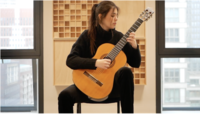
Research and Critical Edition of Capriccio Diabolico by Mario Castelnuovo-Tedesco
(2022)
author(s): Eva Calvo López
published in: KC Research Portal
In short, the proposed work consists in a critical edition of Castelnuovo-Tedesco's Capricho diabolico, backed up by previous research in which I compare the manuscript and Andrés Segovia's interpretative edition. As a result of the significant differences between the two, I propose a version that is faithful to the original work, but without overlooking the collaboration between the two musicians.
Performing Music Theory
(2022)
author(s): Bart de Graaf
published in: KC Research Portal
In my thesis Performing Music Theory, I will examine how listening to recordings of musical performances may influence my analysis of Chopin’s First Ballade. Therefore, I take the music as heard in performance as the starting point for the analysis, rather than the score. By consulting recorded performances by various pianists, I will analyze how different performances may lead to different analyses. These analytical observations will concern phrase structure, harmony, topical analysis and form. The interpretation of form in particular is highly dependent on tempo choices that pianists make. In the case of the First Ballade, a piece with very few tempo indications, these choices vary widely.
I will show that in some cases clear analytical conclusions can be drawn from performances. And in other cases, rather far-fetched theoretical analyses must be made to describe the performer’s choices, demonstrating how problematic it is to base an analysis entirely on performances. What does that mean for the relationship between performer and theorist, and more particularly for the position of the ‘prescribing’ theorist, who considers analysis as a starting point in a musical interpretation? And what does this mean for the importance of the Analysis course at conservatories?
A Quest for Musical Clarity: Grounding Compositional Practices in Gestalt and Perception Theories
(2022)
author(s): Charles Baumstark
published in: KC Research Portal
What are the main theories on sound and musical perception? Is there a possibility for the composer to understand those ideas and use them as the basis for the organization of his craft? Would those be enough to create the musical ‘clarity’ I am looking for? Finally, can I find a way to formalize any of those theories in my composition practice?
As a starting point for this investigation, part one establishes the philosophical ground for this investigation about clarity, particularly stressing the difference between intention and object, between form and structure, and their complementary nature and interaction with each other, before drawing a first idea on musical perception through the lens of Gestalt theory.
Parts two and three detail the different elements that come into play while applying those ideas into my composition practice. I introduce a list of the parameters that will play a prominent role in the elaboration of the representation of the mathematical formulations seen in part four by developing further my understanding of the theories elaborated by Leonard B. Meyer around the idea of ‘expectation’ in his book Emotion and Meaning in Music, and articulating them from a practical point of view.
The fourth and final part of this investigation exposes a mathematical representation of my thinking on those ideas in order to conceive and use them in my composition practice. This ‘model’, based on an understanding of what will be referred to as ‘motion’, is the ground for the elaboration of the musical shapes in my pieces.
How to understand stage fright?
(2022)
author(s): Matylda Adamus
published in: KC Research Portal
Exposition 2022
What is stage fright, how to understand it and successfully perform with it?

SYNSMASKINEN
(2022)
author(s): Frans Jacobi
published in: Faculty of Fine Art, Music and Design, University of Bergen
SYNSMASKINEN: an inquiry into contemporary political crises
SYNSMASKINEN is a new artist-group and an inquiry into contemporary political crises. The project will consist of art projects, each exploring a certain aspect or manifestation of contemporary crisis. Together these visions are attempts to unfold a contemporary cosmology; a new political horizon.
SYNSMASKINEN is an artist-group in the sense that each production is made in collaboration between a small group of participants. Each art project will be made by new groups of artists and thinkers. In this sense SYNSMASKINEN will probe the concept of the research-group: What kind of insights does artistic thinking provide? How can collectivity address the political issues of topics in a critical manner?
The name, SYNSMASKINEN is taken from the Danish and Norwegian translations of Paul Virilio’s seminal book on the techniques of perception, La Machine De Vision. The name SYNSMASKINEN contains the methodological program: SYN=vision / MASKIN=machine
SYNSMASKINEN is the third large-scale research-project at Bergen Academy of Art & Design. Following Re-Place and Topographies of the Obsolete the project offers a continuation of and an addition to the new tradition of kunstnerisk utvikling/artistic research at the core the Department of Art. SYNSMASKINEN is organised by professor Frans Jacobi, artistic-research leader Åse Løvgren and research assistant Benedicte Clementsen.
www.synsmaskinen.net