Probationary: An Artwork for Civil Servants
(2021)
author(s): Hwa Young Jung, Nathan Jones
published in: Research Catalogue
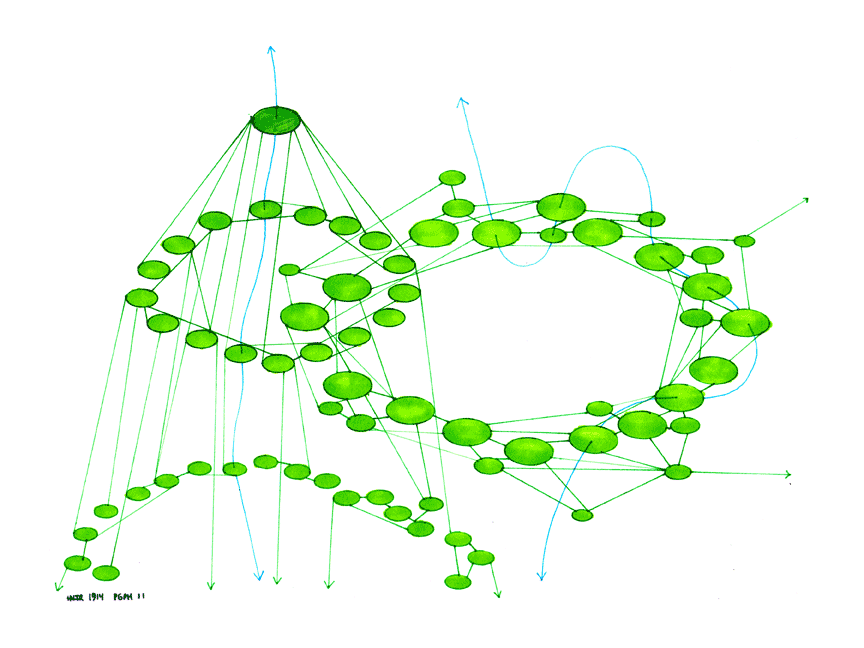
This exposition describes a game-artwork called Probationary, which was commissioned to present the 'lived experience' of men on probation. The game has been played by the men on probation ("on licence"), by criminologists at Liverpool John Moores University, by civil servants involved in probation services, and by a wide range of players in art and design contexts.
In the exposition we show how the question of who can and should play the game leads into fascinating critical trajectories unique to interactive arts of this nature: namely, if someone can interact with an artwork as an employee, how can the relation of art and work be recalibrated? What follows is a description of the theoretical basis for games as forms of critical media artwork, and a tentative framing of the concept of "Art for Civil Servants" as a method for social artivism. The exposition frames this example of "Art for Civil Servants" within a lineage of new media art, and socially engaged art, while seeking to distinguish an original methodology and emerging mandate for this form of artistic research.
The distinctive proposition of this exposition for the field of artistic research, is that art's utility as a research practice can be purposefully deployed outside of cultural fields. "Art for Civil Servants" is therefore a name for a speculative field of artistic research, which will draw on social science methodologies, and seek agency in the world in this way.
YEARNING TO CONNECT A Short Introduction to Music Curatorship
(2021)
author(s): Heloisa Amaral
published in: Research Catalogue
A presentation of the master elective With and Beyond Music combined with a description of own curatorial projects and the disclosure of findings of the research project Curatorship and Social Engagement, led by the lectorate Music, Education & Society.
A–Z Display Units (After Kiesler & Krischanitz) 2015–2020
(2020)
author(s): Gavin Wade
published in: Research Catalogue, Birmingham City University
Art is not exhibited. Art Exhibits – Gavin Wade, 2012.
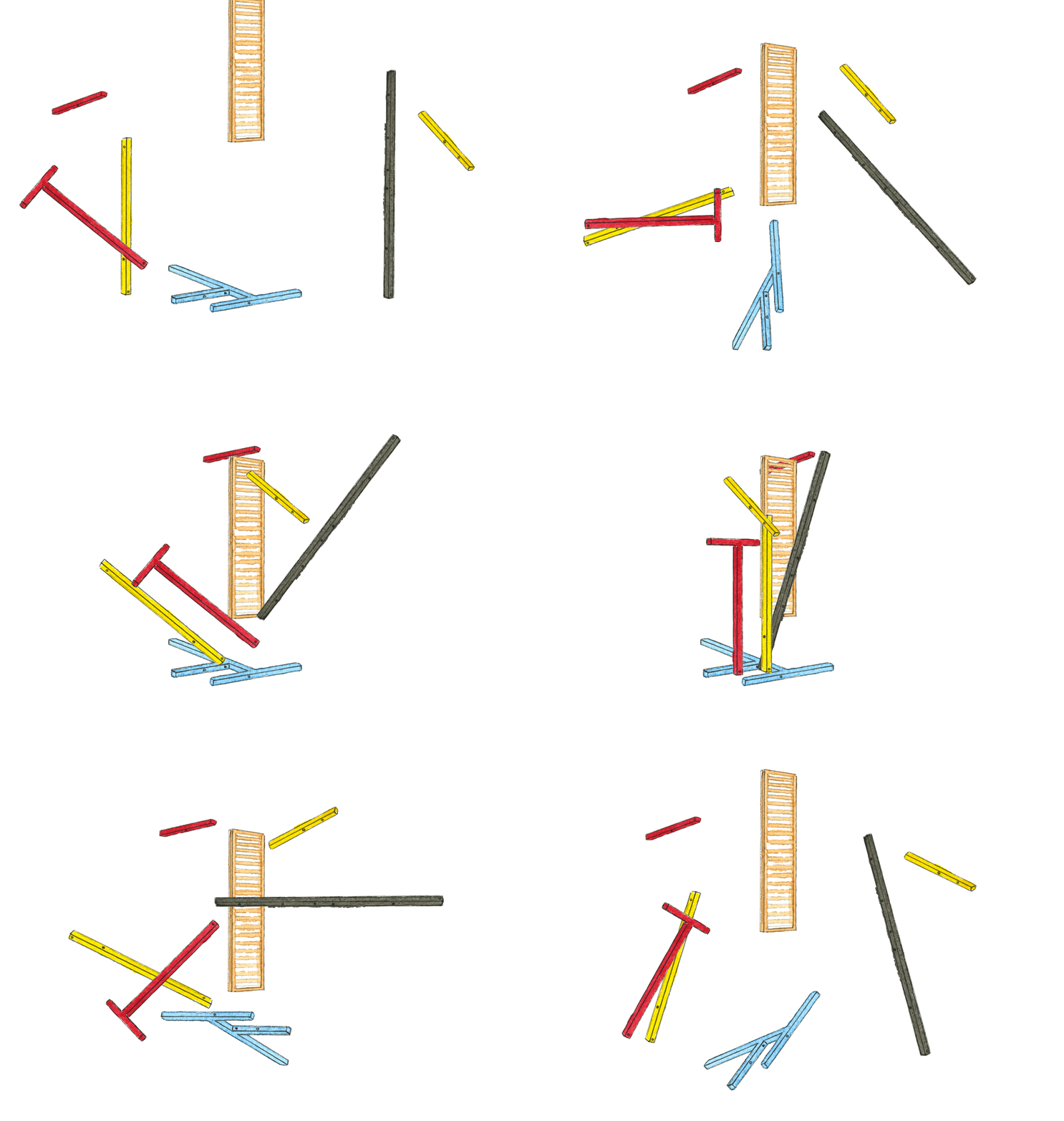
Wade’s practise and research challenges the nature and understanding of art’s primary function as an exhibition. His work expands the artist-curator role through his development of new systems of display. These draw on historical precedents creating sculptural mediations between artists, curators, and publics. He proposes transformative artworks as social systems and temporal experiences, always requiring collaboration with others. Drawing from studies of ‘useful art’, ‘artist and engineering’, ‘support structures’ (Condorelli and Wade, 2009) and referencing Artist Placement Group’s concept ‘context is half the work’, his output informs understandings of ‘when artists curate’ (Green, 2018) and the ‘transhistorical museum’ (Demeester, 2018).
Wade’s remodelling and extending of a series of ‘Display Units’ use a process of ‘upcycling’, a term Wade uses to describe his method. In 2015 Wade started developing artworks upcycled from the ‘L and T–Type Display Units’ (Frederick Kiesler,1924) and referencing the ‘Vienna Secession Mobile Wall System’ (Adolf Krischanitz,1986). Wade’s synthesizing method is generating a new A–Z alphabet Display Unit system as part of the process of re-imagining curatorial activities as a form of art practice. His Upcycle This Book (2017), nominated for the European Prix Bob Calle du livre d’artiste, presents 26 texts on this work and 12 Display Unit drawings.
Wade created Display Units for ‘Display Show’(2015), exhibited in Dublin, Birmingham and Netherlands – funded by ACE/British Council International Artists Development Award. Christopher Williams (USA), Eilis McDonald (IRE) and Leeds Weirdo Club (UK) were collaborating artists.
Wade worked with Frans Hals Museum collection to create ‘Z is for ZOO’ (2017) exploring the transhistorical potential of his ‘Z-Type’ and ‘T-Type’ Display Units, artworks purchased by the museum.
His writing for ‘Display Show’ provided the provocation for ‘That Art Exhibits’: EARN Conference, Brussels (2016). Wade was the invited keynote speaker.
Otherlands
(2020)
author(s): Jacqueline Taylor
published in: Research Catalogue
‘Otherlands’ is an interdisciplinary and collaborative project traversing visual art, linguistics, psychoanalysis and philosophy. It interrogates Julia Kristeva’s concepts of abjection and the semiotic as pre-linguistic markers and their potential to articulate ‘otherness’ in visual art. Whilst Kristeva’s thinking is revolutionary in conceptualising dimensions of experience ‘beyond’ language and representation as vital to the signifying process, its application in aesthetic practice is limited. Those art practices that have engaged with abjection and the semiotic rely on representational strategies and thus undermine their very definition.
Otherlands demonstrates that it is only where representational structures are disrupted towards the place where meaning collapses that abjection can function as ‘abjection’ in art practice, in turn articulating modalities of ‘othering’ as part of an alternative signifying process. Understood via a new theory of ‘intermateriality’ developed by the researcher, Otherlands offers for the first time vital new ways of understanding meaning-making in art practice that shifts from representational and visual economies of signification to the material, performative, affective and intersubjective dimensions of art.
Informed by an eight-year corpus of practice-led research, Otherlands was developed collaboratively through 12 months of rigorously testing ideas. This included textual analysis, an on-site curatorial residency (University of Memphis), field visits to examine ‘othering’ in selected cultural sites, interviews with key practitioners and scholars, and feedback gathered at the Otherlands exhibition and live event at the Kristeva Circle annual conference, Memphis (prestigious interdisciplinary platform for world-leading Kristeva scholars). The work was blind peer-reviewed by the Kristeva Circle directors and Art Museum University of Memphis curatorial committee.
The research includes a two-person exhibition with award-winning artist Georgia MacGuire, curatorial essay by Kristeva expert Professor Estelle Barrett and major live performative event. The research is simultaneously all these outputs, understood via the interrelations between its different parts as an ‘other’ form of signification.
Learning from a vocal approach on music
(2020)
author(s): Sophie Elisabeth Ehling
published in: Codarts
When we speak, there is rhythm, intonation and expression in the words that we choose. When we sing, a melody is added, the story surrounded by musical context. When I play the cello, I can express feelings, thoughts and stories without using any words.
I based my research on the relation between language and music, because I wanted to know how to be more expressive in my cello playing. Singers have the text to guide them into making clear what the story is about. As instrumentalists, we might not use words during a performance, but we can definitely learn from involving vocal elements into our approach to music.
That is why I consulted experts in the German, French and English language, as well as singers and cellists, to guide me in my process of making an ‘instrumental translation’ of vocal repertoire, in order to broaden my spectrum of possibilities to be expressive. Based on the results of desk research, text and score analysis, interviews and work sessions with the experts and experimentation on the cello, I made a comparison that led me towards the final result, recording the third movement of César Franck’s sonata, a piece in which I could put a lot of the new things that I had learned.
I hope that this research can assist anyone who is looking for a way to become more ‘outspoken’ in their instrumental playing, and to stimulate instrumentalists to always stay open for new ways to interpret a piece.
Biomimetics, Color and the Arts
(2020)
author(s): F M Schenk
published in: Research Catalogue
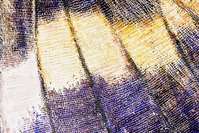
This research is located at the intersection of fine art and scientific developments in optical nanomaterials. Schenk’s work explores the application of the science of mimesis and bio-optics in contemporary painting. Using biomimetic methodologies and iridescent substances, she has innovated studio-based techniques to create image viewing experiences until now only seen in nature.
Experimentation led to new processes informed by extensive investigation into the physics of natural phenomena, e.g. the dazzling iridescent colouration of certain insects and birds. Taking inspiration from these unique phenomena, the researcher introduces optical dynamism into painting, via the novel exploitation of iridescent pigment, allowing her to capture the process of oscillation between permanence and the ephemeral, the recognizable and the obscure. The characteristics of the nanomaterials deployed demanded the development of particular processes for achieving target affects. These involved blending conventional studio practices (pigment mixing, under-painting, glaze application, etc.) with new approaches devised for handling these challenging special media. Applying these new approaches enables colour shifting visual effects, previously unobtainable with conventional studio pigments, offering the means to catapult painting into the nano-age.
Complementing the scientifically informed and laboratory-based dimensions of the work, these transformative methods have been advanced through their application in the researcher’s own artistic practice. A series of paintings deploying these methods have been exhibited.
The underpinning science and novel application process developed to adopt nanomaterials in painting have been disseminated through conference presentations and refereed journals, e.g. invited papers, together with selected artworks, were presented at SPIE, San Diego (‘Biomimetics, Colour and the Arts’, 2015) and the Max Planck Institute, Dresden (‘Towards Smarter Art’, 2019). Also see the article with Prof Stavenga, University of Groningen, published by Faraday Discussion Journal (2020) and debated at the Royal Society of Chemistry’s international Faraday Discussion. Schenk’s artwork is on the cover.