Man's struggle for salvation: A programmatic interpretation of Franz Liszt's B minor Sonata
(2023)
author(s): Leone Monaco
published in: KC Research Portal
Research question: “What can be learned about the programmatic relationship between Franz Liszt’s B Minor Piano Sonata and its programs?”
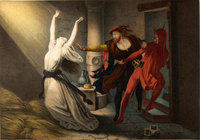
My research started as an investigation of the traditional programmatic relationship between Franz Liszt B minor Piano Sonata and Goethe’s Faust, but it had an unexpected outcome: Liszt B minor Sonata can be programmatically connected to multiple programs at the same time. Through the study of symbols behind themes and harmonies used by the composer, connections with other compositions, and the composer’s notes and letters, my research explains why and how the Sonata is programmatically inspired by Goethe’s Faust, Milton’s Paradise Lost and the Bible not only in its structure, but also from a philosophical and spiritual point of view.
I propose to look at the Sonata in a different way, considering a more general and Christian “leading thought” which connects all its possible programs and permeates the whole work: Liszt’s Sonata tells the story of every man and his lifetime struggle against temptations and damnation to reach salvation. At the end, I give practical suggestions on the interpretation of specific passages of the Sonata based on the considered symbolic connections with its programs and composer’s notes.
The chosen format of presentation is the exposition, because it gives me the possibility not only to include explanatory pictures and score excerpts, but also to use my own recordings to explain better the symbolism of themes or harmonies in certain passages and to show the practical and interpretive outcomes of my research.
Felipe Libón, the first travelling Spanish Virtuoso and his Violin Concerto No.6 (1812). A Performance Practice case study: I. Poco Allegro
(2023)
author(s): Saya Ikenoya
published in: KC Research Portal
One of the first Spanish virtuoso violinists to achieve international recognition, Felipe Libón enjoyed a successful performing and composing career.
He worked and performed alongside other celebrated violinists: Rode, Kreutzer, and Baillot, who were founders of the so-called "19th Century French Violin School".
We will experiment with applying the extensive indications of the treatises (Baillot, Campagnoli, Woldemar, Spohr, Cartier, and Libón himself) to build a performance practice case study.

The Voice in Arranging - Rethinking the role of vocalists in big bands and large ensembles
(2023)
author(s): Giulia Bättig
published in: KC Research Portal
This research explores how the voice can be used creatively in large ensembles and big
bands. It is structured in five parts, starting with an introduction explaining my interest and
personal connection to this topic. I then analyzed the work of composers and arrangers that
used vocalists in their large ensembles before me - for example Kenny Wheeler, John
Hollenbeck and Martin Fondse. There I looked at how they used vocalists in their works and
found that oftentimes, the voice still is used as a doubling part for the lead melody, but
seldomly is used as an independent part in the arrangements.
I then moved on to analyzing my own compositions I’ve written for a vocal section and large
ensemble. I saw that I unconsciously often used the same kind of arrangement style, and
drew a lot of conclusions for my future works out of this analysis. In part four, I compiled my
research of others and my own work into a small handbook of arranging tools for big band
and voice section. With this, I want to inspire other composers and arrangers to write for
vocalists in new and creative ways. After this, I concluded my research with a reflection and
conclusion in the last part.
In my presentation, I want to talk about my progress working with others and my own music,
and the conclusions I drew out of it, as well as showing some examples of my analysis and
the handbook I wrote.

Mindfulness for violinists
(2023)
author(s): Sacha Paredes Sánchez
published in: KC Research Portal
An overabundance of mental distractions may prevent musicians’ minds from being in the moment while practicing. The present mixed-methods study examined the effects of three newly designed mindfulness meditations on six conservatory violinists’ levels of dispositional mindfulness, mind-wandering and respective variables. Thought probes were used before and after the intervention to examine frequency of mind-wandering and contextual variables (task difficulty, fatigue and stress, and motivation) during two hours of participants’ instrumental practice (one of technical work another of a new piece in their repertoire). FFQM (Five Facet Mindfulness Questionnaire) and MfM (Mindfulness for Musicians) questionnaires were used to measure mindfulness levels before and after the intervention. Interviews and meditation logs were used as qualitative data. Results indicated that all participants became more mindful at the end of the meditation week for all mindfulness’ facets for the FFQM and MfM questionnaires. However, the improvements were particularly noticeable for the “Acting with Awareness” and “Non-Judge” facets for the FFQM and for “Describe” in the MfM. Results showed opposing trends in mind-wandering levels throughout the intervention. That is, some participants showed higher mind-wandering at the post-intervention and others lower. However, contextual variables such as fatigue, motivation or worry, may have also affected how much participants wandered while practicing (e.g. some of them showed more rumination when being more worried and having slept less). Overall, results from the experiment evidenced the importance of including mindfulness in violinists’ daily practice as a useful routine to become more aware and less distracted.

Percussion Meets Environmentalism: A method of performance for environmental awareness
(2023)
author(s): Porter Ellerman
published in: KC Research Portal
The well-documented climate crisis often looms over our daily lives. As an artist, I often felt frustrated by not possessing tangible means to enact change to help. This research is, therefore, a base for further investigations and performances geared toward percussion-based environmentalism. By examining four distinct pieces selected for their connection, or their possibility to connect to broad or specific environmental issues, and altering variables of performance location, instrumentation, personnel, and the addition of contextual material, this exposition demonstrates one path of many for environmental advocation in music. By focusing on decisions affecting sound creation and including context or subtext within each piece, this exposition gives the reasoning behind the decisions made in each piece’s performance based on modern musical activism and theories of promoting positive behaviors. This research also examines modern musical activism in popular music and the emerging contemporary genre of ecoacoustics. The conclusions of this exposition present the benefits of flexibility and creativity in this method and the importance of audience engagement while addressing the drawbacks of this method in the challenge of behaving sustainably as a modern artist. Lastly, this research highlights the possibility of community interaction to create small-scale environmental change that is also a creative outlet for the emotional impact climate change can have on individuals.
An Investigation of Eastern Cultural Influences in the Classical Guitar Solo Repertoire.
(2023)
author(s): Samrat Majumder
published in: KC Research Portal
Can Eastern cultures become a more integral part of the classical guitar’s cultural identity through repertoire influenced by these cultures?
In this research exposition, I explore the ways in which cultural elements from Eastern cultures may inspire repertoire for the solo classical guitar. Through this repertoire, I shall examine how such cultural influences may promote Eastern cultures to performers and audiences of the classical guitar. In doing so, the cultural horizons of the classical guitar world may be broadened to represent a greater variety of cultures that also mirrors the growing global community of the classical guitar.
In Part I, I look at some of the pre-existing works that have been influenced by Eastern cultures including works by Toru Takemitsu; arrangements of popular and folkloric music from Eastern cultures; and original compositions that have influences from Eastern cultures. Part II deals with the ethics of cultural inspiration and looks at questions like: “How can we represent cultures authentically through music?”, “Is cultural appropriation ok?”. Finally, Part III presents an overview of the new repertoire specifically written for this research. This comprises of two arrangements of songs attributed to the Bengali polymath, Rabindranath Tagore, as well as a commissioned work with an Eastern cultural influence composed by Italian composer and classical guitarist, Marco Ramelli.
The findings of this research reveal the difficulty of assigning an objective answer to the issues surrounding cultural inspiration. I implore readers to approach this research with an open mind and hope that, at the very least, I can encourage the musical community to consider different types of questions concerning the use of cultural elements in art.