The art of the violin in Verdiales
(2023)
author(s): María Estela Lastre Castillo
published in: KC Research Portal
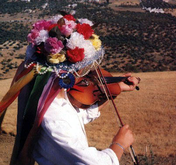
Verdiales is the traditional music from Málaga, Spain, which is little known even within Spain. This research places verdiales in its historical and musical context looking at: the differences between styles, rhythm and harmony, and, most importantly, the role of the violin in this music.
As the main instrument in verdiales, the violin is played in a very different way than in classical music, since it is spontaneous music with a great deal of freedom for improvisation, disseminated purely by oral transmission, and with a particular technique which is suited to playing only this music.
Through the deep learning of verdiales, I have looked for different resources to face my daily practice issues in order to gain more flexibility and freedom in my way of playing. After trying several exercises and approaches in different parts of my practice, I have been self- documenting and verifying the improvement and effectiveness of certain methods, taking into account different aspects such as bow hold, ornamentation, and improvisation. As a result, I came to the conclusion that in order to achieve different results, it is necessary for more exploration and extremely different methods than the ones I have been using when practicing the violin
The use of the horn in the late orchestral works by Robert Schumann
(2023)
author(s): Márton Kóródi
published in: KC Research Portal
When I played a Schumann piece, Genoveva Overture, for the first time, I was wondering, because there were Ventilhorn and Waldhorn parts. I could not imagine what his idea was when he wrote for four horns, but still used two different kinds of the same instrument. Did he want to express something with this set-up? Beside this, I did not understand why he, and other romantic composers, use so much transposition when they had already a completely chromatic instrument.
As I started to get to know and play the natural horn, it was getting clearer what his intention could have been. Why he used an ‘ancient’ instrument, though he could compose for four chromatic horns. This made me even more interested, and I also got more questions and hypotheses about the topic, for what I wanted to find an answer.
In my research, I tried to get to know the use of the horn in the middle of the 19th century. I wanted to get familiar with the contemporaries’ imagination about the old and new instrument, and with the way how they used them. Then, with this knowledge, I analysed Schumann’s orchestral works, especially the horn parts, and tried to find out if the results are matching with the background research.
My aim was too, show the horn players, that the romantic horn playing is not only about the ‘holy’ valve horn, but something more complex and colourful.
Connections; The artistic process of creating a multimedia performance
(2023)
author(s): Mia Kogelman
published in: KC Research Portal
Connections; The artistic process of creating a multimedia performance
Just Do It! Exploring the musician's (use of) bodily performance
(2023)
author(s): Andreas Borregaard
published in: Norwegian Academy of Music
In the 21st century an increasing number of composers and performers include elements in their work that activate the musicians’ voice and body in ways not related to playing an instrument.
The musician’s moving, dancing, touching, speaking, singing, shouting, grimacing, sounding body opens an novel and still expanding palette of expression – but its use also requires new skills that are currently not an explicit part of higher musical education or standard musical performance practice.
Just Do It! is an artistic research project that seeks to explore the possibilities of bodily performance in an expanded field of music and to detect, define and describe some of the skills and knowledge needed to realize them. The project’s practice-based methodology is rooted in the creation of five new solo pieces for accordion and body and a concerto for ensemble and accordionist written by James Black, Marcela Lucatelli, Philip Venables/Ted Hufmann, Jennifer Walshe, Louise Alenius and Andreas Borregaard.
Pause in Nature, then Carry on with Hope
(2023)
author(s): Vija Anna Moore
published in: Research Catalogue
In this project, I set out to investigate and increase my understanding of the ways in which art and music can be used to give us the strength to process difficult emotions arising from complex societal issues and injustices. In psychology, artistic processes can be seen as a way of bridging the external world with the artist's internal world, thereby creating individual logic and organised chaos. (Kogan, 2018; Stratou, 2014; Hagman, 2010). Creating art is a process of the artist processing the outer world within their inner world and channelling the combined emotions into a form of artistic expression, (Stratou, 2014; Kogan, 2018; Hagman, 2010) which, in my case, is music.
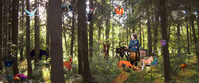
With my current work, the creation process itself takes place in the forest because to me, that is a space that balances the complex and at times overwhelming external world and my internal world. By going into the forest I become immersed in the natural external world, rather than composing conceptual ideas of music in a practice room, isolated from the multi-sensual external world. As a consequence, the natural environment of the forest provided rich inspiration for composing music, providing stability and calm between my inner world and current external complexities. Urban landscapes and nature provide a haven for people in urban environments, especially those living in apartments, such as myself (Tan, Liao, Hwang, & Chua, 2018).
Throughout the project I uncovered new reflections and discoveries about moral responsibility following my research question of: How can art and music enable us to process difficult societal issues, emotions and give us hope?
Hugging Atmospheres
(2023)
author(s): Elena Mooibroek
published in: Research Catalogue
The main question around this research paper is how can we translate ambiances? This ungraspable ‘something’? What is our relationship with the atmosphere of spaces that brings out our emotional state? Can we characterize atmospheres by simply giving them names? Giving them a place for their selves to develop.
I researched six certain atmospheres, Masculinity, Sound, Death, Warmth, Lust, and Serenity. They are the ones that I went through most recently before writing this research paper. I wanted them to all come together and hopefully come across an answer on how they might be useful in day-to-day life as an artist in creating art, but also in general, can we understand each other better while talking about them? They are unseen yet as important as our imagination.
Hoping for a translation of the ungraspable ‘something’. Into moments of poetry and storytelling to get a grip on where they touch each other. Giving them a platform/to create a world where atmospheres/ambiances are more visible. To have conversations with them to create an understanding of what they mean. And how they would look like. Along the way I figured, one can not stand on one’s self, they are all in need of the other. Which seems like a reflection of our reality.