[in]visible_seeing the invisible
(2024)
author(s): Margarida Dias, Maria Lurdes Gomes
published in: i2ADS - Research Institute in Art, Design and Society
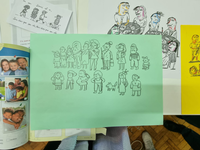
On March 14th 2023 took place the 1st seminar, "Seeing the invisible" of the project "[in]visible - [in]visibility of identities in Portuguese 1st-grade elementary textbooks of Social & Environmental Studies after 1974", at the Faculty of Fine Arts of the University of Porto (Portugal). For the reflection and critical analysis of the illustration works, there was the participation of the illustrators Júlio Dolbeth, Rui Vitorino Santos, Samuel Moura, the guests Catarina Casais, Daniela Fraga Gomes, Inês Capelo, Joana Carneiro, and in addition to the team, the external consultant Fernando Hernández-Hernández (U. Barcelona). Cristina Ferreira and Fabrício Fava took photographs. Through practical and creative proposals, the seminar aimed to think and problematize the illustration in 1st-grade elementary Social & Environmental Studies textbooks published in Portugal in the last 2 decades.

[in]visible_thinking about identities in textbooks
(2024)
author(s): Catarina Casais, Margarida Dias
published in: i2ADS - Research Institute in Art, Design and Society
The communication and workshop “Thinking about (in)visible Identities in Textbooks” of the [in]visible project [2022.05056.PTDC] took place on November 17, 2023 at the School of Communication and Arts of Eduardo Mondlane University (ECA/UEM), in Maputo (Mozambique), organised by margarida dias. The workshop, part of the 8ei_ea - INTERNATIONAL MEETING on ARTS EDUCATION (https://eiea.fba.up.pt/2023/), was attended by approximately 50 people from Mozambique, Brazil, and Portugal, and was supported by José Carlos de Paiva, Paulo Nogueira, and David Neves.
After the presentation, seven working groups were formed. Six groups analysed Portuguese textbooks for Social & Environmental Studies, and one group analysed a Mozambican textbook for Portuguese-Mathematics. All the textbooks were for the 1st year and were being used in schools during the 2023/2024 school year. First, each group analysed one textbook, and then they shared their analyses and comments with all the participants.
Auctor incertus: Issues of authorship and anonymity around Missa Inviolata (ca. 1520s)
(2024)
author(s): Isaac Alonso de Molina
published in: KC Research Portal
A six-part polyphonic setting of the ordinary of the Mass survives as a unicum in manuscript 1967 of the Biblioteca Central de Barcelona, Spain. Although it is clearly the most significant piece in the manuscript, it has received considerably less attention from specialized ensembles than the rest of the repertoire contained therein. This may be due to several factors, chief among them being that the manuscript provides no indication of the composer’s identity. Such anonymity is quite common when dealing with early repertoires. This research aims to address this situation critically and offer several practical, performer-oriented strategies to overcome it.
Úkol
(2024)
author(s): Andrew Novák
published in: Research Catalogue
Úkol do Audiovizuálního praktika
SUPER(IM)POSITIONS: Subverting Melodramatic Representation Through Personal Unpredictability
(2024)
author(s): Emilio Santoyo
published in: Research Catalogue
This Artistic Research in and through cinema explores the possibilities of using outdated melodramatic elements of cinematic representation in a new way, dissolving the intersection between the personal and the fictional as a tool for creating a redemptive act of filmmaking. "Super (im) positions: Subverting melodramatic representation through personal unpredictability" delves into the transformative potential of these elements within cinematic representation. By dissolving the boundaries between the personal and the fictional, this work engages in a redemptive act of filmmaking that reimagines melodrama. The approach employs a contemporary, polyphonic, and playful film language to propose a new form of melodrama—one that acknowledges its inherent perversity to challenge and deconstruct its toxic narratives.
Rooted in the pervasive influence of telenovelas and melodrama, particularly within Mexican culture, this exploration questions and critiques the genre's impact on cultural and individual perceptions of love and relationships. The research was catalysed by a significant personal and professional rupture, leading to a critical examination of the genre's conventions.
By employing a contemporary, polyphonic, and playful film language, Santoyo reimagines melodrama as a genre capable of portraying complex, personal emotions and generating critical, boundary-pushing narratives. This self-reflective genre deviation, temporarily termed the "New Melodrama," seeks to subvert traditional melodramatic tropes by acknowledging and confronting their perverse nature. Through this approach, Santoyo aims to dismantle the toxic knowledge perpetuated by conventional melodrama, offering a sophisticated and nuanced critique from within the genre itself. His work presents a trojan horse strategy, using the familiar systems of melodramatic representation to question and ultimately transform them, proposing a relevant and self-aware cinematic experience.
Through innovative use of superimpositions and a deliberate deconstruction of melodramatic mise-en-scène, this study aims to create a critical and self-reflective genre deviation termed "New Melodrama." This method seeks to subvert traditional cinematic conventions by integrating multiple perspectives and temporalities, fostering a richer, more complex narrative experience. Ultimately, the research stands as a trojan horse within the film industry, using the very mechanics of melodrama to critique and reinvent it, offering a fresh, introspective take on a genre often dismissed as superficial.


