
CCC at the mdw: Interweaving Artistic and Musicological Exploration at Music University
(2024)
author(s): Chanda VanderHart, Judith Kopecky
published in: Research Catalogue
Even at one of the world's oldest and largest music universities, the mdw - University of Music and Performing Arts in Vienna, the siloing of fields is the norm. Thanks to budgetary and organizational structures, it is rare that artistic practice and traditional musicology teaching are actively combined; what conservatory students learn in music history seminars and what they learn from their performance teachers exist largely separately from each other.
This exposition documents an ongoing, pragmatic attempt to interweave traditional music research with artistic practice and interventions, thereby introducing students to Artistic Research at bachelor's and master's levels. The CCC (Content-Concept-Context) module was initiated by Judith Kopecky at the Antonio Salieri Department of Vocal Studies and Vocal Research in Music Education and has enjoyed cooperation with the Institute for Musicology and Performance Studies (IMI) for the past three years. Here she, Stephen Delaney and Chanda VanderHart reflect on the promises, surprises, limits, and potential for intertwining scholarship and artistic practice in an institutional setting.
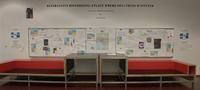
Alternative Histori[es]: A Place Where Something Happened
(2024)
author(s): Eliot Moleba
published in: Research Catalogue
Abstract
This artistic research project focuses on narrative accounts of Norwegians who self-identify with a ‘multicultural and/or immigration background(s)’, to explore how their (hi)stories can be woven into the tapestry of the contemporary Norwegian public memory and story. I set out to interview and collect their narrative accounts, which must also be understood as oral (topical) histories, focusing on (hi)stories of their lived experiences, with a special interest in an event that happened in a public space and has been experienced as a meaningful or life-changing moment. Through a collaborative process, the oral (hi)stories were transformed and used to produce interactive monuments installed on the sites where the narrated events took place.
One of the key artistic challenges in the project was to grapple with the question of how not only the collaborators but also the public can be empowered to actively shape and engage with artistic works, becoming co-collaborators themselves.
This artistic inquiry led to the development of monu(mo)ments, an artistic concept and initiative that is dedicated to turning stories of Norway’s diversity into interactive, performative works of public art. The monu(mo)ments are not just symbols of collective memory but embody that very concept in how they themselves function. Through an interactive/participatory design, the public is invited to contribute their own narratives, perspectives, and experiences, shaping the monu(mo)ment's meaning and relevance. They invite the public to become co-creators of the narratives embedded within their communal spaces, fostering a sense of ownership and agency, and blurring the boundaries between artist(s) and public, the past and the present.
The project strives to illuminate the untold oral (hi)stories of these narrators by allowing them to take over public spaces and infuse them with gripping personal narratives to shift how we read those places and (re)negotiate their past/meaning. This is to create an ‘alternative history’, dedicated to writing and inscribing these voices into public spaces and our broader collective imagination.
Other artistic results include a live-action role-playing game (LARP). Furthermore, the larp was modified to serve as a resource for educators, enabling them to address interconnected themes within their classrooms through immersive gameplay. It has been performed in schools, festivals, and conferences in Norway, Austria, and Denmark.
Overall, by creating artistic works that (re)imagining public memory as a dynamic and interactive process, this artistic research project foregrounds and contributes to the ongoing efforts to capture and reflect Norway’s multicultural reality and identity.
No Show
(2024)
author(s): Steinunn Knúts Önnudóttir
published in: Research Catalogue
This exposition contains six letters about the work No-Show that was performed in Reykjavík in 2020. The performance is a part of the artistic PhD research "How Little is Enough?" Sustainable Methods of Performance for Transformative Encounters in Malmö Theatre Academy at Lund University. The letters address different aspects of my artistic practice and research such as motivation, method, affect, ethics and the findings.
No Show is a series of five immersive participatory performances, solitary experiences performed in five private homes in different neighbourhoods of Reykjavík in June – August 2020.
Crafting desire : Queering the artefact
(2024)
author(s): Rising Lai
published in: Royal Academy of Art, The Hague
Thesis of the Royal Academy of Art, The Hague, 2022
Master Interior Architecture (INSIDE)

Biases, glitches and oppressive values or a happy domesticity: starting from my grandmother’s house
(2024)
author(s): Georgia (Georgina) Pantazopoulou
published in: Royal Academy of Art, The Hague
Thesis of the Royal Academy of Art, The Hague, 2022
Master Interior Architecture (INSIDE)
Intimacy is found where the individual feels comfortable expressing, creating and existing. Our home, the domestic environment, teaches us every day, from the moment we are born, how to exist in a place that often functions as a miniature of the social and cultural system that we will later live in. This relationship continues throughout most of our lives if one considers that we spend more than half of our lives within the domestic realm. This of course does not only concern the relationship that is developed between the space and the people who inhabit it, but also all those elements that make up these interrelated relationships and often define them. Standards, values, cliches, traditions, norms and stereotype patterns are often found in a big part of our daily lives within the domestic environment. Meanwhile, each individual creates their own space of familiar interpersonal encounters.
Foreword reposition #2
(2024)
author(s): Alexander Damianisch
published in: University of Applied Arts Vienna
Foreword by Alexander Damianisch, Project Lead and Editorial
reposition is a support project for research documentation and offers researchers of all disciplines and departments at the Angewandte the opportunity to publish their work according to peer-review principles. Colleagues of any level and doctoral students in arts and sciences are invited to share their work.
This series showcases their diverse approaches to project-oriented research work and presents current insights, captivating research processes, and ongoing projects from a deeply personal perspective that courageously unearth the work-in-progress.
The idea of reposition is to emphasise dynamic approaches that demonstrate the courage to adopt alternative perspectives and a focus that lies always on a dialogue in-between.


