Pause in Nature, then Carry on with Hope
(2023)
author(s): Vija Anna Moore
published in: Research Catalogue
In this project, I set out to investigate and increase my understanding of the ways in which art and music can be used to give us the strength to process difficult emotions arising from complex societal issues and injustices. In psychology, artistic processes can be seen as a way of bridging the external world with the artist's internal world, thereby creating individual logic and organised chaos. (Kogan, 2018; Stratou, 2014; Hagman, 2010). Creating art is a process of the artist processing the outer world within their inner world and channelling the combined emotions into a form of artistic expression, (Stratou, 2014; Kogan, 2018; Hagman, 2010) which, in my case, is music.
With my current work, the creation process itself takes place in the forest because to me, that is a space that balances the complex and at times overwhelming external world and my internal world. By going into the forest I become immersed in the natural external world, rather than composing conceptual ideas of music in a practice room, isolated from the multi-sensual external world. As a consequence, the natural environment of the forest provided rich inspiration for composing music, providing stability and calm between my inner world and current external complexities. Urban landscapes and nature provide a haven for people in urban environments, especially those living in apartments, such as myself (Tan, Liao, Hwang, & Chua, 2018).
Throughout the project I uncovered new reflections and discoveries about moral responsibility following my research question of: How can art and music enable us to process difficult societal issues, emotions and give us hope?
Hugging Atmospheres
(2023)
author(s): Elena Mooibroek
published in: Research Catalogue
The main question around this research paper is how can we translate ambiances? This ungraspable ‘something’? What is our relationship with the atmosphere of spaces that brings out our emotional state? Can we characterize atmospheres by simply giving them names? Giving them a place for their selves to develop.
I researched six certain atmospheres, Masculinity, Sound, Death, Warmth, Lust, and Serenity. They are the ones that I went through most recently before writing this research paper. I wanted them to all come together and hopefully come across an answer on how they might be useful in day-to-day life as an artist in creating art, but also in general, can we understand each other better while talking about them? They are unseen yet as important as our imagination.
Hoping for a translation of the ungraspable ‘something’. Into moments of poetry and storytelling to get a grip on where they touch each other. Giving them a platform/to create a world where atmospheres/ambiances are more visible. To have conversations with them to create an understanding of what they mean. And how they would look like. Along the way I figured, one can not stand on one’s self, they are all in need of the other. Which seems like a reflection of our reality.
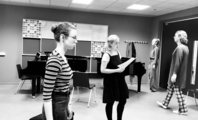
Michael Chekhov’s acting technique through the lens of a classical singer
(2023)
author(s): Vera Hjördís Matsdóttir
published in: KC Research Portal
Research questions:
1. In what ways is Michael Chekhov’s acting technique beneficial to classical singers portraying characters from operas in terms of the aspect of interpretation and acting, the aspect of mental preparation before a performance and the aspect of vocal projection?
2. Are there specific concepts of the technique that are especially relevant to classical singers and why?
Summary of the results of the research:
In terms of interpretation and acting, Michael Chekhov’s acting technique turned out to be very helpful to the singers. By exercising Chekhov’s concept, they acquired a sense of clarity to their character and a physical and psychological understanding.
In terms of mental preparation, the singers felt like they gained tools in calming the mind, achieving a feeling of ease. And that in general, by moving the focus from the intellectual and to the body is a great antidote for nervousness.
In terms of vocal projection, all the singers agreed that their vocal performance improved when they sang their aria the second time when they implemented Chekhov’s elements while performing the aria.
There were differences of opinion among the singers as to which concepts of Chekhov’s were the most beneficial. Questionnaire and discussions though brought to light that the quality of radiation and the feeling of ease appealed particularly well to the singers. I believe that the reason for that is that these qualities create an ideal physical state to sing. The feeling of ease creates a sense of ground, openness, calmness and at the same time alertness. The quality of radiation gives off a strong feeling of confidence, power, and freedom. The act of singing requires physical strength but without creating excessive tension in the body. Healthy singing requires being both firm and soft, which is achieved with both concepts.

HMV_II
(2023)
author(s): Catarina Braga
published in: i2ADS - Research Institute in Art, Design and Society
Fragments of an investigation carried out at the end of the 21st century get intermixed with the invisibility of the object of study — indoor air.
From a speculative practice between the scientific process, the artistic process and the affective, political, social and cultural process that we create with the things of the world, the appearance of a new body is proposed. It is inside a fictionalised laboratory that we get to see this collective, symbiotic and ancestral organism; a multispecies entity that transcends the borders between terrestrial bodies (mineral, human, vegetal, animal, technological) and time and space.
The exhibition and work being presented here is the result of the artist's residency with the LEPABE laboratory team of Environmental Sciences and Technologies (FEUP), which investigates and measures indoor air quality, studying its impact on human health.
This work is a result of project 2SMART, engineered Smart materials for Smart citizens, with reference NORTE-01-0145-FEDER-000054, supported by Norte Portugal Regional Operational Programme (NORTE 2020), under the PORTUGAL 2020 Partnership Agreement, through the European Regional Development Fund (ERDF).

(Des)Aceleração
(2023)
author(s): André Rangel
published in: i2ADS - Research Institute in Art, Design and Society
(Des)Aceleração is a relational system between coherent light, bioactive molecules, velocity, glass, photoluminescence, volume, surface, algorithm and programming, in continuous variation. It is the outcome of a residency in which a dynamic intermedia system was created, articulating knowledge from a spectrum of activities and configuring conditions for a spatial, optical and chromatic experience.
The computer-controlled movement of the light beam, combined with the idiosyncrasies of the glasses, their heterogeneity, and that of the riboflavin, produces indeterminable phenomena of projection, reflection, refraction, and dispersion of light. In this system, coherent light ceases to be coherent. The laser beam is not used as a stylus but produces a visual experience that results from the coincidence of the predicted and determined with the unforeseen and indeterminate, of order with chaos.
This work is a result of project 2SMART, engineered Smart materials for Smart citizens, with reference NORTE-01-0145-FEDER-000054, supported by Norte Portugal Regional Operational Programme (NORTE 2020), under the PORTUGAL 2020 Partnership Agreement, through the European Regional Development Fund (ERDF).
Villivirrestä Virsileikkiin: Virren luomisesta luovaan virteen_Tutkielma_videolinkit
(2023)
author(s): Sirkku Rintamäki
published in: University of the Arts Helsinki
Sirkku Rintamäen taiteellisen tohtorintutkinnon tutkielmaan "Villivirrestä Virsileikkiin: Virren luomisesta luovaan virteen" kuuluvat videolinkit.
Video links of Sirkku Rintamäki's doctoral thesis "From Wild Hymns to Hymnplay: From Hymn Creation to the Creative Hymn"