När vi ses och Hur gör vi med publikinsläppet?
(2023)
author(s): Karin Bergstrand
published in: Stockholm University of the Arts (SKH)
This exhibition shows my project from the Master in Acting 2021-2023 at SKH in Stockholm.
The essay is called "When we meet" and the performative part "How do we let the audience in?"
As an actor and clown, I have worked in many different rooms and with many different audience agreements. Everything from stage-salon situations where the audience knows exactly how to behave and what their participation looks like, to playing for only one person in a hospital bed or in a small rowing boat, where participation must be clearly negotiated and communicated. I've met adults who are world masters of theater etiquette, but can't answer a question if asked from the stage, and I've met children who are wild first-timers who engage in intense dialogue with us on stage.
I am interested in the dialogue between actors and audience and in audience participation. What standards and agreements are they regulated by? How does the fear of making a mistake, breaking the norm, affect the experience of the performance? Does that fear of shame limit what is possible in the theater?
I have also wondered what roles the audience can have, what in a work communicates this role, and whether the audience can change roles in the same work.
In "How do we let the audience in?" you can read about the work with Eva and Margaretha, two half-masks who are both actors but in whose artistry the audience plays very different roles.

Saverio Mercadante and the Neapolitan flute school of the early 19th century. A dramma buffo on the historically informed approach
(2023)
author(s): Enrico Coden
published in: KC Research Portal
Mercadante’s flute works are among the most beloved 19th-century Italian compositions for this instrument. So far, no study has been undertaken to develop a specific historically informed performance practice for them.
In order to do so, I first analysed the Italian flute history in the first half of the 19th century, which revealed a great influence of foreign instruments and methods on local flute makers and players; secondly, I studied the Neapolitan flute school during Mercadante’s lifetime (1795-1870) and discovered which instruments were in use, which methods were kept at the Conservatory Library, and who were the most successful contemporary players. Finally, I focused on Mercadante’s biography and created a detailed catalogue of his flute works, which includes bibliographical indications of manuscripts and editions, musicological details and historical notes (when available). This process revealed that the greatest part of such pieces was composed between 1813 and 1820, that is, while he was studying at the Neapolitan Conservatory.
Once my theoretical investigations were completed, I approached the practical part of my research by following the performance practice instructions of Hugot-Wunderlich’s flute method, whose French original edition is kept in the Conservatory library since Mercadante’s study years. However, an important detail that I discovered at this research stage forced me at once to discard my entire methodological process. This true operatic plot twist - dramatic and yet funny - turned my thesis into a dramma buffo. It forced me to completely rethink my methodology and even what the concept of “historically informed” means to me.

HÉR! An Exploration of Artistic Agency - Media Repository
(2023)
author(s): Halla Steinunn Stefánsdóttir
published in: Research Catalogue
Media repository published as part of Halla Steinunn Stefánsdóttir's doctoral thesis 'HÉR! An Exploration of Artistic Agency' (2023). See here: https://bit.ly/LUResearchPortal
Abstract:
This doctoral thesis is concerned with agency in the work of a performer, curator, and composer, and how these agencies are socio-culturally constructed. Grounded in creative practice as primary research methodology, the project builds on feedback loops between creation, analysis, and interpretation. The aim is to better understand the conventional norms that define the roles of composer and performer and, further, to explore more dynamic approaches to these agencies through the perspectives of a composer, performer, and curator active in the fields of contemporary music and sound art. The project responds to the following research questions:
o How can ecological-enactive and post-phenomenological perspectives on musical practice within Western classical music challenge current understandings of the roles of performer and composer?
o What artistic methods can be employed to provide a more robust understanding of the fluidity of these roles, to uncover their potential for artistic renewal in the creation and performance of contemporary music?
The research was designed as a series of micro-laboratories to look at agency through artistic collaboration in situations set in the concert hall, the recording studio, the virtual domain, and ecological sound art. This resulted in electroacoustic compositions, multi-channel installations, and site-specific work, including performances within a sonic hologram and with artificial intelligence. The analytical approach was built on autoethnography, and audio and video analysis through stimulated recall.
The findings outline how the technological, non-human, and human agencies of environments affect and shape processual work. The analysis highlights how co-relation between theory and practice may both serve to unpack the pre-conditioning of agency, while the artistic experimentation in the laboratories seeks to explore other agential relations. Here, the intentionality of the technologies used in the lab have unfolded new perspectives on the conventional roles of composer and performer, while enabling the development of more dynamic practices. Through a study of the author’s curatorial practice, the role of a curator is understood not as defined by prescribed methods, but rather as dependent on the negotiation of the many agencies at play in artistic practice. The method development of the project has implications for the design of artistic research through the model of the laboratory. Herein, the use of audio and video technologies, particularly their application within stimulated recall methods, are integrated parts of analysis and artistic creation. The artistic research laboratory is proposed as a framework through which the potential of artistic research in music—as a vehicle for the development of new practices in professional contexts and in teaching environments—is substantiated and facilitated.

Assembling a Praxis: Choreographic Thinking and Curatorial Agency - Open House: A Portrait of Collecting
(2023)
author(s): Lauren O'Neal
published in: University of the Arts Helsinki
“Open House: A Portrait of Collecting,” a curatorial project held at the Lamont Gallery at Phillips Exeter Academy in 2015, is part of my doctoral research on “Assembling a Praxis: Choreographic Thinking and Curatorial Agency.” The "Open House" exhibition was initially about collecting and caring for objects, a traditional function of museums. Curating with a choreographic mindset encouraged me to address other questions, including how objects and collections foster emotional connections. My initial question for the project, “How to do things with objects?” soon became “How do objects arrange spaces of relation between people and ideas?” Themes include community, memory, identity, taxonomy, preservation, accumulation, value, story, exchange, and display.
[This exposition corresponds to Section Five: Arranging Spaces of Relation(s): What Can Objects Do? in the printed dissertation.]

Assembling a Praxis: Choreographic Thinking and Curatorial Agency - Being and Feeling (Alone, Together)
(2023)
author(s): Lauren O'Neal
published in: University of the Arts Helsinki
What "moves" in an exhibition, if not the bodies of artists, audiences, and objects? How does conversation move us? What can speculative artistic research offer? This exposition, "Being & Feeling (Alone Together),” held at the Lamont Gallery at Phillips Exeter Academy in 2020, is part of my doctoral research project, “Assembling a Praxis: Choreographic Thinking and Curatorial Agency.” While some aspects of the project (including the title), were developed before the COVID-19 pandemic, most of the project unfolds in relation to myriad cultural, spatiotemporal, and civic situations that the pandemic produced. This situation required experimental and responsive curatorial methods that encouraged the project to move in unexpected ways.
[This exposition corresponds to Section Seven: Letting Things Move in the printed dissertation.]
Topographies of the obsolete
(2023)
author(s): Anne-Helen Mydland, Neil Joseph Brownsword
published in: Faculty of Fine Art, Music and Design, University of Bergen
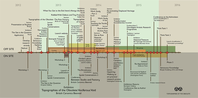
Topographies of the Obsoleteis an Artistic Research project (KU Prosjekt) initiated by Professors Neil Brownsword and Anne Helen Mydland at Bergen Academy of Art and Design (KHiB) in collaboration with partner universities/institutions in Denmark, Germany and the UK. Our main collaborative partner is the British Ceramics Biennial, who invited KHiB to work at the original Spode Works factory in Stoke-on-Trent, to develop a site specific artistic response as a core element of their 2013 exhibition program. More than 40 international artists and theoreticians have participated in this multidisciplinary project with a program of seminars, publications and exhibitions. Three residencies have accumulated individual artistic projects from which the overriding project has developed.
The project focus centres upon the landscape of post-industry, more particular; that of Stoke-on-Trent, a world renowned ceramic capital that bears in its city evidence of fluctuations in global fortunes. The original Spode factory, situated in the heart of Stoke-on-Trent, was once a keystone of the city's industrial heritage which operated upon its original site for over 230 years. Amongst Spode's contributions to ceramic history include the perfection of under-glaze blue printing and Fine Bone China. The factory's industrial architecture dates from the 1760's to the late 1980's, with spaces associated with all aspects of the design, manufacture, retail and administration in close geographical proximity. In 2008 Spode's Church Street site closed, with most of its production infrastructure and contents left intact.