The Art of Adjusting the Oboe Reed
(2022)
author(s): Christos Tsogias-Razakov
published in: Research Catalogue
The following material is an excerpt from the master’s research exposition: THE IMPORTANCE OF ARUNDO DONAX CANE SELECTION, FOR MANUFACTURERS OF OBOE REEDS (2020) by Christos Tsogias-Razakov.
Limited Publication.
The master’s research exposition was published to members of the KC Research Portal, 3. Internal publication (20/8/2020).
All rights reserved.
The current fragment is from the section: b) from the introductive Chapter I about The Art of Adjusting the Oboe Reed.
DIGITAL RITES and EMBODIED MEMORIES
(2022)
author(s): Elena Giulia Rossi
connected to: EU4ART_differences
published in: Research Catalogue
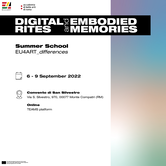
Creativity at the crossroads of Neuroscience, Artificial Intelligence, Gaming, Alternative Economies, and Humanism, will be discussed by leading voices from the international scene at DIGITAL RITES and EMBODIED MEMORIES, EU4ART_differences Doctoral Summer School.
A group of researchers from different European capitals will meet in the Monastery of Casa San Silvestro in Monte Compatri (Rome Province) for an intensive program that will take them, and their research, to the limit between physical and digital space.
Since the talks and workshops organized by The Fine Arts Academy of Rome mean to contribute on the currently relevant debate on art practice and new technologies, the series of webinars will be free and open to the public through a registration link.
;viewBox(0,0,1122.5197,793.70081)))
Listening to Messiaen’s colourful hands
(2022)
author(s): Arjen Berends
published in: KC Research Portal
Name: Arjen Berends
Main subject: Master Theory of Music
Supervisor: Dr. Bert Mooiman
Title of Research: Listening to Messiaen's colourful hands
Subtitle: Analysing harmony and voice leading in the two homorhythmic chorales from Messiaen’s La Transfiguration de Notre Seigneur Jésus-Christ.
Research question: How to analyse harmony and voice leading in the two homorhythmic chorales from Messiaen’s La Transfiguration de Notre Seigneur Jésus-Christ?
Abstract
Olivier Messiaen (1908-1992), one of the most famous French composers of the 20th century, was also known to be a great organist and improviser, as organist of Église de la Sainte-Trinité in Paris for over 60 years. His huge oratorio La Transfiguration de Notre Seigneur Jésus-Christ, composed 1965-1969, includes two entirely homorhythmic movements entitled ‘Choral’. As a listener, I am fascinated by Messiaen's extraordinary approach to harmony. The aim of this research is, therefore, to attempt to understand how best to analyse Messiaen's unique harmonic language.
Many approaches to analysing Messiaen’s music are vertically orientated, including his own way of describing his use of harmony. He himself never discussed the horizontal aspects of his music. Because of his coloured hearing synaesthesia (son-couleur), Messiaen's analyses are particularly special in their manner of addressing the colours of certain chords. A colour analysis by Messiaen therefore may give the listener some insight in the way Messiaen might have perceived his music. This research includes videos with the music and paintings of the colour analyses by Messiaen and two other musicians with synaesthesia of one of the chorales, specially made for this research.
Considering Messiaen’s own lack of emphasis on horizontal aspects of his music, is it possible to understand Messiaen’s music from a horizontal perspective as well? Since the two chorales are homophonic and homorhythmic, the bass and soprano are the most important voices. These parts can be perceived clearly, but the attention of the listener is also caught by other aspects such as the complexity of the chords. It is difficult to determine the precise voice leading of the inner parts because it is ‘blurred’ by the varied orchestration, but by way of harmonic reductions of the chorales, Messiaen’s horizontal compositional techniques can be clarified. This research includes a harmonisation of a melody by Messiaen in the style of the chorales in La Transfiguration.
Biography
Arjen Berends teaches music theory and arranging at the conservatories of The Hague and Utrecht. He graduated in music education at the Utrecht Conservatory, where he also studied classical piano with Henk Ekkel and Martyn van den Hoek. At the Royal Conservatoire of The Hague he completed his studies in music theory with Paul Scheepers, Arie Boers, Diderik Wagenaar, and Ineke Kien. He is répétiteur of Toonkunstkoor Amsterdam conducted by Boudewijn Jansen; he has previously worked with choral conductors such as Louis Buskens, Iassen Raykov and Béni Csillag.
DRUMS IN THE DEEP
(2022)
author(s): Johan Björklund
published in: Research Catalogue
Embracing and finding inspiration in my youth and background to explore methods and paths for creating art.
In this project I have explored and investigated my background growing up in Hedekas, a small rural village in Sweden. I wanted to see both socially and geographically how it could relate to and inspire my artistic work and practice. This resulted in three exstensive series of works that exemplifies this. An important overall aspect of this project is how I connect and releate the titles of my works to specific locations, people and events that have inspired them.
The primary knowledge about cane, by Theophrastus.
(2022)
author(s): Christos Tsogias-Razakov
published in: Research Catalogue
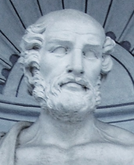
The following material is a short excerpt from the master’s research exposition: THE IMPORTANCE OF ARUNDO DONAX CANE SELECTION, FOR MANUFACTURERS OF OBOE REEDS (2020) by Christos Tsogias-Razakov. It is mentioned that already from the period of classical antiquity existed methods that helped manufacturers to make playable reeds for the instruments of that time.
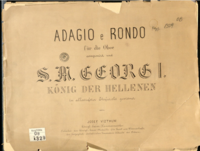
"Αdagio e Rondo” for oboe and piano accompaniment, by Josef Vitzthum (1815-1884). The oldest oboe piece that is associated with the newly formed independent Greek State.
(2022)
author(s): Christos Tsogias-Razakov
published in: Research Catalogue
Excerpt from the lecture at the "Portitsa" Festival about the musical piece “Adagio e Rondo” for oboe and piano by the Bavarian composer Josef Vitzthum (1815-1884). It is considered the oldest oboe work related to the newly formed independent Greek state. It came to the surface after more than a century, from the moment of its creation, during the doctoral research on oboe works by Greek composers.
Christos Tsogias-Razakov
Oboist - Ph.D. Candidate
Tsogias-Razakov, Christos. “‘Αdagio e Rondo’ oboe and piano by Josef Vitzthum (1815-1884)” First Festival of Portitsa. Lecture, August 5, 2022.