Queerin’ the Hoggee
(2022)
author(s): Marko Mikael Marila
published in: Research Catalogue
Inspired by my lifelong history in working with horses, especially through the philosophy of natural horsemanship, Queerin’ the Hoggee draws attention to the complicated human-animal relationships in the industrial past.
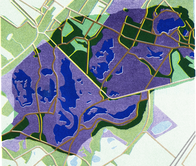
Voices in Nature: A Sensory Experience of the Hatertse and Overasseltse vennen
(2022)
author(s): Maarten Hendrik Jan Bekhuis
published in: Research Catalogue
As part of the Visual Ethnography master’s at Leiden University, this interactive website invites you to join my interlocutors and me to walk, hear and see with us the Hatertse and Overasseltse fens (near Nijmegen). After four months of fieldwork – I conducted semi-structured interviews, recorded collaborative footage and performed sensory walks – I studied human-nature relationships of educated individuals with extensive knowledge of this area. In presenting the various experiences, I analysed four workable concepts (wind, noise, crowdedness, and pathways) that shape the immersive perception of visitors. This interactive website and creative methodologies used provided me as a visual anthropologist with possibilities to research human-nature encounters within the epoch characterised as the Anthropocene. So, walk with us and experience this extraordinary environment!

Co-authoring the Future: Stories from the Road
(2022)
author(s): Jessica Renfro
published in: Research Catalogue
Framed by the metaphor of a road trip, this exposition explores the use of participatory performance in building cultural discourse about decision-making during the climate crisis. Using Rancière’s concept of the emancipated spectator, common human experiences such as childhood development of subjectivity (acquired through Lacan’s mirror phase and symbolic order) and image schemas (as discussed in Mark Turner’s The Literary Mind) are explored as possible strategies for co-authoring an artistic landscape alongside spectators. An audio narration accompanies the written work, attempting to explore these theories in the form of a correspondence between the author and her elusive self-awareness. Each track reflects on these individual-but-common experiences as a method for creation. The author concludes that a co-authored artistic landscape may only be accessible to participants who are enticed to set aside limiting social norms in order to explore it, and this is the challenge of the artist.

The singing Performer: Who am I on stage when not singing?
(2022)
author(s): Julia Pallanch, Heloisa Amaral
published in: KC Research Portal
Approaching Kunstlieder with the background as a jazz interpreter, has challenged me to find, not only, my interpretation of the lieder/songs but to also find my interpretation of my role(s) as the singer on stage between classical music and jazz scenes. Through performing music, the chosen body of work, we are not only repeating and interpreting the music but repeating and interpreting ways of performing it. This research focuses on the role(s) of the singer on stage and the moments between the songs; the open space between one piece of music and another that offers the possibility to communicate and connect with the audience. What happens in these moments? What stories do we tell and how do we tell them? What do I communicate with, through, in - and outside of the lied, the song, the piece of music. What do I perform in the open space between between the songs - my self(s)?
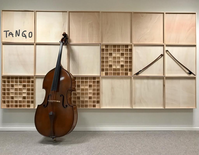
The German Bow in Tango Music
(2022)
author(s): Maria Alejandra Bejarano Salazar
published in: KC Research Portal
This artistic research compares French and German bow techniques in Tango music. I have been playing for a couple of years with a German bow when I play classical repertoire, and a French bow when I play tango. Considering that Tango has changed and added many things throughout its history, I wanted to investigate why the tradition of playing with a French bow is still extremely strong. So that is why the main question of this work is how to approach Tango music for double bass using a German bow technique? To answer this question I have been studying the method "The bass in tango" published by Tango sin fin, that approaches all of the elements from the perspective of the French bow. However, I have studied this using the German bow technique. I have found that you can play Tango with both techniques, but you cannot follow the same instructions to find the same results. This is mainly because of the anatomy of the bow. Additionally, because there is not a strong tradition outside of Argentina of typical orchestras or soloists that play beyond Piazzolla the tradition of playing with a French bow is still strong. After finishing this research, I would like to continue working on this subject through a new repertoire in a personal search to improve my performance as a tango player and then share this knowledge playing concerts or teaching with other double bass players.
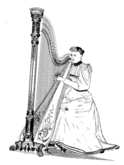
Lyon & Healy: the American Harp
(2022)
author(s): Ian Mcvoy
published in: KC Research Portal
The design of the pedal harp underwent a series of dramatic changes at the turn of the century, most of them attributable to the inventive minds at a Chicago-based musical instrument manufacturer and music publisher, Lyon & Healy.
Of the many innovations of the Lyon & Healy company, three of the utmost importance to the development of the instrument: the “adjustable fourchette,” allowing simple regulation of the harp’s tuning in the natural and sharp positions, the “single-link mechanism,” an internal change to the mechanism greatly simplifying both function and manufacture, and lastly the “extended soundboard,” an extension of the soundbox of the instrument allowing for greater volume. Each of these improvements has since been adopted by every modern-day harp maker.
This paper endeavors to combine original patents, miscellaneous historical documents, and evidence gathered from extant historical instruments by Lyon & Healy to identify each of the above and other specific changes, their inventors, the time of their introduction, as well as the overall motivation behind each of these important changes.