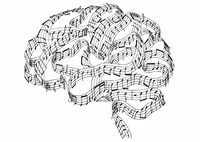
Music, Meaning and Emotion
(2022)
author(s): Hannah Jefferies
published in: KC Research Portal
Name: Hannah Jefferies
Main Subject: Classical Flute
Research Supervisors: Ines de Avena Braga,
Research Question: How can elements and features from psychology and philosophy illustrate what is fundamental to our emotions, in what way can these concepts be represented within and expressed by the flute repertoire, and how can we incorporate and convey these understandings as performers to create music meaningfully and be of beneficence to others?
Summary of Results:
This research sets out to contrast and evaluate diverse standpoints from psychology and philosophy to discuss firstly how emotions can be defined, whether music creates real emotions in us, and what capacities we possess to be both receptive and conveying of emotion within music. During my discussion, I incorporate examples of excerpts from the flute repertoire, consider the harmonic language used and function of musical structures, and balance this against the resulting emotional response from us.
This initial discussion is in support of a questionnaire which I conducted in order to gather results from respondents of their perceived emotional response and valence when presented with differing musical excerpts, both upon an initial and second listening. I aimed to gauge and qualify their reaction to musical traits which have been connected more strongly than others to specific emotional states, and additionally I was interested to find if there was a connection between memory of a piece of music, and emotional valence due to this familiarity.
Finally, having demonstrated the emotive strength it is possible for music to hold, I investigate how as artists we can harness and emphasise certain functions of music to create performances which are highly engaging and positively affecting for listeners. Additionally, this research then leads us to an understanding of the impact of integrating the effects of emotion and music, and suggests how this combination can be beneficial and utilised in and for the wider society, namely in the field of music therapy.
Biography:
I am currently a second year masters student from the UK studying classical flute at the Koninklijk Conservatorium with Jeroen Bron and Dorine Schade, having recently completed my Bachelors degree at the Royal Northern College of Music in Manchester. During my studies I have been very lucky to have had the opportunity to perform as part of ensembles including Asko|Schönberg, New European Ensemble, European Youth Wind Orchestra, and Amadeus Orchestra Academy. Outside of performance, I greatly enjoy being part of outreach and community music; a highlight was working with the Manchester Camerata Orchestra, delivering music therapy to people with Dementia.
How the Degree To Which Instrumentalist and Composer Work Together Affects the Compositional Process, the Composition and the Final Performance
(2022)
author(s): Stef Van Vynckt
published in: KC Research Portal
This research focuses on the compositional process from the point of view of the performer. It examines the extent to which collaborations with composers have an effect on the composition and subsequent performance. More specifically: how do compositions in which you, as an instrumentalist, were involved during the composition process compare to compositions where this was not the case? How does the relationship with the composer contribute to the final performance?
Flow, The Optimal Experience
(2022)
author(s): Francesco Siri
published in: KC Research Portal
In this research I would like to investigate the psychological aspect related to the practice of a musical instrument, going deeper into the experience of the flow state that the musician can live intensely. It is a state of mind of complete absorption in what one is doing.
The process started by reading and informing myself as much as possible through books, articles, and personal experience. Based on these I created a strategy of work and exercises that would help me to be more focused and inside the music both in my studies and especially in my performances.
I prepared two questionnaires to be filled in after the performances:
1) Personal Questionnaire
2) Group of critical friends
To check whether the strategy I had been using over the last few months was helping me to achieve my goal or not.
From the results of the two questionnaires until now, I can deduce the most effective and useful aspects of the strategy I implemented. It is also interesting to see how the suggestions of critical friends are similar to the "criticism" I made myself in the personal questionnaire.
Over the last few weeks while analysing my latest performances and the results of the questionnaires, I have realised an increase in pleasure in playing and concentration on the task to do, which was not always present before I started this work. I am quite convinced that whatever strategy you want to use, you need patience to see over time if it really works.
Classic Expression: the effect of storytelling in a classical concert for children
(2022)
author(s): Vivian de Graaff
published in: KC Research Portal
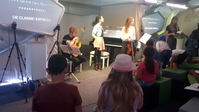
The traditional way of classical concerts – i.e. a concert of 1,5 hour, no moving or making sounds, no interaction – is not the way to attract children to classical music. There are different inviting ways to interest children in a classical performance, for example with interaction, participation or storytelling. In this research we investigate if storytelling has an effect on children’s enthusiasm for classical music and their likeability of playing an instrument themselves. Furthermore, we assess if there is a relation between musical interest, engagement and/or emotional intensity during the concert. We do this by comparing a story-condition with a technical information-condition, in which the presenter talks about the instruments or the performance location. It is executed in the Classic Express, a concert truck in which laureates of the Prinses Christina Concours, a Dutch competition for young musicians, perform and present classical music for primary school classes. Children answer questions before, directly after and one week after the concert about how much they like the music, if they want to experience it again and if they are interested in playing a musical instrument themselves. The results can support musicians wanting to give engaging performances to children, improve the quality of concerts for this target audience and raise likeability of classical music in young generations.
Why can't I sleep?: A psychoanalysis of the manifestation of unattainable control through the art of composition.
(2022)
author(s): Franki Dodwell
Limited publication. Only visible to members of the portal : KC Research Portal
After nearly two decades of sleep problems, one question haunts me. Why can’t I sleep? Like many composers, sleep and its mysteries have become an obsession that for myself personally, has inspired an exploration between the conscious and unconscious in relation to the works of The Surrealists, Sigmund Freud and John Zorn. Using autobiographical experiences of insomnia; close analysis of scholarly texts and musical scores I will explore the various ways in which musical expression is informed by the concept of sleep. Through this exploration I will establish how the lack of control I experience due to my inability to sleep can aid my own compositional process. I will investigate how these specific artists use psychodynamic theories to take control away from their audiences and identify what drives their desire to musically capture, embody and control what is at its core, the uncontrollable.
A modern analysis of Historical Informed Performance: considerations about the method, its past and its future
(2022)
author(s): Pedro Antonio Pérez Méndez
Limited publication. Only visible to members of the portal : KC Research Portal
The results of this research will be presented to the public in the form of an exposition in which the whole analysis process will be explained and both an answer to the research question and a reflection about past and future of the Historically Informed Performance influence in the musical stage will be stated. Through this exposition we will be addressing relevant questions about the concept of Historically Informed Performance and its application as a work method that I encounter on my research, such as the use of reconstructed or modern instruments, the existence or absence of limitations of time and style frames for which the Historically Informed Performance is a useful tool or the common misconceptions about this idea by some group of musicians, aiming to establish a basis for the correct application of the Historically Informed Performance idea as a useful work method by any kind of musician and leading to a final reflection about the future development of the Historically Informed Performance ideal.