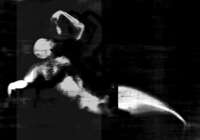
"Avec Picasso, ce matin..."
(2022)
author(s): Inês Lopes, Heloisa Amaral
published in: KC Research Portal
The current music scene is manifold in its means of expression. As music becomes more diverse and embraces other art forms it makes room for a new type of performers to flourish. My academic path, comprising jazz theory lessons and an uncomplete bachelor’s in composition beyond my classical piano studies, gave me the opportunity to develop a set of artistic skills that go beyond the standard performer curriculum. I saw in this artistic research the perfect chance to apply this knowledge.
In my work I explore three distinct approaches to a specific piece of music: Constança Capdeville’s Avec Picasso, ce matin… (1984), starting from a more traditional analysis and progressively diverging from this path towards a subversive approach inspired by the concept of anamorphosis. Capdeville’s score is essentially an open work with a set of guiding instructions. However, the lack of documentation, clear instructions and reliable sources concerning the piece made the notated score more ambiguous than expected. This possible setback in its reconstruction turned out to be the perfect context to put my expertise to the test. While dabbling with Capedeville’s score I resorted to experimental processes, to my experience with composition, my transcription and editing skills, archive work and the use of different media in contemporary performance practice.
I approached the score as a “script” rather than a “text” (Cook, Nicholas). In this research the score is no longer an end in itself, but rather an excuse towards the development of a musical project larger than it.
The appearance of the sound
(2022)
author(s): Giangiacomo Sala
published in: KC Research Portal
Luthiers throughout the centuries have always tried to adapt and improve the characteristics of the instrument to the needs of the musicians of their time. I myself, as a bassoonist, am also a luthier of my own reeds and in their construction I try to help my musical needs as much as possible. It was in trying to improve the characteristics of my reeds that I felt the need to know better how they work. I wanted to understand how my manipulations on the reeds went to influence their functioning and consequently the sound generated. So, I decided to observe a reed while it vibrates and understand its movement. I want to repeat the experiment on different reeds to note any similarities and differences.
Searching for the Siren | Exploring contemporary vocal aesthetics
(2022)
author(s): Kristia Michael
published in: KC Research Portal
“Searching for the Siren” explores contemporary vocal approaches that mirror the aesthetics and the contemporary perception of defining the elements of Beauty. Specifically, three main thematics are researched: 1) The Folk Voice, which explores how folk elements and timbres enter in classical and popular music, 2) The Extended Voice, which describes the use of extended vocal techniques with reference to technical and physical aspects of timbral contrasts, vocal fry, scream and inhalation phonation, 3) The Absent, Transformed and Replaced Voice which occurred with the technological development. Ends with conclusions around the definition of the mythical creature of the Siren and its relation to the human voice. Every aspect includes personal views, works, performances and syllogisms.
Pikatreffit
(2022)
author(s): Christina Stadlbauer
published in: Research Catalogue
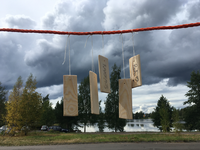
A participatory performance proposes intimate encounters with floral life forms. Potentially unexpected effects could be observed. Work in collaboration with The Hot Box.
Cello Meets Soleares
(2022)
author(s): Candela Mier-Terán
published in: KC Research Portal
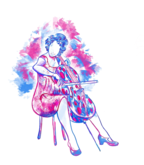
Flamenco is still a mystery and although there is a growing body of academic literature seeking to understand it, there is still a long way to go. In addition, flamenco is opening up to such variety and innovation that various instruments have been included in the traditional ensemble of guitar, cajón, clapping, cantaor/a and dancer. For these reasons, this research aims to bring cante por soleares closer to anyone interested in the world of flamenco, although perhaps with special attention to string musicians, and cellists in particular. This work, together with my analysis of the rhythm, melody, harmony and structure of the soleares, seeks to offer reflections, tools and conclusions for those looking to imitate soleares singers on the cello. This work is carried out through the transcription and analysis of six soleares, carefully selected for the purpose of being played on the cello [having done so much work with flamenco experts, it is a pity not to mention this as one of your key methods]. With these insights, I seek to better understand the characteristics of cante por soleares, to propose different forms of imitating it on the cello, and to offer options more suitable to the instrument when close imitation is not possible.
Adding to the Narrative: Intersectional Feminist Critical Curatorial Practices in Classical Vocal Music Performance
(2022)
author(s): Shanice Skinner
published in: KC Research Portal
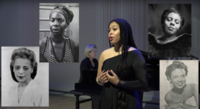
Diversity and inclusion within Western art music have become topics of elevated importance in in recent discussions. To create enduring results regarding these matters, there needs to be a commitment to in-depth study of practices that will produce visible change. This is one of the goals of my research, in which I tackle issues of representation by focusing on Black women composers and their absence from the canon as overlooked and marginalized artists. It is well known that women have been denied many opportunities throughout history; as composers, many experiences crucial to professionalism were not always available to women, including music education in composition, the publication and circulation of their works, not being hired as conductors, or receiving reviews from influential critics. These opportunities and resources dwindled further if a woman was also a person of colour. Thus, in order to ensure their inclusion within the canon, these underrepresented identities demand and require unique recognition.
I have examined the issue of neglected women of colour composers in classical music from an interdisciplinary standpoint, utilizing the methodologies of history and experimentation to form an “intersectional feminist critical curation” framework. This framework implements knowledge from intersectional feminist theory and music curation practices in order to answer following questions: “What is the impact on new audiences of diverse backgrounds experiencing classical music through an intersectional feminist curatorial framework?”, "Can classical music be an effective device for messages of social and political change?", and “What is the impact on myself as a classical vocalist and a Black woman to implement an intersectional feminist curatorial framework within my musical study and performance?”. The overall goal of this research was to discover an effective way forward to achieving diversity in classical music for underrepresented groups. Drawing from this study, I have created a digital performance project entitled “The Narrativity Sessions,” which functioned as an experiment utilizing this knowledge of intersectional feminist theory and praxis fused with select critical curation strategies applied to my own artistic practice as a classical singer. The outcome was a novel artistic practice that can contribute to creating innovative and artistically fulfilling performances while simultaneously advancing diversity and inclusion in the classical music sphere for audiences, performers, and composers alike.