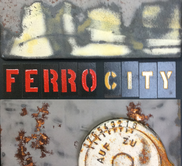
FERROcity: Iron in the city
(2022)
author(s): Stephen Edward Bottomley
published in: Research Catalogue
Jewellery and objects by twenty-two contemporary makers displayed alongside gemmological samples and photography that explores the interpretation and influence of Iron as catalyst, material and fundamental element of life. The exhibition was co-curated by Professor Stephen Bottomley, Head of School and Elizabeth Turrell visiting Professor at School of Jewellery, Birmingham City University.
This 2019 international touring exhibition brought together fascinating artistic responses to the theme of iron by twenty-two contemporary makers, including works by academic staff from Birmingham’s eminent School of Jewellery and invited international artists.
It explored iron is a material that has become synonymous with human life and civilisation and as such has become embedded in both our language and understanding of the world
FERROcity showcased a breadth of approaches to this fascinating but familiar material. Ideas explore the interpretation and influence of Iron as catalyst, material, and fundamental element of life, culminating in contemporary metalwork and jewellery ranging from steel vessels to recycled iron nail jewellery. Alongside this gemmological samples and photography taken on specialist microscopes was commissioned from the Gemmology department at the School of Jewellery which captured the transformative effect iron has on the colouration of gemstones.
The show opened in Germany at the Museum Reich der Kristalle, Mineralogical State Collection, Munich and ran in tandem with the city’s international jewellery fair ‘Inhorgenta’ in February 2019 and ‘International Jewellery Week’ and ‘Schmuck’ exhibitions over February and March 2019. The exhibition then moved to the Vittoria Street Gallery, Birmingham, United Kingdom, April 2019 and was invited to China as a special exhibition at the 4th International Art Jewellery Exhibition at the Beijing Institute of Fashion and Textiles October 2019 before moving to the Academy of International Visual Arts, Shanghai November 2019 until it closed in December 2019.
Exhibitors
School of Jewellery:
Dauvit Alexander, Jivan Astfalck, Stephen Bottomley, Jeremy Hobbins, Bridie Lander, Anna Lorenz,
Sarah O’Hana, Drew Markou, Toni Mayner, Jo Pond, Rebecca Steiner, Elizabeth Turrell.
Invited artists:
Marianne Anderson, Tim Carson, Rachael Colley, Bettina Dittlmann, Christine Graf, Kirsten Haydon, Michael Jank, Joohee Han, Simone Nolden Jo Pudelko.
Exhibition Dates:
Germany, Munich | 21st February to 17th March 2019
United Kingdom, Birmingham| 1st April to 18th April 2019
China, Beijing |18th October to 28th October 2019
China, Shanghai| 31st October to 30th November 2019

Arcade: A Guide to the Operas in the Doctoral Project "An Operatic Game Changer"
(2022)
author(s): Hedvig Jalhed
published in: Research Catalogue
This exposition is a guide to the four ludo-immersive chamber operas in the doctoral project An Operatic Game-Changer. The operas were created during the period 2016–2020 and are contextualized and discussed in the dissertation with the same title, in which the practice of facilitating operas as adventures rather than spectacles is fleshed out. Through these participatory and multi-disciplinary concepts, conceived with the purpose of generating and analyzing live encounters between professional opera artists and co-playing visitors, immersive features are realized and explored.
Arcade is also a kaleidoscopic performance and an exhibition, designed as an operatic amusement park in miniature, with artefacts and excerpts from the operas, and presented live in connection with the public defense of the thesis in 2022 at the Academy of Music and Drama in Gothenburg. This online resource functions as an archive of information about the operatic works and their performances, both for those attending the performance/exhibition in Gothenburg, and for those wanting to learn about the project without experiencing this event.
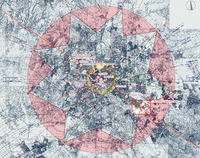
Discovering the Altera Forma Urbis of Rome through a site-specific project and performance at Garbatella district, Rome
(2022)
author(s): Andrea Moneta
published in: Research Catalogue
The aim of the research enquiry was to uncover old and recent past history of Rome through a urban scenography design project that produced an exhibition (output 1: Segni Percorsi) and a sited performance (output 2: Tramandala), in the Garbatella district of Rome. Specifically, the research-led project was initially inspired by the ‘invisible’ structural urban form of Rome, the ‘Altera Forma Urbis’ in the shape of a ‘Star’. The aim was to explore connections with its contemporary structure focusing on the Garbatella district, area of study of the research. The final output (exhibition and a performance) was based on the findings of both historical and experiential analysis of the territory of the Garbatella district. The process in fact, revealed stories and characters that became the content of the storytelling of a site-specific performance for Teatri di Vetro 3, a site-specific theatre festival based in the courtyards of Garbatella’s building lots. Methods used to explore these enquiries involved recent studies by Italian archaeologist Giuseppe Lugli and his son Pier Maria Lugli (2006) on the ‘Altera Forma Urbis’ of Rome; the use of location-based digital technologies (Geo-Blog) for mapping, and Scenarchitecture, a trans-disciplinary methodology developed by Moneta (2012) for reading and interpreting the Genius Loci. The project involved 12 students of Module of Scenography of MA Architecture course at University of Rome La Sapienza, that exhibited their works at Urban Centre of Municipality XI of Rome, and then devised and performed during Festival Teatri di Vetro 3. Output 1 was funded in kind by Roma Europa-Palladium Foundation and output 2 by the Municipality XI of Rome. Feedback collected during the exhibition and after the performance evidenced the engagement of the audience with the ancient and recent past of Garbatella. The dissemination of the work includes two published articles.
Investigating new forms of content creation, storytelling and audience engagement to reveal the Genius Loci of heritage sites (The Workhouse, Southwell)
(2022)
author(s): Andrea Moneta
published in: Research Catalogue
Heritage Project at The Workhouse, Southwell, is a 5-year long collaboration partly funded by National Trust with Nottingham Trent University; it was enabled by National Trust’s Research Strategy aimed at ‘fulfilling the role of heritage in the modern world, realising experiences that move, teach and inspire’. The project was focused on The Workhouse, Southwell to reveal its Genius Loci (distinct character), to unearth its forgotten, denied and unexpressed stories; and to unveil them through Scenarchitecture, Moneta’s performative methodology that utilises architecture and performance to provoke visitors to think differently about history, identity and today’s world.
Scenarchitecture blends Imagination with Memory using a given architectural site; it works with the complex overlay of historical and contemporary fragments embedded in the host building, and it combines them with the stories, memories and meanings of the people that lived there. The aim of this process is to unveil feelings, to reveal invisible links between places and people, using perception and sensibility.
Moneta’s project was developed through research-led teaching: since 2015, a number of Theatre Design students had been involved as active researcher for content creation; they had been paired with Workhouse’s volunteers to engage with the building and its archive material; together, they devised different 'stories' inspired by The Workhouse’s archive; in the first two years of development the project inspired students’ installations; from 2017, after gaining interest from National Trust, the ‘stories’ evolved into a collective, costumed promenade performance open to public around The Workhouse, with the volunteers as storytellers and Moneta as project manager and director.
The project is now a regular and popular feature of The Workhouse’s Public Programme inspired by a specific year’s theme. Outputs included photos and video, website and blog, newspaper article, exhibition; in 2019, a documentary captured the development of the project and final performance.
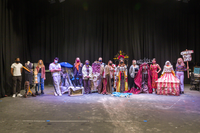
Ghosts! Heritage design project and performance at Nottingham Castle Grounds
(2022)
author(s): Andrea Moneta
published in: Research Catalogue
The aim of this research enquiry is to foster a collaboration with Nottingham Castle realising public activities to improve visitors’ engagement. Methods used to explore these enquiries involved Scenarchitecture, a trans-disciplinary methodology developed by Moneta, that uses the process of reading, understanding, and interpreting the Genius Loci as an in-depth exploration and expression of Spatial Practice and community engagement. Recent studies on phenomenology of Place (Relph, 1976; Alexander, 1977; Norberg-Schulz, 1980), and the role of Genius Loci in Placemaking (Brooks, 2001; Golan, 2012), are confirming the importance of considering a multidisciplinary approach to enhance heritage sites using perception and emotions. Heritage sites with their peculiar identity and character, provoke intense spatial experience in those who engage with them, having the quality of Place, i.e., the power to focus human experiences, and actions spatially. The enquiry was about researching and then revealing historical characters that had a role in the NC’s history, and to help audiences engage with them on a perceptual level through storytelling, site-specific performance and CosProps as the medium. The project involved six students of BA (Hons) Theatre Design at Nottingham Trent University as part of the Realised Design curriculum, that selected and designed a CosProp for each character. They devised the performances in collaboration with six students of The Television Workshop in Nottingham. The work was funded in kind by NC (supporting staff and use of spaces and facilities) and by NTU (£1000.00). The final outcome is a promenade performance across different stories and characters located in specific places of the NC Grounds; the audience followed the promenade in small groups to adhere to Covid19 regulations. A questionnaire after the performances evidenced that ‘the performance enhanced the experience of the Nottingham Castle grounds’ (73.3%). The dissemination of the work includes pages on NTU and NC website and a video published on YouTube.
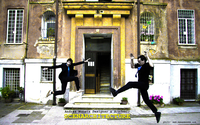
Scenarchitecture: exhibitions, live events and sited performances in Italy and UK, 2006-2021
(2022)
author(s): Andrea Moneta
published in: Research Catalogue
The Exposition illustrates the body of work of 15 years of research-led teaching and professional practice that produced 17 performances, 2 installations and 4 exhibitions in Italy and UK, during the period 2006-2021. They are documented with photos, video documentaries, social media, info about the research and design process to demonstrate impact, significance, and originality. All the output presented in this portfolio involved projects in partnership with universities, research centres, theatres, and cultural institutions.
Performances had been developed through Scenarchitecture, a trans-disciplinary methodology developed by Moneta’s research, that blends Scenography with architecture and urban design. Scenarchitecture involves the process of reading, understanding, and interpreting the inner character and performative attributes of architecture and sites, as an in-depth exploration and expression of Spatial Practice and community engagement, essential aspects for any design intervention in a specific place. Scenarchitecture, in fact, can also help designers, stakeholders, and citizens to engage with the character of the place as a propaedeutic step for the co-creation of architectural and urban design that are respectful of places.
Performances and related exhibitions, in the roles of designer, exhibitor and director, had been an important step for the author to disseminate Scenarchitecture methodology, and to assess it in different areas: in Research-led teaching at Nottingham Trent University (UK) and University of Rome La Sapienza (Italy); in Professional practice for theatre design and architectural design, as co-founder of cultural association Archabout; in Professional practice for live events in marketing and communication, as co-founder of ethical and un-conventional communication firm Smart Jokes.