Vox Spatium
(2021)
author(s): Sofía Balbontín
published in: Journal for Artistic Research
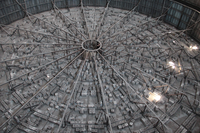
This exposition recognizes the "Vox Spatium" through the comparative study of acoustic spaces and their reaction to an impulse response (IR). The artistic research arises from two creative instances: a residency at the Experimental Base for Sound Art TSONAMI Valparaíso, Chile (2019) and the field studies of the project Resonant Spaces (Balbontín-Klenner, 2019-2020) in Belgium, Scotland and Spain. Both experiences unfolded as expeditions towards the sound exploration of the acoustics of urban and architectural space. In the exploratory process, the project begins to change its course and redirects the north towards new spatial horizons; the spaces visited are increasingly uninhabitable generating a direct relationship with the intensity of their acoustic interest. In the tracking process towards the "Vox Spatium" a narrative begins to be forged that transcends from human spaces to non-human spaces, raising issues around urban entropy and the current geological era of the Anthropocene. The sound exploration becomes an agency and sound becomes the evidence that reveals the rhythm of the anthropic impact on the planet.
I lost time and space. Where am I? – Erzählen von chronischen Schmerzen
(2021)
author(s): Tabea Rothfuchs
published in: Journal for Artistic Research
Was passiert mit der inneren und äusseren Welt eines Menschen, wenn kein medizinisches Verfahren den Ursprung des erlebten Schmerzes (mehr) zu entziffern vermag? Wenn der Schmerz zum eigenständigen Krankheitsbild 'Chronischer Schmerz' geworden ist?
In einer Dialogserie mit Schmerzpatient*innen und Schmerzspezialist*innen erforsche ich in dieser Untersuchung – als Künstlerin und Schmerzerinnernde –, wie chronische Schmerzen das Leben beeinflussen, verändern und welchen Raum sie im Leben der betroffenen und behandelnden Menschen einnehmen. Oder als Kernfrage formuliert: Liegen Menschen mit chronischen Schmerzen im Leben anderer Menschen, in unserer Sozialstruktur und dem politischen System überhaupt drin?
––––
What happens to a person’s inner and outer world when no medical procedure is able to (further) decipher the origin of an ongoing perceived pain? When pain becomes an independent clinical picture called 'chronic pain'? In a series of dialogues with pain patients and specialists, I investigate in this study – as an artist as well as someone who remembers an episode of chronic pain – how chronic pain influences and changes lives and what space it takes in the lives of people affected and those providing treatment. Or expressed as a central question: Is there room for people with chronic pain in the lives of other people, our social structure and the political system at all?
Cleaning in progress: the line between art and life
(2021)
author(s): Ulvi Haagensen
published in: Journal for Artistic Research
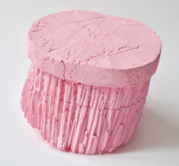
This exposition combines image, text, and video to provide an overview of my artistic research, which focuses on the embodied experience of art-making in relation to the everyday. Equipped with the notions of a line and a circle, I explore the connections and overlaps between art and life through a multi-disciplinary art practice that combines installation, sculpture, drawing, performance, and video, and merges this with everyday experiences, mainly cleaning, one of the more mundane aspects of everyday life. In this work, I am accompanied by three imaginary friends, who are also artists. We find ourselves constantly crossing the lines between art, art-making, and everyday life as we move between our roles and various places of work, such as home, university, library, and studio. We dip into the everyday for materials, tools, and techniques, and work in the manner of a bricoleuse, using a ‘make do’ approach and ‘what is at hand’. Along the way, we ponder the specialness of art, especially from the perspective of an artist for whom art and art-making are a part of the everyday and therefore quite un-special. As we puzzle over the distinctions of whether something is practical or impractical, useful or useless, art or non-art, mundane or special, we end up blurring the borders to discover an approach that attempts to dispense with the idea of boundaries and binaries altogether.
Future Earth Scream Now - The Solresol Birdsong Translator
(2021)
author(s): Jim Lloyd
published in: Journal for Artistic Research
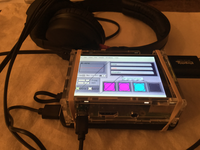
In this exposition, we describe a ‘speculative fabulation’ on communication with birds. A device was built that ‘listens’ to birdsong and translates this into human speech utilising the obscure musical language Solresol (François Sudre, 1866). Birdsong is analysed and converted into musical notes (one octave in the scale of C Major: do-re-me-fa-sol-la-ti). These seven notes are grouped to form four-note ‘words’ that are looked-up in the Solresol-English dictionary. Each note also has a rainbow colour assigned to it. In a variety of configurations, the device can output the birdsong, notes, music, translated words, and colours. Text and MIDI (music) files can both be saved for further output or processing. The software can run in a variety of modes and on a variety of hardware, including PC and Raspberry Pi. It can make use of both live and recorded birdsong. The device and software are described, as well as several examples of its outputs, such as ‘auto-poetry’ and music. The presentation of the work and modes of engagement are described. The contextual significance is discussed in relation to claims about the practice as artistic research.
Aubiome: A Collaborative Method for the Production of Interactive Electronic Music
(2021)
author(s): Joel Diegert, Adrian Artacho
published in: Journal for Artistic Research
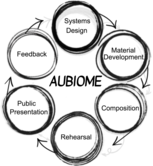
Using a ‘performer-centric’ working method, artistic researchers Joel Diegert and Adrián Artacho investigate the potential of integrating the saxophone with real-time electronics. The musical work, 'aubiome', is used as a case study to demonstrate their collaborative co-creative approach. The six-stage, iterative working process that emerged during the aubiome project is broken down and described in detail.
Sound At Home II: City, Home, Body - Sonic Relations and Voice
(2021)
author(s): Mette Simonsen Abildgaard
published in: Journal of Sonic Studies
This is the second special issue of the Journal of Sonic Studies on the topic Sound at Home. In the original call for papers, we asked scholars from a variety of disciplines to engage with home sounds – everyday sounds such as the hum of appliances, the babble of water piping, the chatter of media or the creaking of a wooden floor; sounds that seep in from other homes and from the world outside (traffic, music, shouting, etc.); disconcerting, unfamiliar sounds of places that have become a temporary home; or sounds that go unheard in their familiarity – using a wide range of approaches and methods.