Rethinking WTC: a new interpretation of the Well-Tempered Clavier by J. S. Bach through the prism of the theory of Boleslav Javorsky
(2023)
author(s): Natalya Pasichnyk
published in: Faculty of Fine Art, Music and Design, University of Bergen
In this project I sought to get new insights into the interpretational process, to make a contribution to the renewal of methods of working with a musical text, to find a new way to communicate meaning found in music, to broaden the role of the pianist to a co-creative one, and to unfold a new facet of the understanding of the Well-Tempered Clavier by J.S. Bach.
The initial inspiration for this project came from the theory of the Ukrainian-born musicologist Boleslaw Javorsky (1877-1942), the main sense of which can be formulated as: the main foundation of the Well-Tempered Clavier (WTC) is the protestant chorales, and that the WTC is an artistic interpretation of images and plots of the Bible.
The use of metaphors, images and narrative is important as a way of working with music for many musicians. For me this way of thinking has always been the most important working method, along with the wide range of other elements within my individual working processes, which inform my artistic practice. I intended to go further and through the creative process during this project develop a new methodological approach in working with the music text. I call the process in search for meaning in preludes and fugues.
I try in this project to tell the story of my personal understanding of this iconic piece, often called the pianist's Bible. The story presented is not merely a descriptive Bible story, but rather a personal reflection over our existence.
My working process began with trying to find and understand the connection between words in the chorales as well as other vocal works of Bach, and the music text of WTC. When analysing the found connection, each prelude and fugue receives a concrete semantic meaning. I decided to place the pieces chronologically according to the meaning I found, so that the entire WTC becomes a unified coherent story, instead of a collection of 48 separate pieces.
I did not attempt to imitate the way of performing that was common during Bach's time, but rather to use all the advantages of the keyboard instrument of our time and all the expressive means it offers to share my findings. By experimenting with interweaving the motives of vocal music with WTC's music texture, I wanted to make my understanding of the genesis of the piece audible, but also to embed my reflections into my playing. It also broadened the role of the pianist to a more co-creative one, which was the common practice in Bach's time, but in an entirely different way. In other words, my intention was to make my interpretation historically informed, but to be faithful to the spirit of the time, rather than to the letter of the time.
The legendary Bach scholar Albert Schweitzer wrote about WTC: "What is gripping, is not the shape, or the structure of the pieces, but the worldview reflected in them". To make my understanding of this worldview audible to all listeners, and to invite them to immerse themselves into Bach’s spiritual universe (where the music's aim is the “recreation of the spirit”), is the overall goal of the project. Bach’s faith generated his music, and so I hope that this music can in turn generate faith, which we need in our current times more than ever.
Embodying Recognition: Dance Improvisation for Scientists
(2023)
author(s): Susanne Martin
published in: Research Catalogue
In this exposition (text, videos, photos) I discuss a series of participatory lecture performances as one major outcome of my artistic research on dance improvisation in and for science and technology oriented higher education. These lecture performances aim to give different stakeholders in the science field an initial insight into dance improvisation and to facilitate discussion of its potential for the scientific learning, teaching and research culture. From the perspective of a dance artist and artistic researcher, I trace the details of how and why I created events for scientists to encounter dance improvisation through shared exploration and shared reflection. Interlacing descriptive and reflective writing, I unfold the argument that by engaging in improvisation as an embodied recognition practice, reflective processes can be set into motion, which critically question habituated forms of bodily, social and epistemological exclusions within academia. In other words, by conceptualising dance improvisation as recognition practice, I hope to shed light on its critical potential which exceeds questions of spontaneity and creativity.
Sonic Placemaking: (Re)Creating Place as a Comprehensive Compositional Practice
(2023)
author(s): Isaac Barzso
published in: KC Research Portal
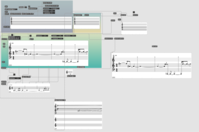
This paper is focused on the development of a large-scale personal compositional practice centered around the concept of placemaking. Its content is focused on the relationship between data analysis, data sonification, and musical structure in the development of art which engages in a practice which I refer to as ‘sonic placemaking.’ In the end, this research intends to put this artistic practice in a space to interrogate the relationship between art and social change, both on small and large scales. The different sections of the paper will provide context and support for my practice's conceptual and philosophical background, drawing on related theoretical writings in geography, sociology, fine art, and composition while guiding the reader through my process in executing these concepts through works of multimedia art and acoustic composition — and, at the same time, actively questioning the ability of this process to influence social change and worldmaking.
PRESENCE as an actor
(2023)
author(s): Ann-Sofie Nurmi
published in: Research Catalogue
During my master in Performing Arts at Stockholm University of the Arts, I have been looking into finding a greater presence, in a text based theatre rehearsal and workshop context. I have tried to look at things how they appear in front of me. A dilemma is, that when I afterwards try and look at presence, it has already gone. Therefore, I used different tasks/exercises, that can be recreated in order to try and catch presence again.
When exploring presence in a rehearsal and workshop context, I found a few clues how to find/create presence and doing tasks in order to find/create a greater presence. In this exposition you can find some of these clues. They are all entangled with each other so one will not work without the other so please see them all as a whole. This exposition is a tangible ans embodied complement to my master essay.
NAVIGATING NOISE
(2023)
author(s): Simon Rydén
published in: Research Catalogue
Simon Rydén
Documentation for the MA Project Navigating Noise at The Department of Performing Arts at Stockholms Konstnärliga Högskola.
This project explored how different art practices from different fields cross-pollinate in the process of making interdisciplinary art. I want to trace how the process of exploration and thinking in different mediums create a dynamic interchange of ideas that leads to the development of new ways of relating to practices.
I used different approaches and techniques, from somatic practices to experimenting with digital tools, to understand how different practices interact with and inform each other. The process becomes an intricate system of similarities and feedback loops, where one can reflect and interpret in many different mediums.
ILUF/Never forget that we met@internet
(2023)
author(s): Normann Hanna
published in: Stockholm University of the Arts (SKH)
Together with an artistic team I’ve been working with stalking as a concept, examining ”who is stalking who?
Using multible media.
This is my Individual project degree on the master's programme in acting, 120 credits. Stockholm University of the arts. 2022-23. Supervisor Ulrika Malmgren.
I’m showing the process on a timeline, with two different parts.
Part 2, is from a serie of examining stalking as a phenomeno, film and performance.
Part 1, as an inspiration for part 2, showing my character work and process with ”ICON”
(Nico (Christa Päffgen) a Factory model and singer in The Velvet underground.)
The probs in the picture are inspired by the probs we where using in the movie, a cherrytree. In a seminarie about stop motion I made a musicvideo in clay. A cherryflower.