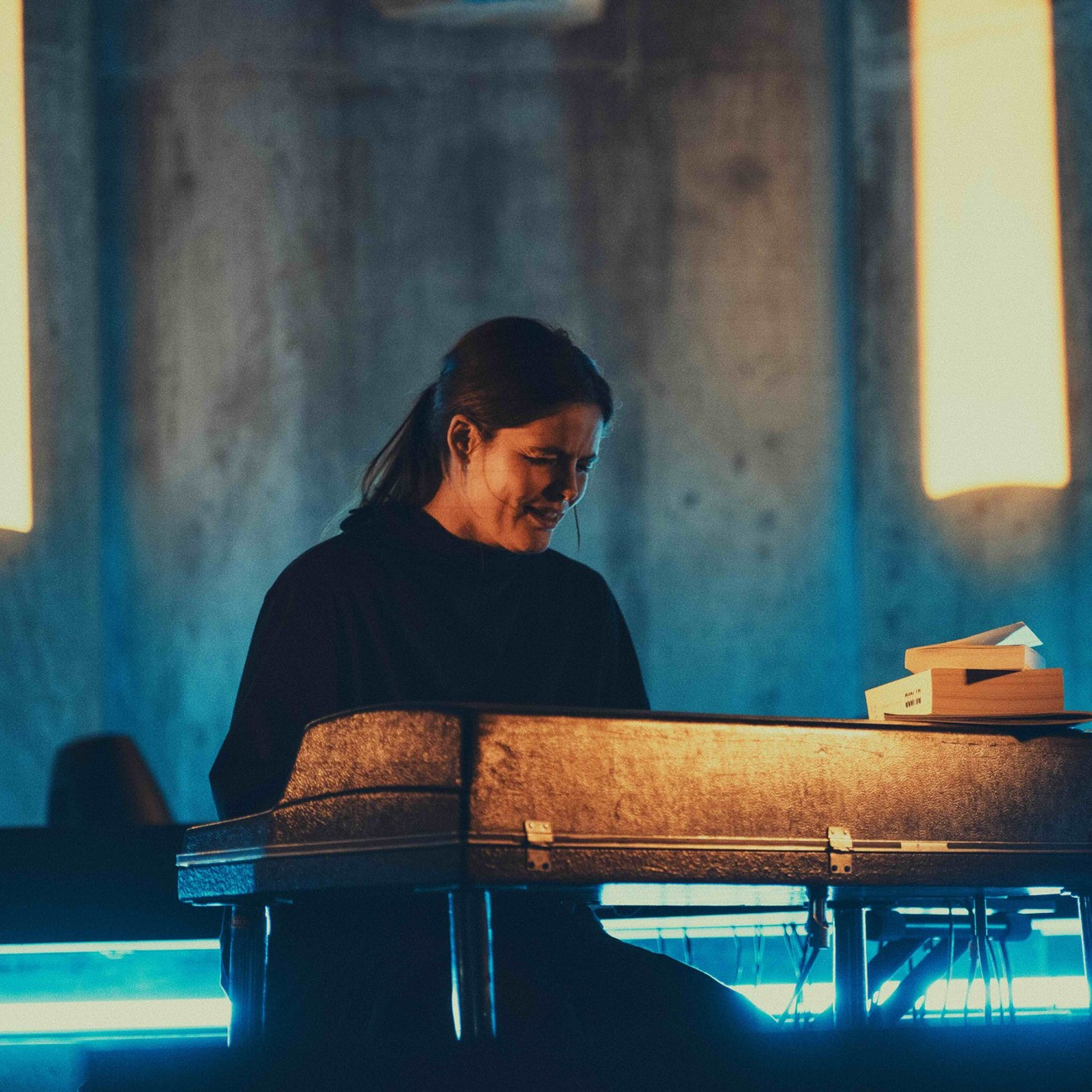
The project explores how performing improvised music can foster empathy and emotional resonance around climate issues, open reflective spaces, and encourage the kind of community-building essential for meaningful, collective action.
James Bridle argues that «by expanding our definition of intelligence, and the chorus of minds which manifest it, we might allow our own intelligence to flower into new forms and new emergent ways of being and relating. The admittance of general, universal, active intelligence is a necessary part of our vital re-entanglement with the more-than-human world».
«To improvise is to join with the world, or to meld with it» writes Deluze and Guattari, and it is through these two lenses I am exploring ways of improvising in music, and how to make visible the connection I feel to the more-than-human intelligences, despite their otherness in language, form and shape.
My notion is that ideas occur from a circle of agencies, inside the space between myself, my instruments, and my umwelt (Bridle). This space has many descriptions – listening with (Annea Lockwood), Quantum listening (Pauline Oliveros) or even the ‘now’, ‘flow’ – and I think it’s crucial that we open up our ears to the more-than-human agencies already acting in this space. I am experimenting with finding entry points into that space, through directing attention to an object, a stone for example, getting random (Bridle) or using field recordings. Another entry point for me has been focusing on a previous experience or feeling, an imagined dialogue with a place, friend, a character in a book, a mood. Moving with the attention to act with emergence. Something similar to this was described as a multi-attentiveness by choreographer Rosalind Goldberg (2025) in her artistic research from Khio «Choreography as a meaning-generating aggregate».
Key questions
How can musical improvisation make a relational self more visible — a self that emerges through its ongoing interaction with the environment? Drawing on Tim Ingold’s ecological perspective, in which the human being is understood as an organism-in-environment continually shaped through relations and movement, I explore through various experiments how this can be made experientially accessible and perceptible to an audience.
Can a musician act as an “agent for change” (O’Brien, 2018) without compromising the freedom of improvisation — and how might such engagement influence the music’s relationship to the world’s urgent challenges?
Anja Lauvdal
Freeform pianist and electronic musician Anja Lauvdal (born 1987) has an inimitable ability to conjure multiple sonic moods, reflecting on the fragility of the natural world while exhibiting a positive stillness. She's an established force on the Norwegian scene with her playful and textural playing, running the All Ears festival and collaborating with Jenny Hval, Hamid Drake and William Parker, among others. ‘From A Story Now Lost,’ marked her first solo album on Smalltown Supersound, and won the Edvard-prize. ‘Farewell to Faraway Friends’ is a collection of improvisations on Wurlitzer. She is a frequent member of Trondheim Jazz Orchestra.
She is a part of Shape+ Platform, Re-Imagine Europe, Phd fellow at the Norwegian Academy of Music (2024-).
She has performed at esteemed festivals and venues internationally: Semibreve (Braga), Blank Forms (NY) Rewire (The Hague), Akademie der Kunste (Berlin) and made commissioned works for Ina GRM (Paris), Henie Onstad Kunstsenter, Munch/Ultima, Videodroom (Ghent) and Fosseprisen/NRK. Former Artist in Residence at Punkt and Kongsberg Jazzfestival.
She holds a bachelor degree in Jazz piano from NTNU, and in Journalism from Oslo Met
Link to sound and video: https://www.dropbox.com/scl/fo/izn7gd713grevinr113yp/AIiefQimOgVOFdG4gS-WTA4?rlkey=foazgn0dbq8u33btequgsk9h3&st=0ol4lsmk&dl=0
Artistic Research Spring Forum 2026
1st presentation
The presentation takes its starting point in my ongoing artistic research project at the Norwegian Academy of Music, titled Close Proximity Soundscapes.
Questions for ARF:
I would like to discuss three questions that have emerged through the project: 1 Where is the ‘nature within’ the improvised music? 2 Where is the score? Can the score be experiences in landscape? And 3 Different approaches to get in to the more-than-human playground and contribute to making aspects of it more visible.