This project aims to investigate the indigenous voices in the fashion/design industry. A growing presence of indigenous designers has emerged to the established Western platforms. With increased visibility, more perspectives on indigenous identities and cultural expression are made available to the mainstream consumer and industry.
With this expanded discourse in contemporary indigenous expression and practices in design and fashion, both opportunities and ethical quandaries will emerge:
- Can anyone be a consumer of indigenous design?
- What distinguishes the indigenous designer from other Western designers?
- What responsibilty does the indigenous designer bear on their shoulders?
- What does it mean to be a indigenous designer today?
- What distinguishes indigenous design from crafts and cultural expression? What distinguishes indigenous design from art? Is it necessary to distinguish?
- Will the growing presence in, for example, the fashion industry have negative consequences for indigenous cultures, and will opening up lead to stealing, cultural appropriation and washout?
- How does participation in the modern fashion industry align with the mandate of being part of indigenous culture or collective?
- Can indigenous methodology be a tool or inspiration to create a more sustainable, holistic way of managing one's practice and the industry as a whole?
- Must there be strong forces to safeguard, and how do you safeguard your own indigenous culture as a modern person?
- What is the responsibilities of the designer, the industry and the consumer?
- Are we too focused on expanding and reaching out?
With my perspective as an indigenous designer as traveling tool, I wish to navigate in the landscape of the ethics and responsibilites of sharing culture, as both a individual and part of a collective. Through my own artistic research, I will map these questions, and create networks with other indigenous designers, to gain a broader perspective on how one might
imagine the interest in indigenous design should be managed or guarded, and the possible consequences and benefits of being visible and accessible. The project aims to create a dialogue between past, present and future, expanding and protecting, and discuss the vulnerability of sharing culture and heritage as a minority in the modern world.
Ramona Salo Myrseth is a fashion designer and textile artist from Gáivuotna, Sápmi. In her artistic universe, her roots and Indigenous philosophy serve as a compass for navigating the landscape between the past, present, and future. Working at the intersection of fashion design, Duodji, and art, she views clothing and textiles as vessels for personal and cultural memories, and narrators of stories, identity, and lived experience—rather than mere commercial products. While her work is deeply rooted in the coastal and Arctic landscape, it also resonates globally. She explores the landscape as a living archive, shaped by time, movement, memories, and narratives. Elements such as stone, mountains, grass, water, and minerals are understood as carriers of knowledge and experience, forming the foundation of her material-based practice.
Relationships, care, and collaborative processes are central to her artistic approach. Her doctoral research at the Oslo National Academy of the Arts explores cultural heritage as a method for knowledge sharing, safeguarding, and ownership in relation to clothing design. Through her work, she investigates the profound relationships between landscape, heritage, humanity, and craftsmanship. Ultimately, her research poses a fundamental question: What is the role and value of clothing—if not measured by economic gain alone?» Her practice is deeply rooted in Sea Sámi culture, where the Arctic and Sápmi are not perceived as a periphery, but as a natural center.
Artistic Research Spring Forum 2026
1st presentation
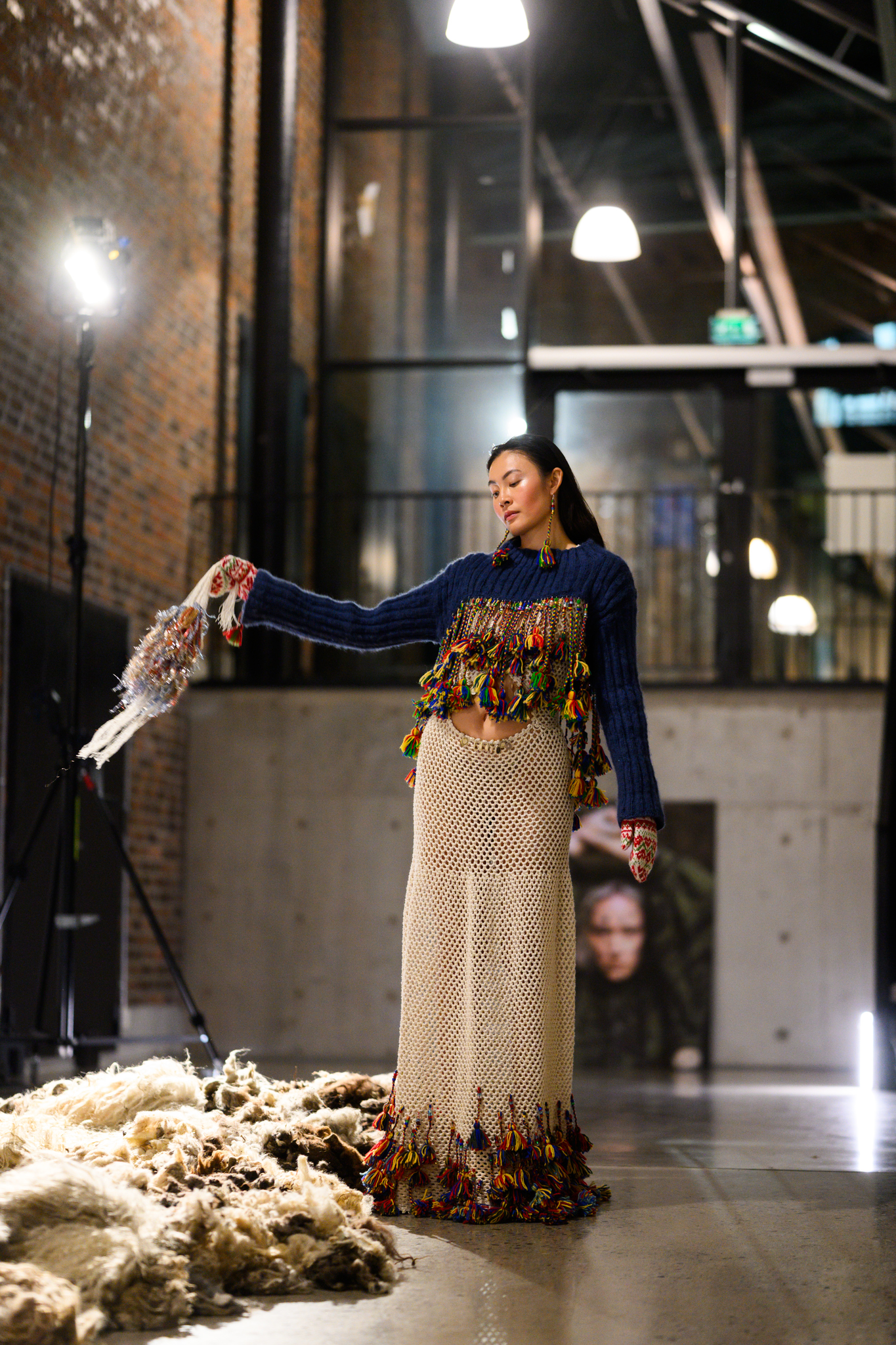
For my first ARF presentation, I will provide an overview of the motivations and foundations of my project, while sharing insights into my creative processes and travelogues from the past year. I will briefly discuss my journey to Nuuk, the intensive process of learning to weave the rátnu (and the reasoning behind undertaking such a time-consuming craft), and the exhibition/performance 'Fashion is Sharing'—which debuted during Artistic Research Week at the Oslo National Academy of the Arts on January 21st. Finally, I will offer reflections on these experiences and their significance to my ongoing research.