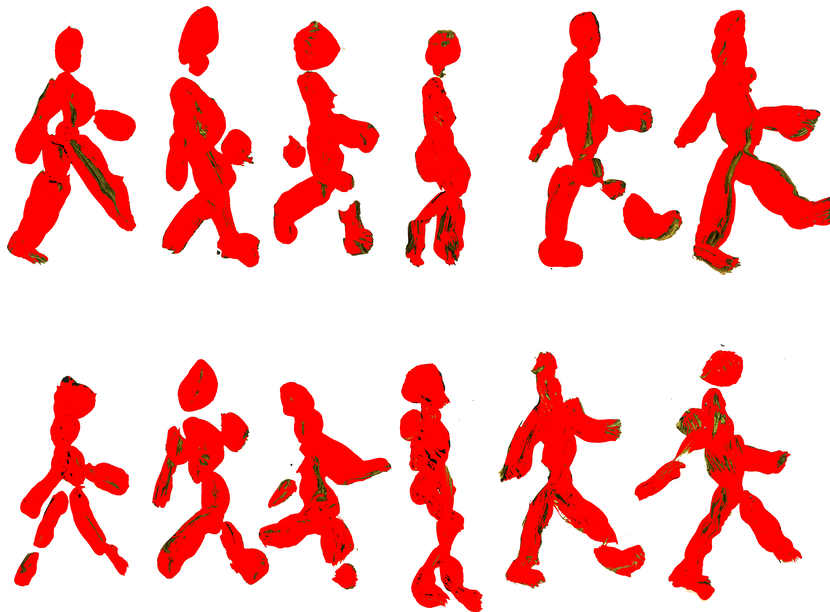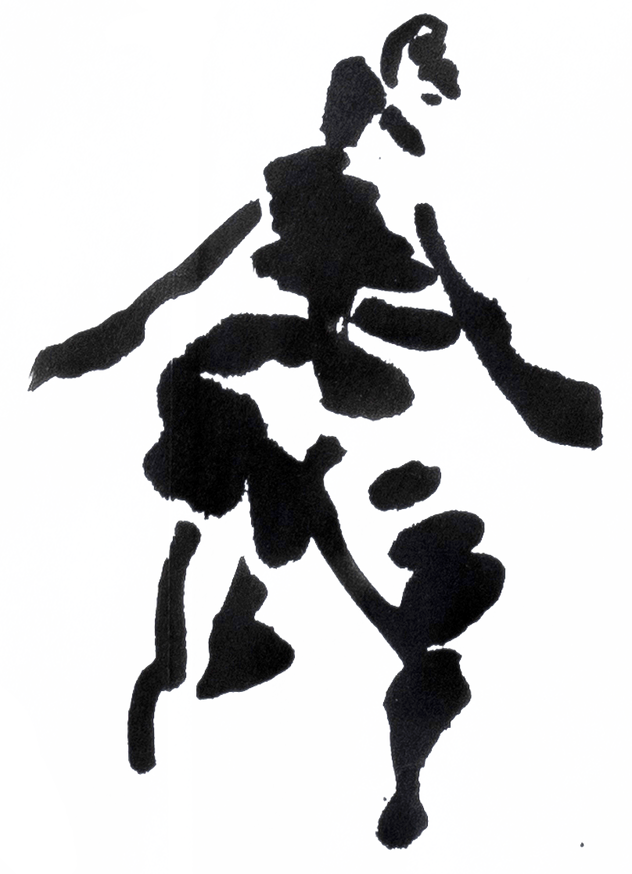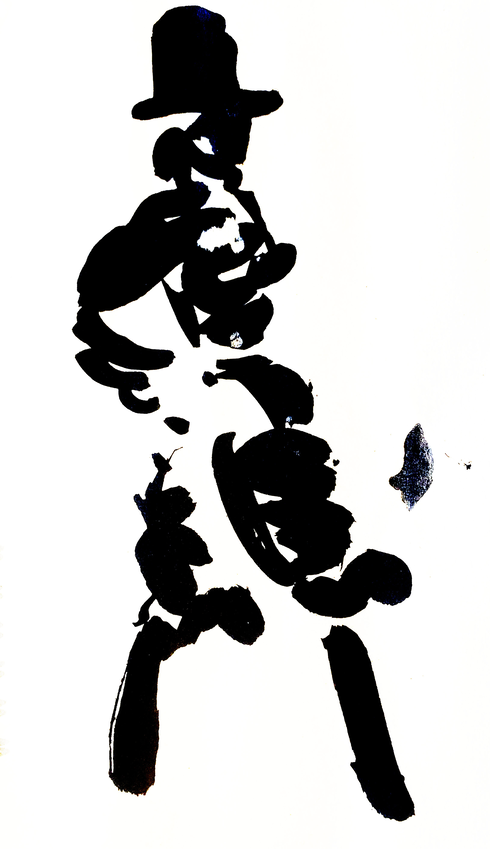
In this light, the images generated through Charms can be understood as outgrowths of an imagining body — a methodical construction of an imaginary world offered to the world. This framing implies a particular worldview: that artworks belong to another world, one which reveals itself — whether it is the artist's world or the sphere of art itself. Such a perspective assumes a distance between the viewer and the work, presupposes an external gaze upon that interiority. Like a fruit ready to be devoured. Paradoxically, these works are both of the world and outside it.
I remained acutely aware of the viewer's role in the transformation of perceived images. Reception becomes participation. To imagine artistic practice as located within a specific imaginary world positions its production within a liminal domain — between material and immaterial, possible and impossible. The body, as our first instrument of perception and action in the world, becomes the medium that collides with inert matter in a kind of corporeal confrontation.
As it will become evident, the costume Charms gave rise to a cascade of other images. It is itself an imaginative delirium, a fleshy assemblage of anachronistic and satirical references. It acts as a materialist manifesto. Its hybridity invites multiplicity and ambiguity. It lives in the crevices of the dreamworld, straddling the threshold between waking life and the subconscious. It is a visceral body — raw, exposed, and alive—urging us to imagine the body, and to do so through veins, tendons, and skin.
In my experience, the studio is above all a space of productive procrastination, a site where delays, diversions, and deviations nourish the generative process. The mutable nature of images — both mental and material — is at the core of my studio practice. Forms shift through modelling, brushwork, subtraction, and transformation, making imagination an ever-present force in the production of art. As a cognitive faculty, imagination operates through anticipation and unlikely associations. It becomes a privileged, even subversive, method — an unruly guest within the studio, unsettling any pretence of seriousness, rationality, or linear intent.
The studio turns a stage of metamorphoses. While I may set a direction, other elements invariably intervene. Imagination is one of the most potent of these forces. Once regarded in the 19th century as essential to visual perception, imagination has become, in my work, a conscious method of inquiry. Imagination and vision are entwined—one enables the emergence of fleeting, transformative mental images that suggest new relationships and unexpected material outcomes.
Imagination offers me images that crystallize through studio labour. It appears when the body surpasses mere perception and begins to excrete the imaginary. We see and are what we imagine — our perceptual cage offers little escape. In every dream or tear, we encounter not only ourselves but the strangeness that also belongs to us.
Within the studio, imaginary constructions of the body take on plastic, transformable form. The process invites accidents, visual triggers, and pareidolic phenomena — spontaneous recognition of forms within chaos. These acts are material and metaphorical expressions of organic and imaginative flows. Transformism is here understood as the plastic reconfiguration of identity, gestures toward another key force: freedom. All forms of transformation disrupt fixed structures, reordering patterns of thought and behaviour making space for the irrational and the unexpected. In assuming other identities — like a legacy from Odysseus—we adapt and become multiple.
The works I produce often function as imaginal exercises, calling upon the viewer to imaginatively invest in their embedded meanings. In the process of making, I search for a liminal state in which I become both the agent and a distant observer of the evolving material. This act of shaping—whether driven by vision, dreams, or the material’s own demands — occurs in the interstitial space between desire, intention, accident, and mimicry.
Whether drawing, painting, or embodying the costumes, I often find myself observing from outside — watching my body act, momentarily detached from both it and the emerging forms. It is as if I am under a spell — enchanted by the movement itself and the body’s longing for materiality.
This enchantment is the spell of transformation, and it is through this spell that imagination gives flesh to form.