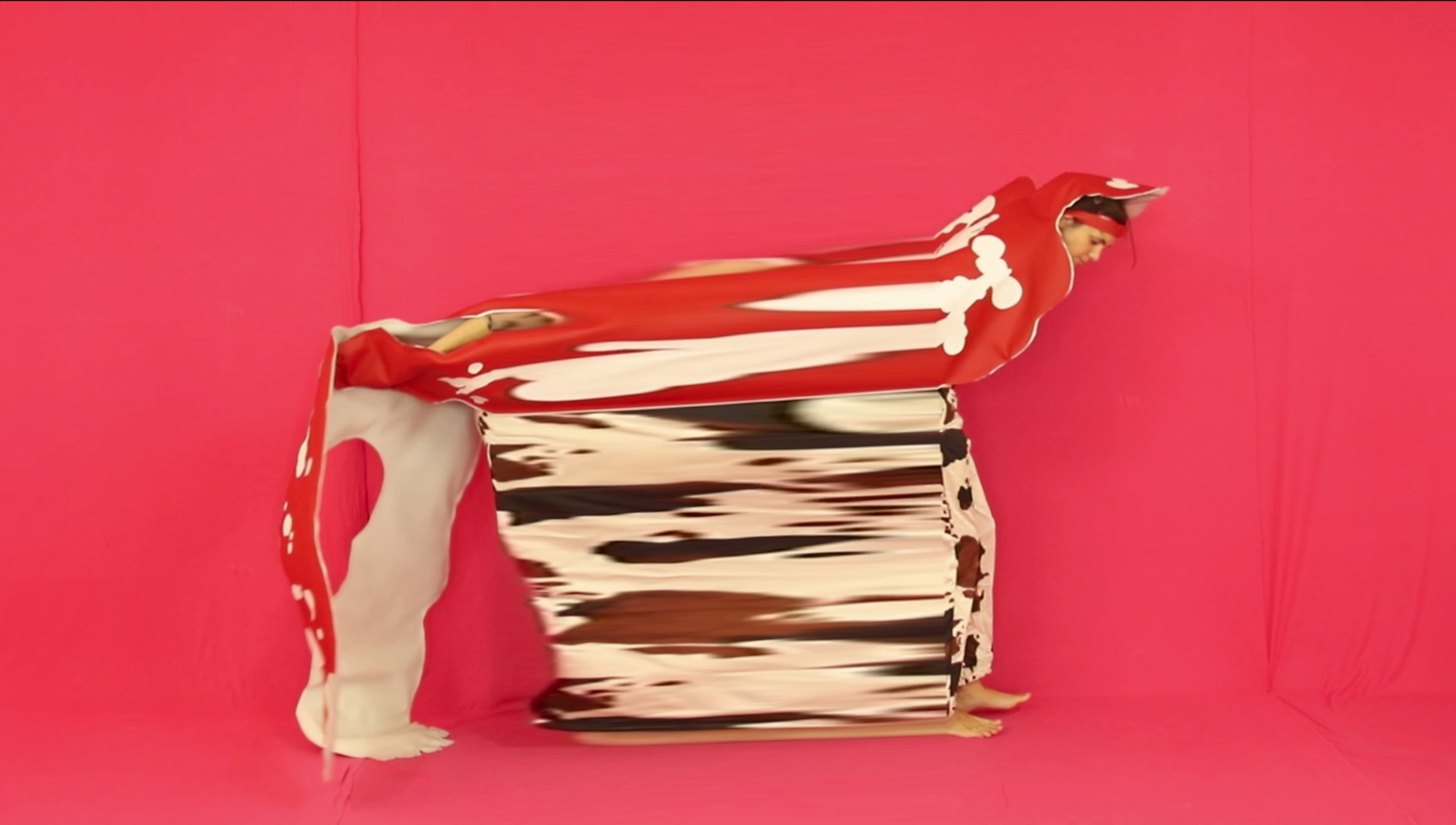
However, skin may also resist the status of armour, as it is as permeable and fragile as it is resilient. It may accommodate multiple images because, from another perspective, “the body does not conceal itself behind armour but lives on its vibrant periphery” (Dagognet, 1993, 90, quoted by Babo). Gyu's skin is a potent form that enables the dissimulation of the body it cloaks. This condition, which detaches it from notions such as envelope or armour, also fractures the deep-rooted dichotomy of interior/exterior.
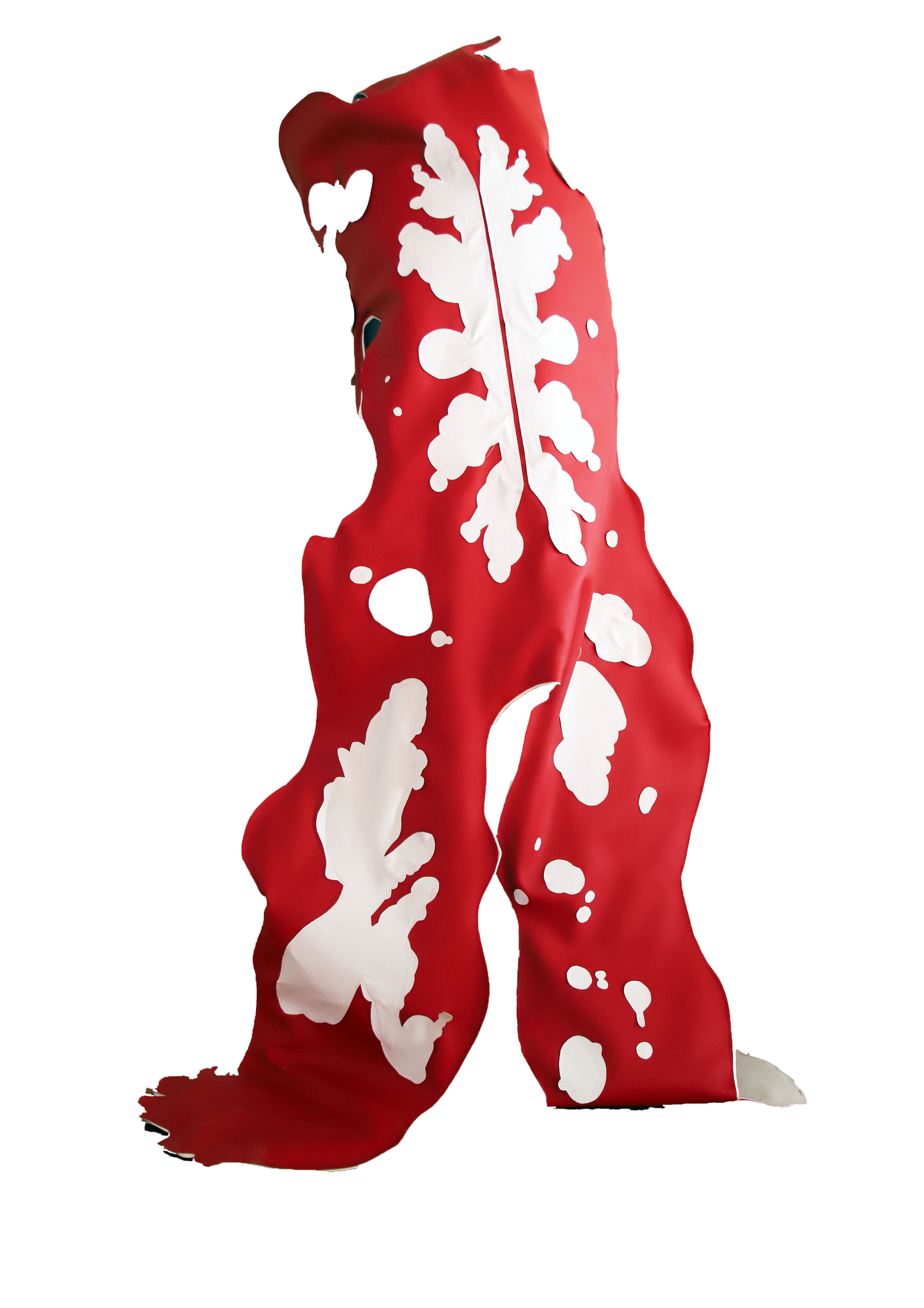
Gyu's over-skin is quite distinct from that of Charms. At one moment, it questions whether imagination — capable of dissimulation and transformation — can truly reshape matter. Can it? Hippocrates attributed such transformative power to the maternal body: the pregnant woman’s imagination, he claimed, could mold the fetus according to her whims (see Stafford, 1991). This implies that matter is passive and imagination shapes it. Skin thus appears as a surface of analysis, reflecting the interior imagination absorbed during gestation. The organic and relatively random stains on Gyu’s surface correspond to imagination’s transformative and impermanent inclinations. Through a sort of osmosis or mimetic affinity — magic! — this mottled skin unites body, imagination, and chaos within the visible world.
Let us recall that skin markings function mimetically, as camouflage, a means of identification with the environment (again, magic!). Here, I created a triple union: the dominant symmetry of the spots aligns with the morphological structure of living organisms; the red-and-white contrast evokes “marbling” (intramuscular fat between fiber bundles); and the stains mirror the pattern recognition we find in clouds.
When I cloak the body in this over-skin, I disguise myself and gain the ability to reimagine new formal compositions. Its apparent stasis gives way to folds — it can resemble a coat, become animal, or transform into flayed flesh. It covers the body just enough and grants it a new power: that of incorporation. It is a magical over-skin, whose formal plasticity becomes a surface for perceptual experimentation and articulation of other historical references. Gyu operates in me as an accessory of freedom, where — beyond the playful pleasure of its plastic potential — I find echoes of ancient tales: the Golden Fleece, the skin Odysseus dons, the Donkey skin princess, the cloak of invisibility, and even Hermes’ empowering leopard skin. This skin also evokes treated parchment hides — inscribed with meaning — and stems from a creative reflection on medical imaging.
Skin renders the body visible and, at first glance, is the beautiful outer film whose smoothness conceals an interior of visceral disorder — of fluids, organs, and muscles. Perhaps this is why it has traditionally been associated with armour, a protective device. It also serves as a support for inscriptive language, as in the medieval imaginary where human flayed skin became the surface upon which laws were written. In the Charms costume, skin is understood as a hybrid of écorché and armour — apotropaic and captivating. It embodies the form and material of a boundary: the threshold between subject and object. It is a space of disorder, capable of sustaining images for the metamorphoses of irreverent imagination that ceaselessly fabricates new bodies.
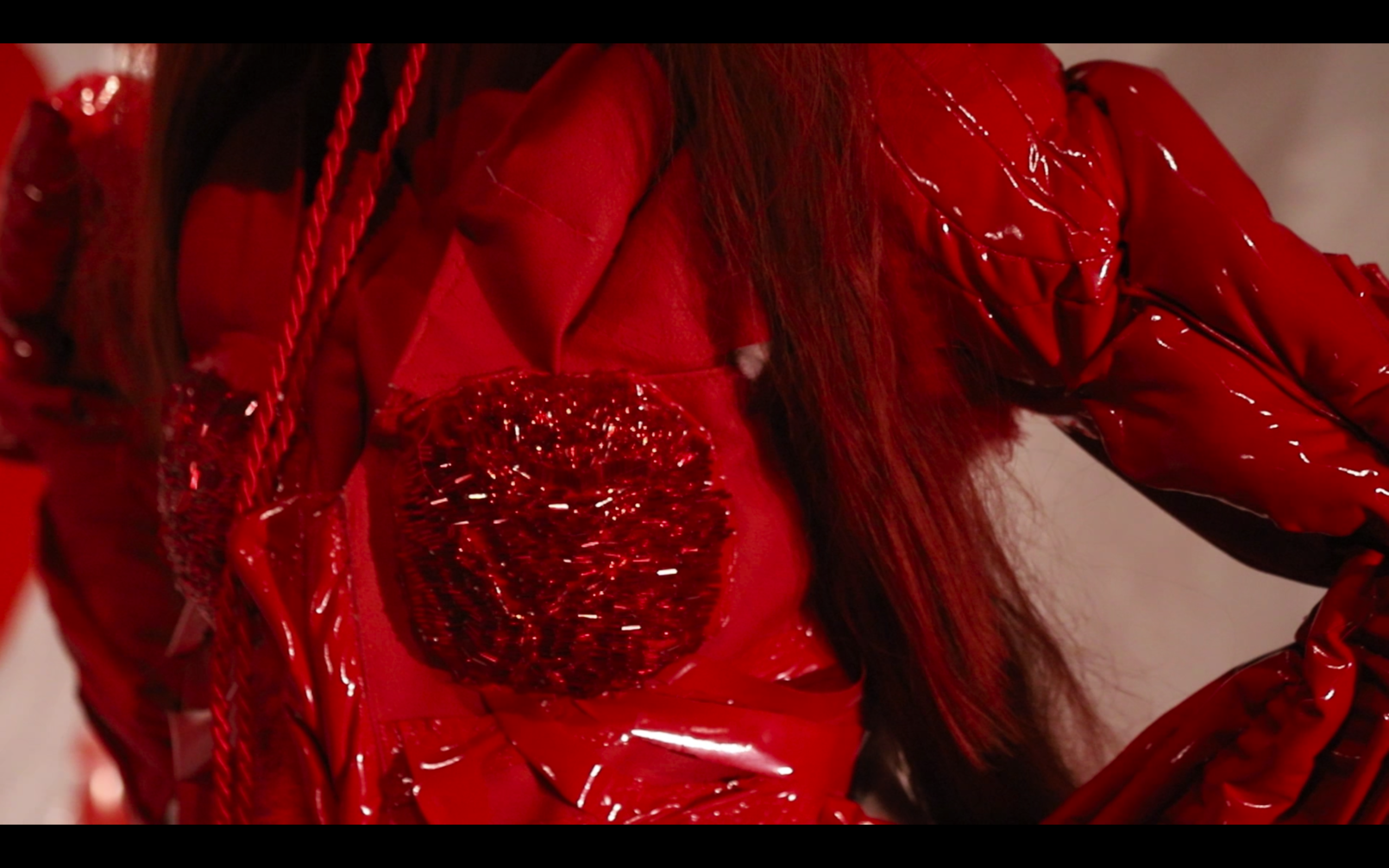
In Charms, skin is an entangled fabric of surfaces and displaced elements. It was designed to powerfully engage the sense of touch, mediated by vision. The plastic expressivity of the bright, visceral crimson vinyl evokes a somatic, pre-cognitive response — a body that feels before it thinks — eliciting precisely the type of reaction I seek from viewers of the Charms videos. The armour grants the costume an active vitality, an endogenous force of imagination and corporeality. It is an anachronistic skin—a montage of forms brought together in the present to shape a body open to imagination.
On this skin, anatomical features fuse with structural elements of armour, and with the apotropaic figure of Medusa at joints and vulnerable zones. Elements from sixteenth and seventeenth century clothing (ruffs, coats, stockings) also blend in.
This montage of temporally diverse components suggests a work of temporal complexity, rather than one simply inserting itself into a historical frame. It is thus a skin freed from a homogenous historical narrative, striving instead to express “the exuberance, complexity, and overdetermination of images” (Lund, 2019, 24, quoting Didi-Huberman).
But Charms’ skin does not merely cover his literal body. The costume acts as a demiurge, constructing its own imagined environment. The skin expands into the surrounding space, as evident in the video where the scenography features stains. The opposition between inside/outside, subject/object, collapses. It is a visual metaphor of how we imagine with every vein, tendon, joint — with the pulse of blood. His inverted body is flesh, matter shared with animals and humankind. Despite its references to humanist history, Charms' form is not anthropocentric but rather an opening to becoming, transformation, and relationality with other beings.
The impertinence of imagination manifests when the gaze exceeds its bounds and sympathetically recognizes itself in external elements. In this way, the skin acquires a profound symbolic dimension — as the primary surface of inscription: expressive of the human being’s interiority, a tangible and visible interface of desires and imaginings. It becomes the ideal space for impertinence, and perhaps for this reason, it is subject to myriad transformations across diverse cultural practices. More than a fleshy film, the skin delineates the body's boundary. Yet it also overflows, a corporeal medium through which flows the full semiotic charge that invests the body—from nourishment to linguistic-cognitive competence.
Charms’ body nullifies itself to become a vehicle of cultural and phylogenetic memory, articulated in a language that transcends spoken expression, defining it and rendering it, to some extent, undecipherable. It is an inverted body, expelling its interior, emptied out, and whose surface-image unsettles and transgresses precisely by disrupting the order that should prevail (the structure of the body, the division between inside and outside). It inverts biological and logical orders, even enacting a form of interdiction: to show what should remain unseen. What is inside is meant to stay inside. Yet the anatomical écorché figures proliferating in Europe from the sixteenth century reveal skinless bodies, their veins and muscles exposed, often posed in classical postures or demonstratively holding the knife that flayed them. The notion of the flayed body as an over-skin — a body that overlays another, rather than simply exposing the skeletal frame — suggests layers, superimpositions, akin to garments. Curiously, some engravings and woodcuts depict the flayed body evocative of coats—skins-as-coats. These images, in my view, derive from earlier medieval metaphors that equated skin with clothing. In the medical realm, Guy de Chauliac, in a 1363 treatise, distinguished the outer skin from another, which he termed panic [from pannus, cloth], said to envelop the inner organs. Skin is thus a visible marker and regulator of the boundary between interior and exterior.
Before turning to the genealogical context of the anatomical flayed figure and the all'antica armour — elements that merge into a single skin — I introduce Charms' two skins: the Charms and Gyu costumes (embodiment devices of my own creation), which, despite their differences, share a common function: surfaces of affection and becoming, between the self and the other.