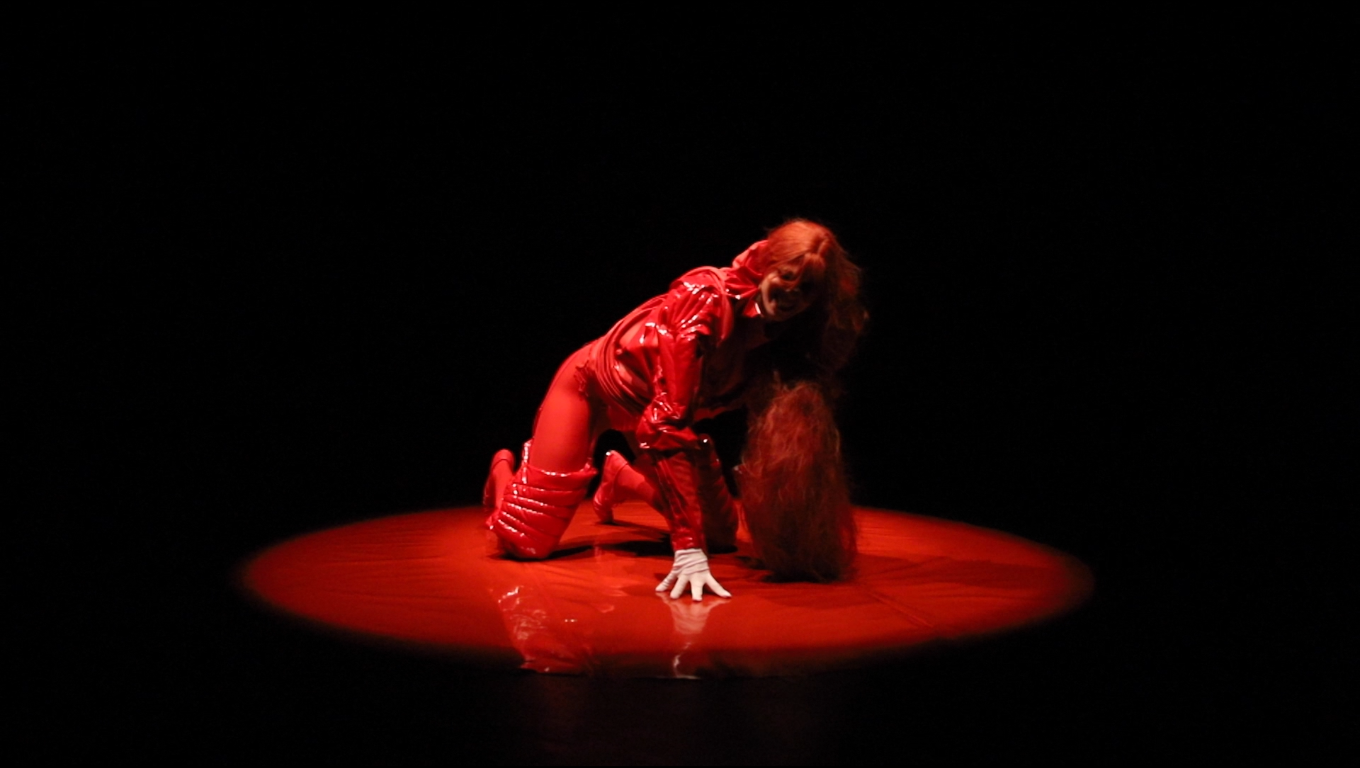
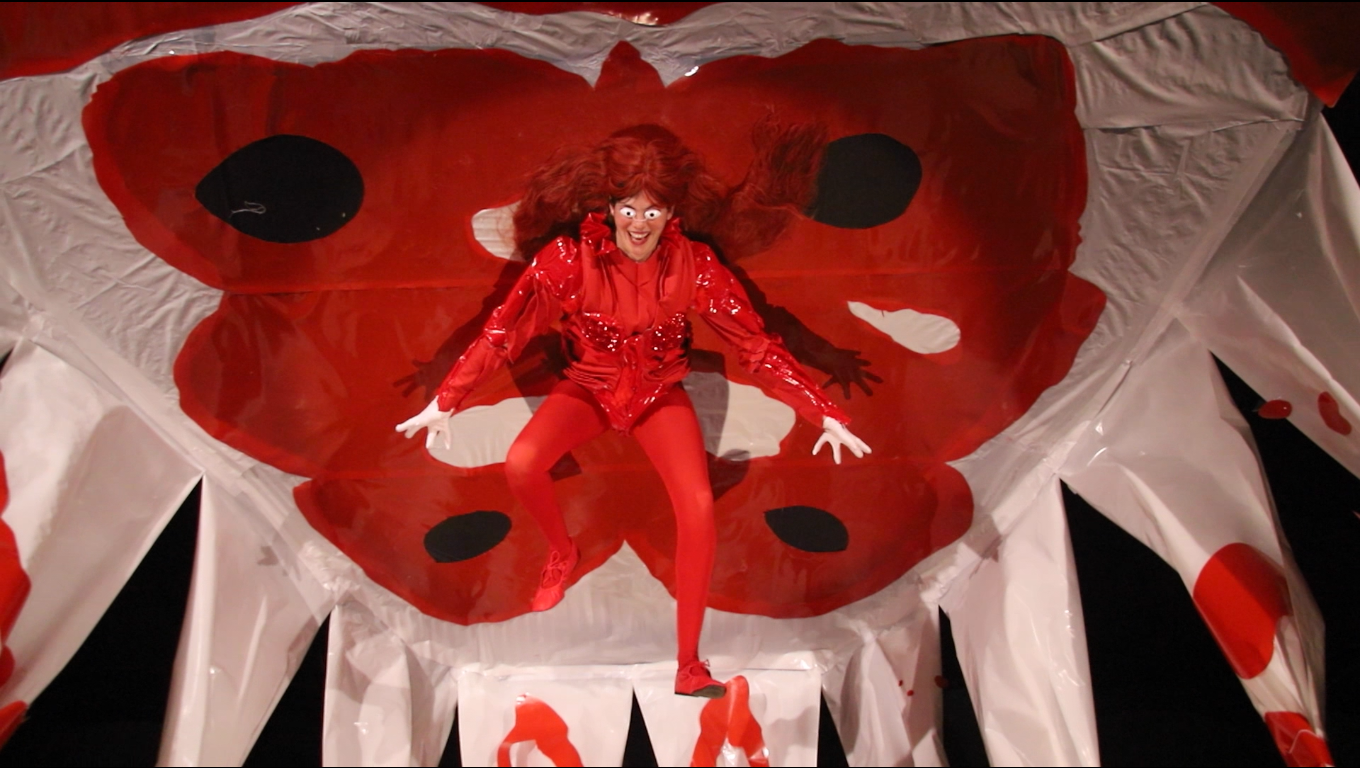
Charms emerged as a vision during a liminal state of consciousness known as hypnagogia — between sleep and wakefulness. This vision, somehow perceived as an external image, was a red, swollen, shiny body, deeply fissured. Hands penetrated these fissures, paradoxically reaching their skin from within. Between the fissures and the raw flesh were white feathers. A skin within skin, a body dressed in body. Desire. More relevantly, it was a vision that profoundly appealed to touch. This was Charms' first subversion: an inverted body, an exogenous image — a spell clinging to me that awakened the desire to externalize the imagined in the studio.
But... how does this subversion happen? Subversion occurs when the usual order is reversed.
This happens at multiple layers in Charms, the most palpable being the transformation of the internal and vulnerable into a protective device. An apotropaic body bearing paradoxes, multiple temporalities, and in constant becoming. According to Descola, the body, which once found its image of inner beauty in nudity, in the evidence of its red and visceral interior, reveals its true nudity when “stripped of both its epidermis and its spiritual mesh that clothed it with a memory of incarnation” (2010, 97). For José Gil, the flayed are not naked, “they ended nakedness by removing their own skin” (1995, 128), an idea illustrated in various prints of flayed figures posing proudly, wielding the blades used to skin themselves. If they are not naked, then they are dressed. An inversion takes place. Perhaps this is why a meat suit is such a potent transgressive image.
The impertinence of imagination always lies in imagining the impossible — or the invisible. Making the invisible visible, or uncovering traces of invisibility in matter, is like a film that adheres and settles — like skin coating the body — onto Charms. My imagination’s impertinence lies in imagining with the body and making it a tropos of transformation, from the standpoint that we can only access the world through our biotype: dissolving the perception of being mere voyeurs of what we observe, and instead, grabbing the bull by the horns—becoming immersed agents in the construction of the real. In Charms, the body is both producing agent and image of itself. This simultaneity of categories demands a constant unfolding on my part, integrating movement (imagination's a priori condition) as both process of imagining and image construction. Imagining coincides with producing—a method I applied in performances using LABIOMEP-UP’s motion capture technology. In that lab, I could imagine other bodies through movement, translated into temporal lines in space, resulting in the video Conjuring Alternative Bodies (2025). Additionally, I used the theatre stage to embody Charms (the video-performance figurine) through movement within a scenographic space I view as an expanded body. Movement became at times an act of subverting supposed species hierarchies (such as crawling versus bipedalism). These movements veer away from western traditions that structure the body — and the world — through splits and oppositions. I try to avoid a dualist worldview, which impoverishes and endangers understanding. I thus place my work within Bourriaud’s inclusive aesthetic, which levels form and matter as “constituent elements of a kind of cooperative” (Bourriaud 2022, 12).
In the body, flesh and image coincide — a dense intertwining of imaginations sedimented in the indistinct atmosphere where culture, biology, and dream converge. This simultaneity also creates a slight displacement, a sensation of dissociation in which the body seems slightly outside itself, out of place. The entire work thus feels like an act of conspiracy, a magical act of invoking the vitality of physis to make itself visible, to bring forms to the surface. I begin from the recognition that if the meaning of things escapes discourse, it is because meaning is disseminated in action and bodily movements. Hence the need to move beyond representations of human morphe in static images and to explore the moving image — born of bodily experimentation — as the ideal medium to construct this fictional work.
The crimson armour is embodied, and I experiment with unlikely compositions with the over-skin. The body leaves a visual trace, implicating the gaze of others who participate in the meaning-making of these potential images. All the visual anachronisms that compose these bodies stem from periods in which individuation arose as a concept (Renaissance, Enlightenment, Modernism), when perception and phenomenology became topics of inquiry and, in the realm of body representation — both artistic and scientific — sources of complex image production, between abstraction and figuration.
"Charm" is a spell cast upon the other, a protective amulet worn close to the skin. For any image of the body is a cultural construction, an artifice (just like the charm, which seduces in order to install its truth) I invite you to step into this charm:
This charm infiltrates the materiality of the works produced in the studio, both as a way of captivating the gaze and as a subterranean method for image production.
Charms reflect magical thinking more than logical or rational processes. Magical thinking endows objects and beings with a metamorphic power, it arises from a state of unknowing and links magic to the combinatory art of imagination, a cognitive faculty rooted in the body. This ability extends beyond the body itself and unfolds in the artwork, where body-images are rearranged, displaced from their usual contexts, creating new meanings.
I consider artistic work as a series of actions that preserve values marginalized by rationalization, as this work cannot be reduced to the ideology of utility.
All the works that comprise Charms are rooted in the performativity of the body and its reimagining through an assemblage of images. It arose, by coincidence or inevitability, at the core of the body itself.
Since the relationship between image and body is foundational, I immediately understood that the skin's surface would become the tropos of symbolic transformation. This skin that both reveals itself to sight and to touch. That vision expanded into a digression on the rise of the scientific body, beginning with anatomical flayed-body imagery and its reflection in all’antica armours as over-skins. The flayed body—exposed and fragile, yet also strong and protective like an apotropaic armour. Studio works soon emerged in the form of garments to be embodied and performed in video.
These garments diverge from their apparent function of covering the body, instead becoming visual devices laden with symbolism: a body's artifice.
Charms appears — a figure tied to vision and a central element of the practice — as does the other work, the over-skin Gyu (meat in japanese), both inseparable from a scientific or medical body established during the Renaissance (a body emptied of its interior, as we will see throughout this exposition).
These impossible bodies were reenacted through the reimagining of the human morphe, anachronistic references and hybrid costume elements. Oriental hats, petrified eyes like the ones at archaic sculptures or mummies, white gloves like those of a magician or cartoon. But also, clinging to the visceral, inside-out armour — referencing musculature — are elements of attire corresponding to the flayed-body period. I found a simple visual analogy for the symbiosis between clothing and skin, dissolving categorical boundaries.
This idea reveals the medieval metaphor of skin as garment, which I believe underpinned later anatomical representations of flayed bodies as if wearing overcoats. The integration of all these elements allowed me to solidify the initial vision with a memory that I understand as both cultural and phylogenetic. Charms has always existed.
The image of the body is reconfigured from an amalgam of references, highlighting the hybrid constitution of the costume and, more subliminally, of all living beings. This project is an act of conjuring, of bringing imagination to the surface of the skin, to the inescapable materiality of bodies — whether organic or fabricated in my studio. I transform the interior into the exterior, the invisible into visibility and the imaginary into matter. Over-skin upon over skins: the imagination made material, the body reimagined.
The body emerges as both medium and support for images, the two being inseparable, in an anthropological perspective as defended by Hans Belting (2014), who sees the human being as the site of images that fill the body. These are manifestations that take form through the experiences with which the body collides, and which are intrinsic to it.
Speaking about the body demands an exercise in contouring its boundaries, as one faces the difficulty of its widespread metaphorical use. It is as if the body itself has been reduced to its organic materiality, emptied of meaning in order to better accommodate other significations. Metamorphosed, it becomes a medium in which cultural and ritual codes are inscribed. The image of the human body is a construction—there is no "natural" body, for meaning is always inscribed upon its flesh. This inscription, which transcends its physis, can take on various formal manifestations.
The cultural crisis articulated through the body arises from the way we have learned to separate ourselves: first through mythical narratives, and later through the dualism imposed between logos and physis. According to Bragança de Miranda, the body is the result of a “long process of invention, ruptures and metamorphoses, which eventually constructed our body based on a logical reality, of logos — which does not correspond to the evidence, since we are naturally physis, that is, flesh” (Bragança de Miranda, 2017). Knowing what matter the body is made of does not, in my view, empty it of the potentials of meaning it continues to carry “within” itself.