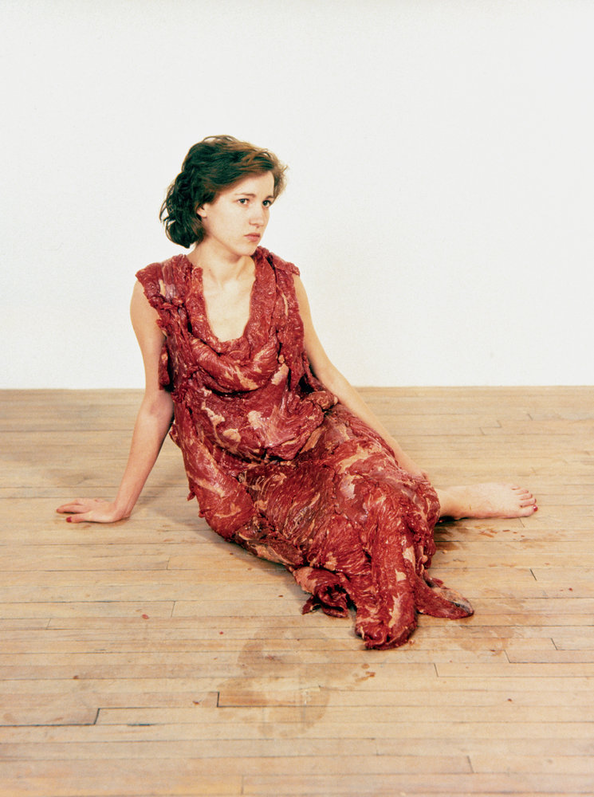
Vanitas: Flesh Dress for an Albino Anorectic [Performance documentation]. Sterbak, J. (1987).
Courtesy of the artist.
Philippe Descola holds a different position from José Gil regarding the transformation of the body instigated by the flayed figure. According to Descola, the body, which previously found the image of its inner beauty in nudity, in the evidence of its red and visceral interior, reveals its true nudity when "stripped of both its epidermis and its spiritual mesh that clothed it with a memory of incarnation" (Descola 2010, 97). For José Gil, the flayed figures are not naked; "they have ended nudity by removing their own skin" (Gil 1997, 128), an idea literally illustrated in various prints of flayed figures that, in pose, display their bodies and wield the blade with which they removed their own skin. So, if they are not naked, they are dressed; an inversion occurs. Perhaps it is precisely for this reason that a meat suit is a potent transgressive image. There is an incorporation of the body itself by the body, a feeling of the body as another. Maria Babo points to the human body's capacity to incorporate other elements into itself This observation corroborates the flesh as "a plastic reality [...] open to technique as an amplifier of perception and sentient faculty, so that it is no longer pertinent to pose the question of inside/outside or of the skin as the limit and frontier of the body" (Babo 2004, 26).
In this line of thought, wearing the flayed figure is nothing more than taking one's own body. Now it is the suit, like a strange tool, that wears the body. What does it mean to wear this meat suit?
Studies in social psychology confirm an impact on the cognitive performance of those who incorporate certain garments, as this act combines with the incorporation of collective cultural scripts (Babo, 2004, 68). In this case, Charms was constructed by me without a ritualistic function. However, there is an incorporation of his attributes by me, at the level of cognitive/imaginative transformation. This transformation approaches Stanislavski's "magic if" principle: a tool for actors' embodiment. In this principle, they must imagine being the character, thinking like them. It is a magical transformation of a subjective nature, entailing the internalization of the character's circumstances so that the actor may experience them as though they were real. In my case, the body functions simultaneously as subject and instrument of embodiment, operating through simulation and imaginative processes. Since the character Charms lacks psychological depth — being an emptied-out body — embodiment unfolds through the exploration of its plastic appearance, through an understanding of the body as exposed and constructed to be seen. This appearance fuses flesh with armour — a second skin melded with the body, assuming its attributes.
The costume I wear imposes itself upon the body: from the first physical sensation, wearing it proves difficult. It is heavy, its rigidity constrains thoracic mobility. The voluminous wig often becomes entangled in the grooves along the back, the hat compresses the skull, and most significantly, the red-filtered lenses obstruct my vision. These conditions collectively impose a specific way of moving and gesturing. Such actions become essential to articulating an inversion of the conventional meanings embodied in Charms’s corporeality, thus activated. He expresses himself through a clumsy corporeality: he stumbles, he sways. His voice fails to produce language, existing instead in an intermittent zone between the human, the animal, and the beastly. In this way, Charms subverts the longstanding image of the human body as the apex of a hierarchical evolutionary continuum. The manipulation of the body is constrained, demanding alternative forms of movement and generating a new mapping of gestures.
One of the most curious phenomena encountered during the embodiment of Charms was what I term a deviation of locomotion. I experiment with motor incoordination. This body, capable of producing knowledge of a fundamentally kinetic nature, becomes a medium for rethinking its relational qualities with the surrounding environment. Locomotion thus becomes a process of deconstructing bodily control, a way of exploring imagination. This form of movement, which traditionally carries associations with progress and human specificity, is rendered parodic. I began to crawl as Charms... and it was the costume itself that compelled me to return to the ground. When crawling, the body crouches and the hands become paws. The position of crouching and crawling evokes the sub-human; it conjures images of the animal realm and of a degeneration of human capacities. This act of bending also bears gendered implications: crouching has been historically associated with the feminine, and bipedalism with the masculine. In our Judeo-Christian heritage, woman has been positioned closer to beasts than to man — hence her frequent representation as either an object of desire, a prey, or a degenerate being who transgresses order and reason. It is no coincidence that we find images of crouching women — figures not entirely human — in paintings and literature alike. “To bend, to fold, to incline — that is, conquiniscere, ocquiniscere — acts of lasciviousness, as evidenced in Pseudolus III and in Prostibulum by Lucius Pomponius” (Pimenta 1995, 159). The crouching postures of Charms function as subversive gestures: they signal a body that distances itself from all hierarchical constructs — a body that surrenders to itself, echoing the self-abandonment seen in Dionysian rites. In addition to the preference for crawling, the figure also wrestles with its own hair, which assumes an exogenous nature — like another being in itself. The long, unruly hair is overtly linked to animality, reinforcing its untamed essence. This hybridity of the body is mirrored in the hybridity of its (my) movements, producing a corporeal condition that exists in tension between species, categories, and modes of being.
To embody Charms is to embody a hyper body. As with those who once donned Renaissance armour, the body’s movements become restricted— an artifice that removes it from the realm of the banal and projects it into a domain of the superhuman. The armour — this vivid crimson flayed suit — becomes a double of the body, an extension of power that dissolves the flesh’s inherent vulnerability and reconstitutes it through the gleam of a super-body. In this sense, there is a superimposition of aesthetic precepts upon the natural disposition of the body, elevating it to another form of appearance. The capacity to fascinate others becomes a mechanism of power, thus, in donning this flayed suit, I automatically embodied the values of ostentation and exhibitionism — values that align with the technical choice to film the body in action, invoking a voyeuristic gaze.
Wearing the flayed suit is also an act of conjuring an alternative body. The artist Joachim Koester, in Bringing Something Back (2019), notes that all techniques for inducing out-of-body experiences involve the imagining of an alternate body — one that disrupts our internalized body image. This is a true act of conjuration, of magic, transgressive in nature.
This flayed suit does not merely exist as a historical delirium or subversive symbol. It serves as the foundation for actions that reveal the profound entanglement between imagination and the body. Imagination — which is always an anticipation, a way of seeing absence — resides both in the movement of the body and in its images. These images may be mental, hypnagogic, or even hallucinatory (from a Sartrean perspective), and they pulse within the body’s core: in the viscera, veins, tendons, and trembling muscles. They rise to the surface of the skin, burst forth through the eyes and fingertips, generating drawings and visions.
Charms is a subversive body: he reverses the inside and the outside and moves beyond the norms of exemplary bodies: he enacts a body that resists coherence, embraces excess, and performs a poetics of disorder.
The philosopher and neuroscientist Francisco Varela argued that the mind cannot be understood in isolation from the body and lived experience. In The Embodied Mind: Cognitive Science and Human Experience (1991), co-authored with Evan Thompson and Eleanor Rosch, he posits that knowledge is not pre-formed nor merely reflected from the external world; rather, it emerges from an active interaction between brain, body, and environment — a concept known as embodied cognition. This embodiment occurs constantly, as we simultaneously are and have a body. Embodiment is a mode of presence, of unity. In the case of Charms, he becomes a corporeal image of this interaction with space (milieu), a body that expresses subjectivity.
My proprioception is conflicted; however, this may have become a privileged condition when I decided to embody both Charms and Gyu over skins. There is no psychology at the level of performance representation. Instead, there is a theatrical abstraction that deviates from verisimilitude. At times, Charms resting figure is deformed by lines of tension that blur the boundaries between figure and background. The surroundings also deform; the structure agitates. Movement is subordinated to force. The artifice is total.
As the body is also where our subjectivity infers and intermingles with space, the flayed figure is one among the multiple images that humanity has endeavoured to bring to life, carrying it to the surface of the skin. It is, however, a powerful image because it is subversive and fascinating. Wearing the flayed skin becomes an act of making the body shine in its carnality, obscene because it is exposed. The flayed armour is a carnal protection that pulses with vitality, despite always referring to the forces of death and senescence. When I literally wear Charms' over skin, I embody a memory of the world, because it is "on the skin of things that this memory is truly imprinted" (Leal, 2014, 27). This memory has various ramifications: phylogenetic and motor memory, memory of culturally inherited images, memory of transmitted gestures.
Thus, the skin assumes itself as a symbolic punctum in Charms, an expanded visual element that carries a complexity of combined memories. These skins extinguish interiority, interfaces that abandon the interior/exterior dichotomy in favour of a "vision of the body as a whole, of which the skin is the true 'power that ensures our identity and its defence'" (Babo 2017, 39).
Hair wrestling [Video with sound and color]. From multichannel installation Charms. Barrote M. (2025).
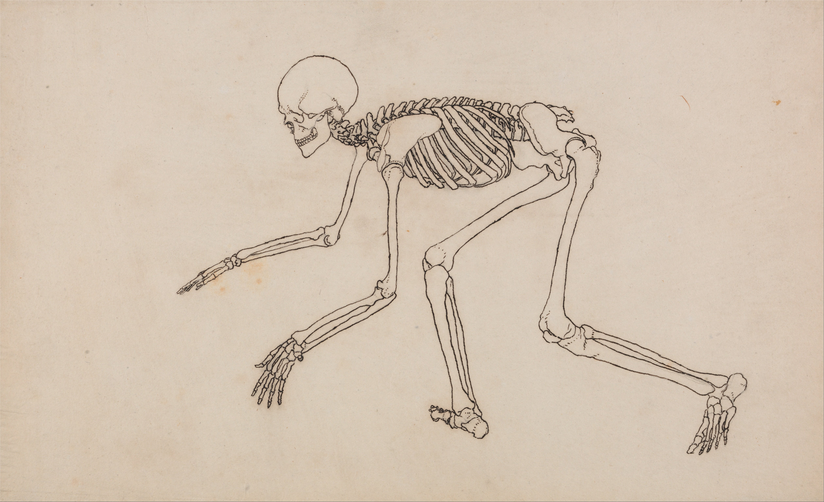
This reimagined body of Charms is an inside-out body, akin to the anatomical flayed figures of the 16th century. But how has this flayed figure survived, and what transformations has it undergone? How do artists still relate to this image of an inverted body, where red musculature replaces the skin — a terrifying and transgressive image? This body, nevertheless, aligns with the image of the scientific body that emerged from dissections and anatomical studies during the Renaissance. The interior of the body was unveiled to the point of losing its interiority and being made visible. This transgression of viewing the forbidden, which consequently desacralizes the body, emptying it in exchange for knowledge, provokes an interesting inversion. The body wears its own flesh, as if finally taking possession of itself.
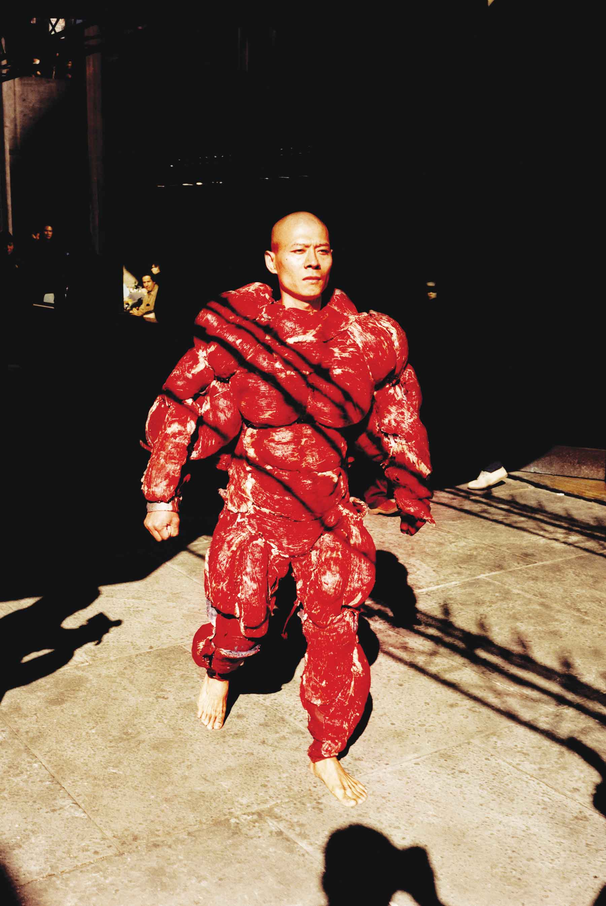
This image of musculature as armour, an over-skin, persists in visual culture to this day and still demonstrates its repetitive presence as a subversive manifesto. For instance, the raw meat attire worn as protest by Canadian artist Jana Sterbak in 1987. The red meat overlaid on the living flesh of the body has an impact directed first at our physical sensitivity, as a threat. Such sensitivity to the skin of those who view these meat armours can be observed in the raw meat suit that hyperbolically mimics the body's musculature used by artist Zhang Huang in his performance My New York (2002). This meat suit created a protective shell that endowed Zhang Huan with a formidable presence, approximating him to armour, an overlaid addition that amplifies the body's powers. However, as Eleanor Heartney (2007) aptly notes, it is also this same suit, with its raw and red surface reminiscent of a flayed body, that brings the artist closer to sharing the animal condition.
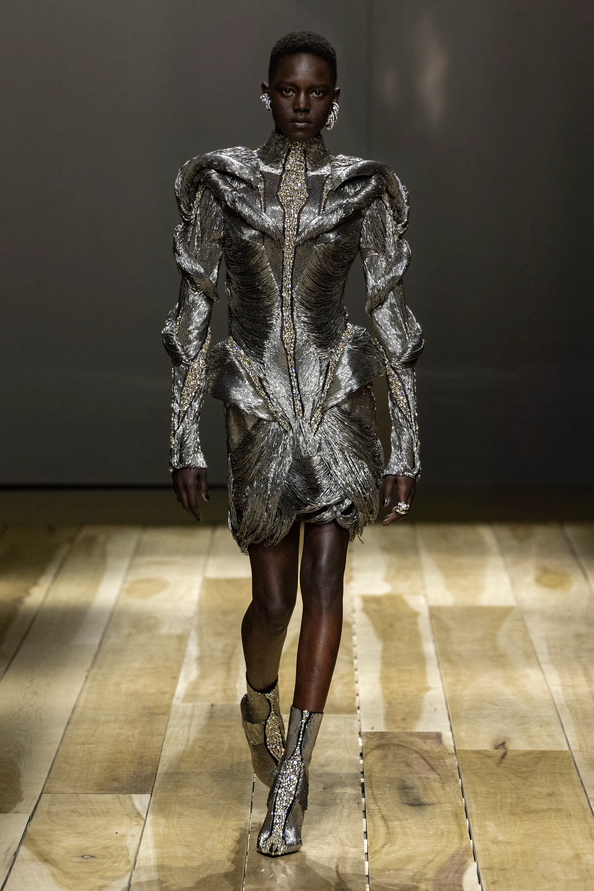
A curious fusion of flayed figure and armour is the costume designed by Eiko Ishioka for the film Bram Stoker’s Dracula (Francis Ford Coppola, 1992). Dracula's armour is a blood-red flayed figure of hybrid anatomy. It appears as a body in raw flesh, much in the style of the horrors committed by the historical Dracula. The hybrid aspect of the armour, between the human and the animal, also highlights the contamination of cultural references to both Western and Eastern armour. Designer Sarah Burton presented the Anatomy I collection (inspired by Leonardo da Vinci's drawings) in Alexander McQueen's AW23. One of the dresses in the collection unequivocally invokes the fusion of the anatomical body with the shiny, metallic body of armour.
There are plenty examples, and the persistence of this metaphor in the imaginary and cultural construction of the human body is understandable. The anatomical body continues to intrigue and surface to the skin, becoming a duplicate of the body, an over-skin for those who wear it.
This relationship of the flayed figure as a garment has been continuously demonstrated since its earliest images in the 16th century, but also through its relation to armour. From the outset, images of flayed figures reveal this relationship:
The process of establishing a science began by tearing the body away from man, to make it its object. The irreparable lies in this interior of the body that can no longer transform into a place of metamorphosis: it is exposed, it is to be discovered. It is no longer the body with skin that will be a surface of mobile and plastic inscription, relative to knowledge: the flayed figures are not naked; they have ended nudity by removing their own skin — without skin, they remain, however, alive, dressed in muscles, which mark like tattoos, which simulate overcoats (see the Hussar) or fabric dresses. (Gil 1995, 128)
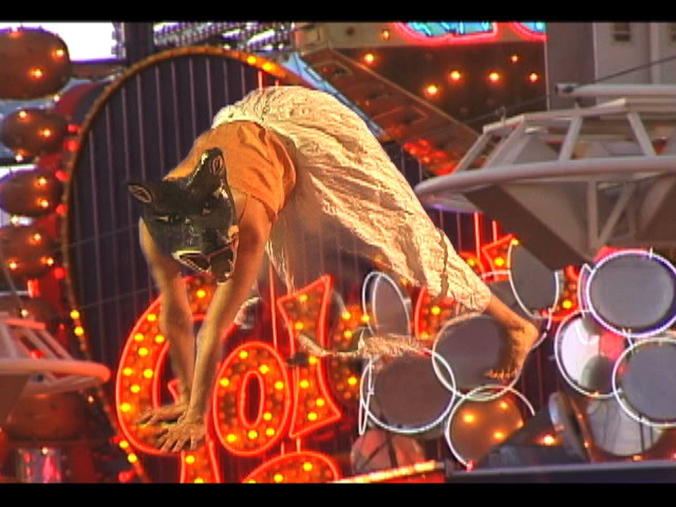
Wolf Lights [Single-channel video, color, sound, 2:49 min, loop. Ed. 5 + 2 AP]. Jonas, J. (2004). © Joan Jonas.
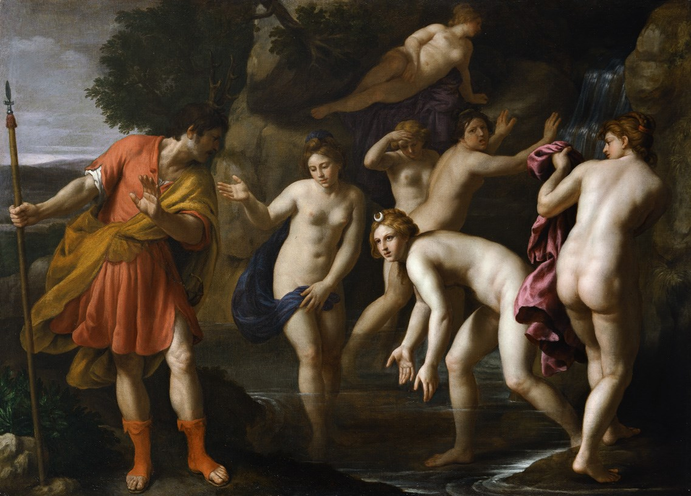
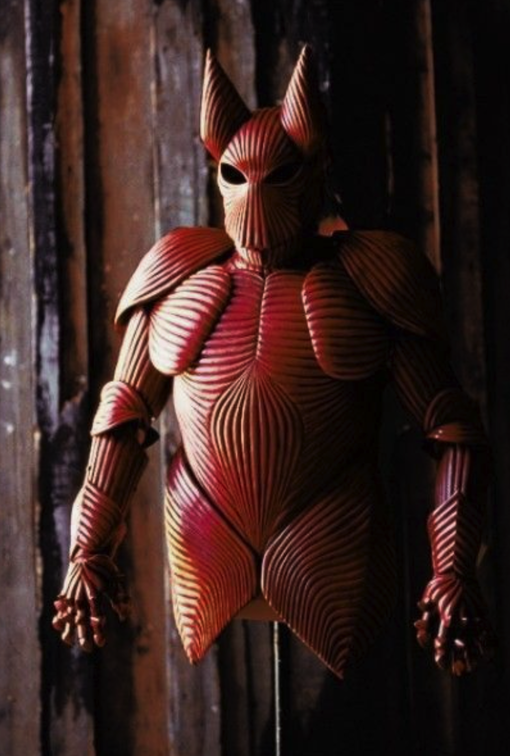
Costume design for Dracula [Photograph]. In Francis Ford Coppola (Director), Bram Stoker’s Dracula [Film]. Columbia Pictures. Ishioka E.(1992).