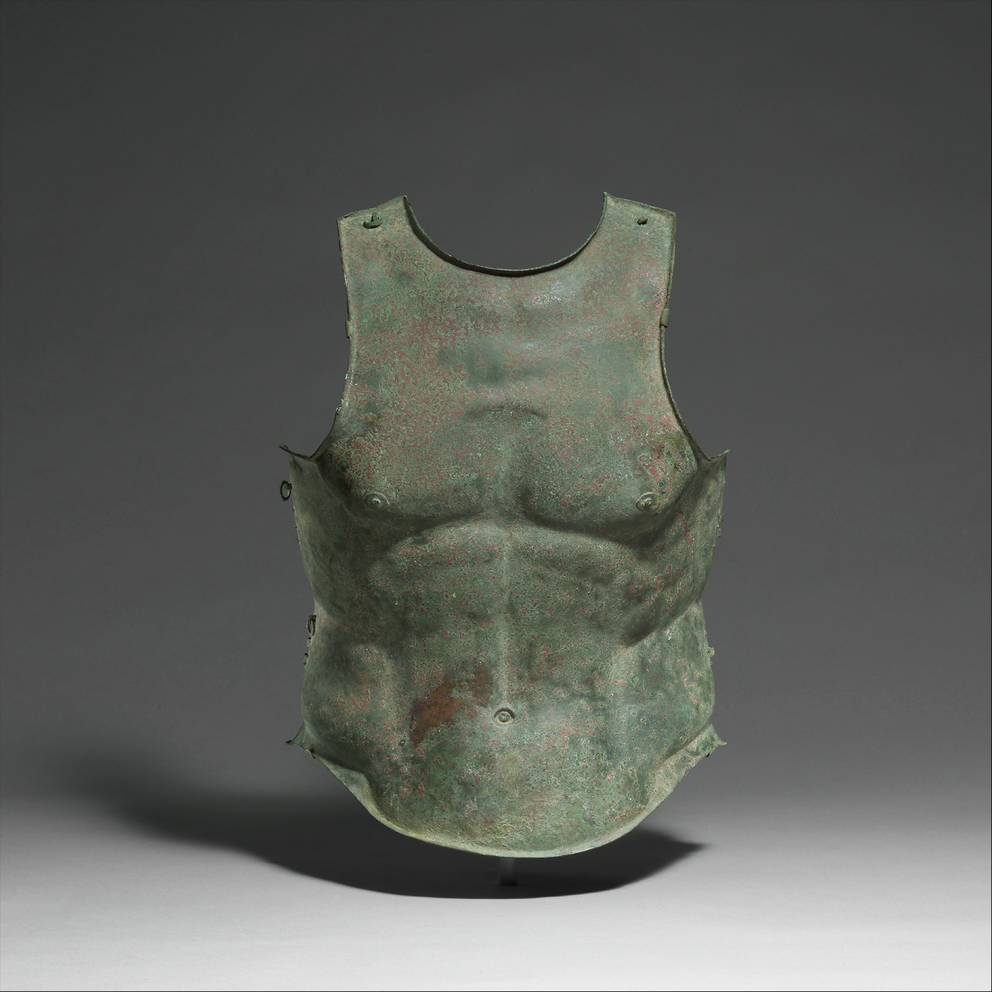
Cuirasse all'antica. Milan, ca. 1545-50. Museo Nazionale dell Bargello, Firenze. Not in exhibition. Public domain.
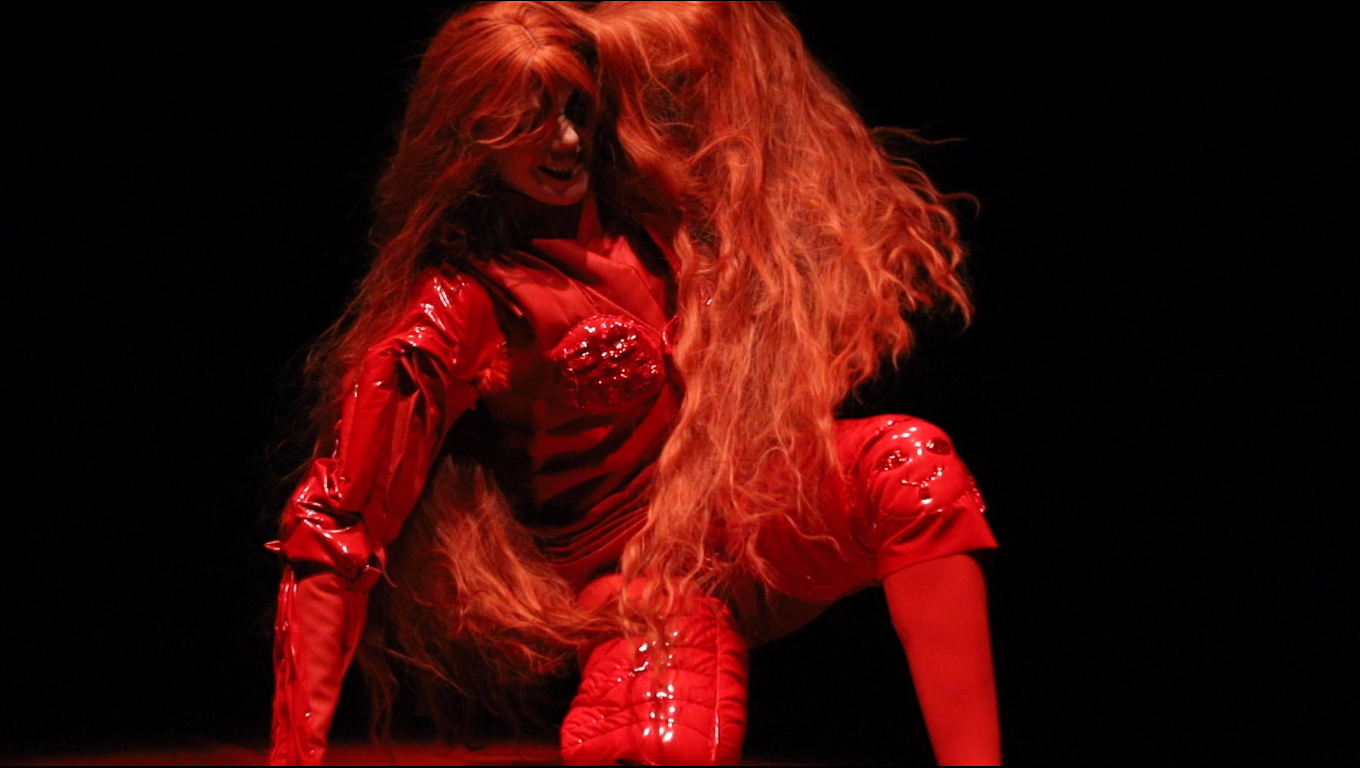
The world of imagination unfolds in Charms' body. Excessive in its constitution, provocative in its bright crimson hue, this excess serves as an initial trap, meant solely to captivate the gaze. Here, one dreams of delicate bodily imagery: mental, hypnagogic, hallucinatory. On its overskin or hyperbody, visual references intertwine: flayed anatomical figures and elements of 16th-century armor and clothing. This fusion creates a hybrid entity —neither flesh nor garment — emphasized further by the torsion and contrasting fabrics employed. This flayed body is also in transit: between the structured order of a suit and the luxuriant, chaotic disarray of a body devoid of skin.
During the 16th and 17th centuries, the image of the body underwent a profound transformation, coinciding with new observational methods and the dissection of cadavers. Anatomical engravings of flayed figures helped establish this shift towards viewing the body as a scientific object. Interestingly, armor too experienced significant changes in this period, shedding its practical and martial purposes to become a symbolic device that idealized the body all'antica.
This exposition presents the body inside-out: reconfigured according to the structure of armor in a perverse play where, paradoxically, flesh becomes a kind of overskin. Merging these two images results in a flayed, armored body full of contradictions that subvert established binaries: inside/outside, alive/dead, human/animal, powerful/fragile. This hyperbolic, subversive body reveals itself repeatedly across time, attesting to the persistent entanglement of the scientific body with imagination and visceral sensation.
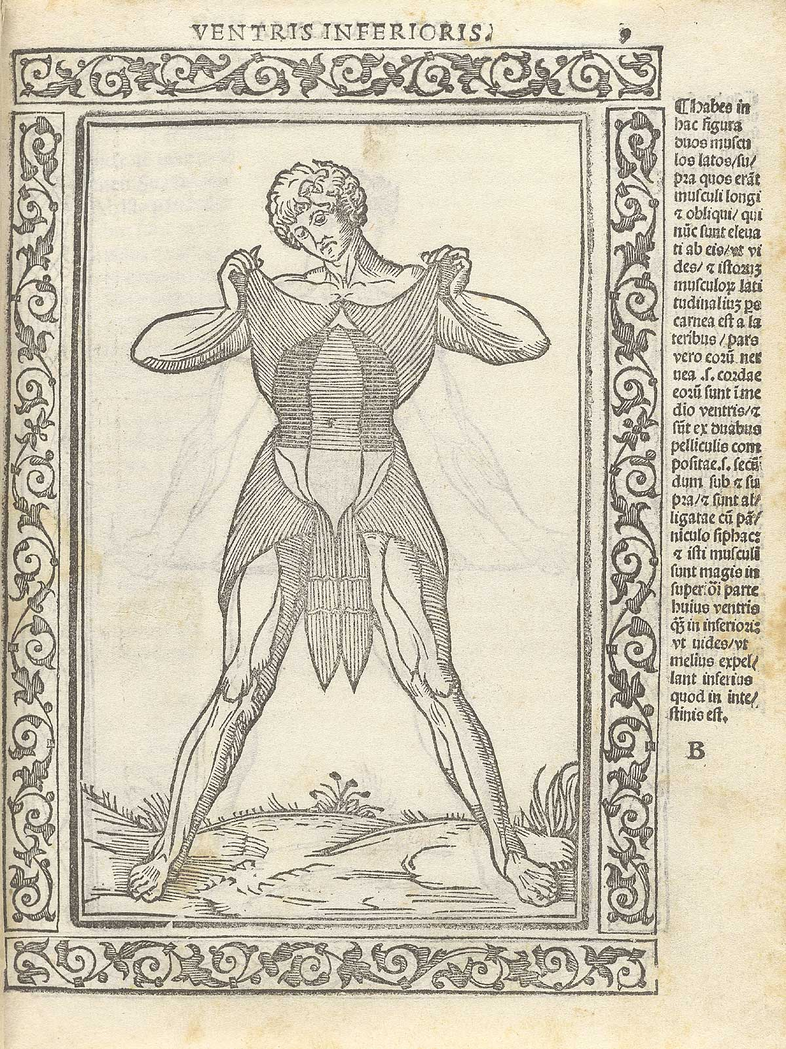
Berengario da Carpi, J. (1522). Anatomia Carpi Isagoge breves perlucide ac uberime, in anatomiam humani corporis [Woodcut illustration]. public domain. https://archive.org/details/b33083782/page/2/mode/2up
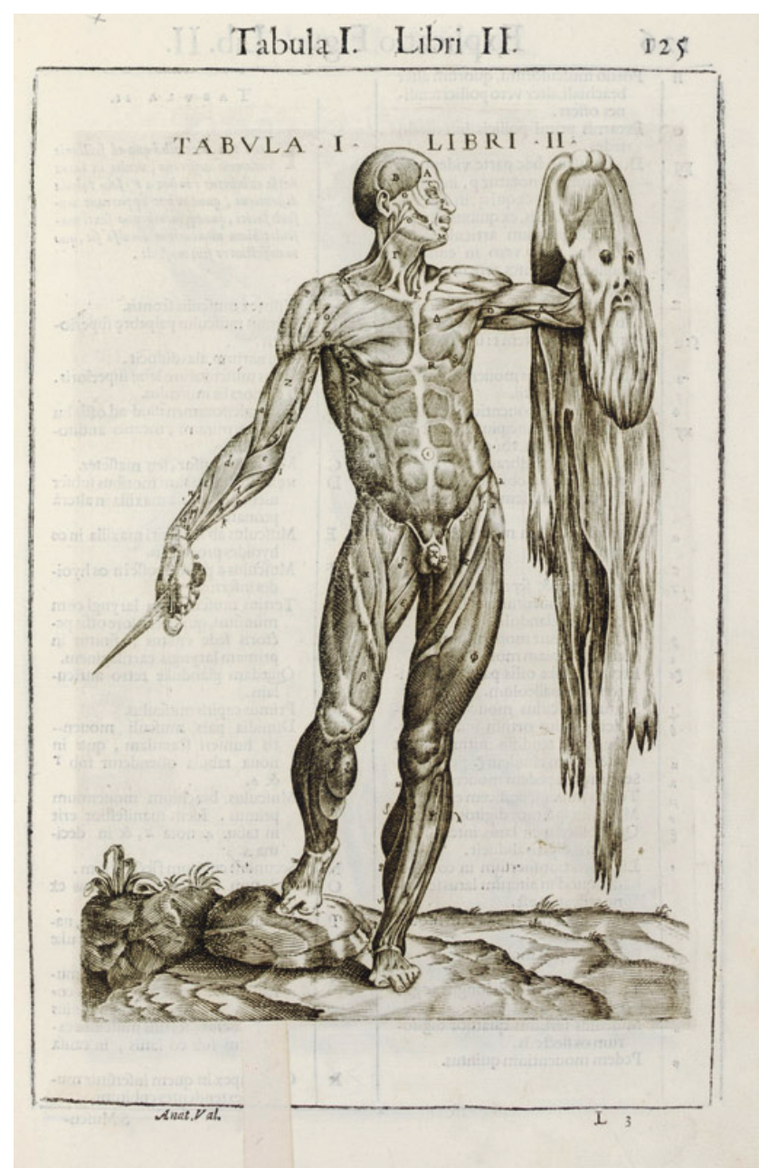
Écorché holding his own skin. Engraving by Nicolas Beatrizet, in Juan Valverde de Hamusco, Historia de la composición del cuerpo humano (1556). Public domain.
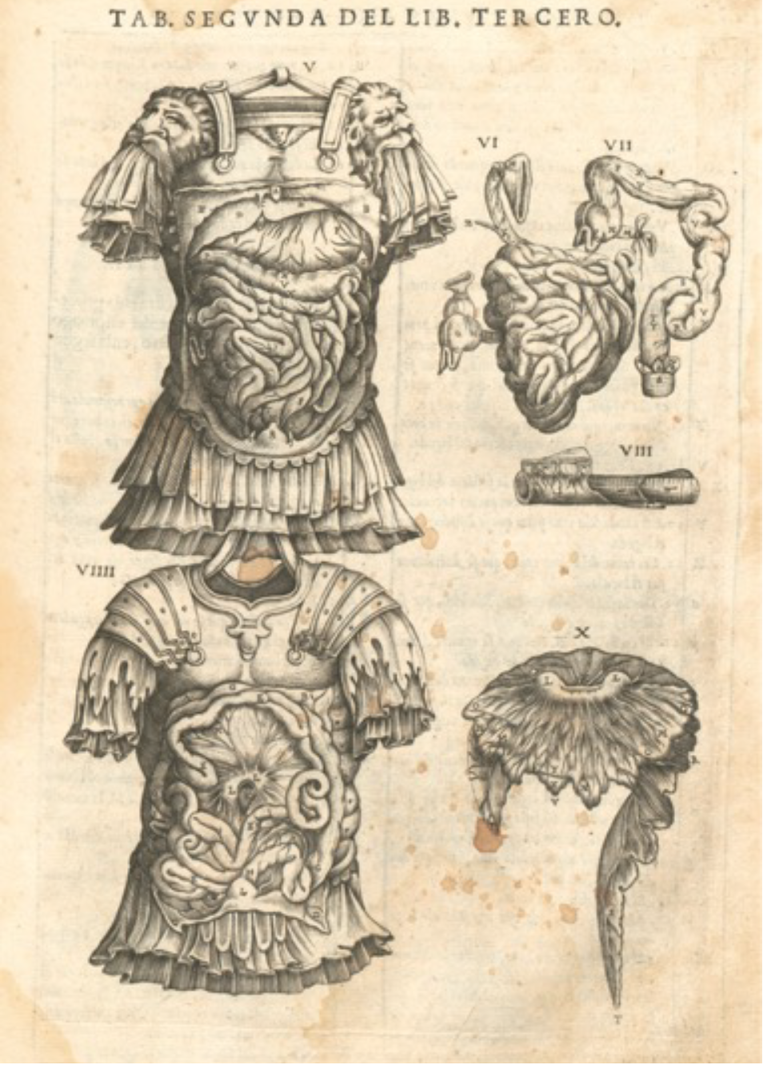
Valverde de Amusco, J. (1556). Historia de la composición del cuerpo humano [Engraving]. Public domain. https://archive.org/details/2294023R.nlm.nih.gov
REIMAGINING CHARMS' SKIN
a genealogy of the 16th and 17th centuries
anatomical flayed figure and armour all'antica
Isagoges Breves (1535) by Jacopo Berengario da Carpi was the first printed anatomical treatise to contain original illustrations not based on medieval manuscripts. Within it are flayed figures that appear to wear muscles like jackets, or to peel off their skin, displaying bare muscles as the true surface. These paradoxical images — a body dressing itself after removing its own skin—sparked my curiosity. They suggest an autonomous body. Yet it is in De Humani Corporis Fabrica (1543) by Andreas Vesalius that the new visual method truly materialized. Its anatomical illustrations, marked by accuracy, are rooted in a scrutinizing gaze aligned with scientific inquiry.
According to José Gil, this new visual language endowed the body with a scientific lexicon. The medical corpus was inaugurated (Gil, 1997, 128), and its representation followed suit. Anatomical illustrations dissect the body layer by layer, from skeleton to muscle. The flayed figure stands at a key moment in this unveiling: stripped of skin, musculature exposed. Sometimes it holds its own skin, peeled with a knife; at other times, it appears to be removing muscular garments. This emptied body, desacralized through exposed arteries, tendons, and viscera, becomes an animalistic, perishable shell. Without interior. But it is upon this emptying that scientific knowledge was built (Gil 1997,142).
During the same period, armour underwent a major transformation. As a practical device, armour constrained certain movements and enhanced others beyond natural human limits. Once it shed its martial function, it became a symbolic apparatus of bodily defence — a reinforced double of the wearer with apotropaic qualities (Stoichita 2018, 1).
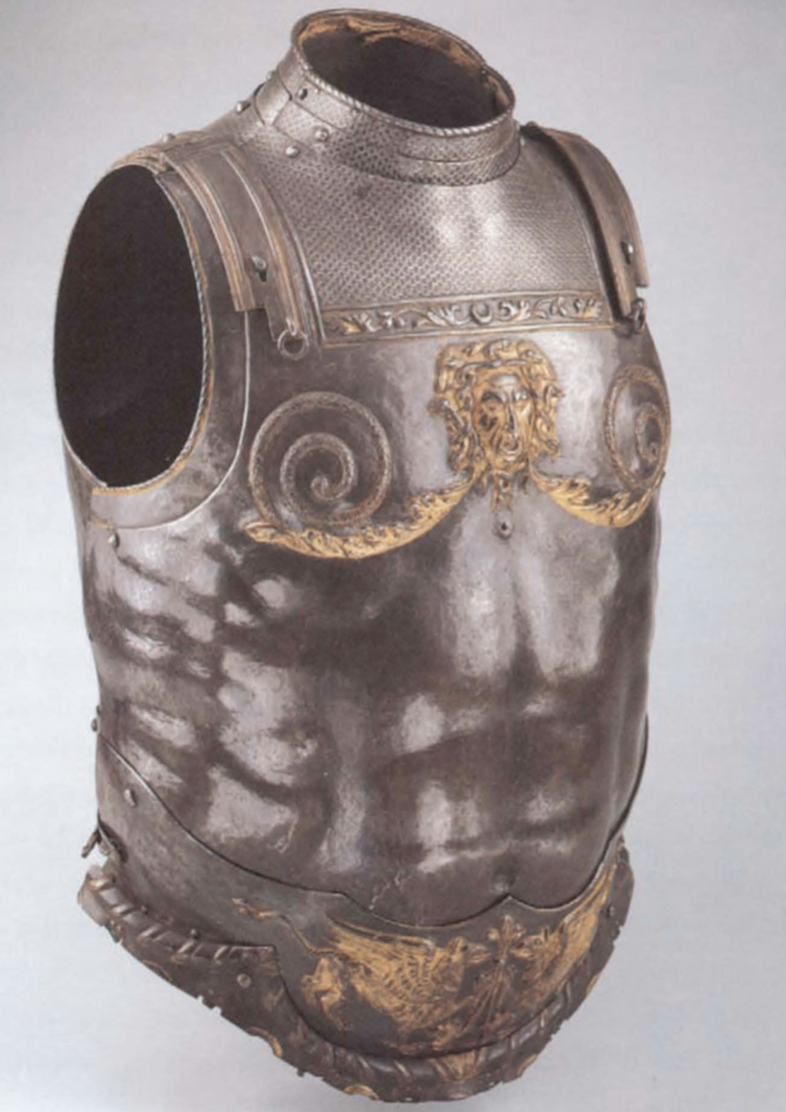
The 16th-century classicist muscled cuirass (armatura all’antica) emphasized anatomical features and was reconfigured based on an interest in antiquity — particularly the hoplite cuirass (8th century BC). The representational strategy adopted was anatomical simulation (with the appropriate exaggeration of the muscles) and the reinforcement of vulnerable areas of the body through the application of apotropaic elements, like Medusa. It was made from bronze, adorned with abstract, vegetal, animal, or mythological motifs. Such armour was both status symbol and artistic statement. It incorporated “an anatomical knowledge in tune with the image of the humanist body that was cultivated by the aesthetic, political, and social sensibilities of the period” (Jäger 2023, 64), derived from the study of écorchés, as seen in Nicolas Beatrizet’s illustrations for Juan Valverde de Amusco’s Historia de la composición del cuerpo humano (1556). Valverde, who performed public dissections, commissioned images that replaced abdominal musculature with visible viscera — a fusion of anatomy and all'antica armour.
Armour metamorphosed its wearer: from soft flesh to armoured flesh, from body to sculpture. The body emerged into the metal surface, transforming flesh into steel. "The armour became a symbolic, protective skin realized in anatomical exaggeration" (Stoichita 2018, 2). Representation strategies like shine served to attract and dazzle the viewer.
Why such a hybrid image? It reflects the body’s malleability and transformative potential: central to Renaissance material culture. It promoted a more functional understanding of the body based on fluids, organic chemistry, and metabolism. These cuirasses underscored vitality while signaling wounds, war, and death (Jäger 2023, 67). They revealed the subversive nature of the flayed suit: life revealed through confrontation with death.
From the flayed figures in De Humani Corporis Fabrica to Valverde’s engravings, a shift occurs. The former evoke anatomical idealism; the latter portray a potent, armoured body that aspires beyond anatomical norms. The same mechanism that turns armour into flesh — layered emergence — is what transforms muscles into skin for the flayed figure. The body’s interior becomes its surface, a paradoxical over skin, both garment and protection: like armour.
The flayed figure is a body without skin, with muscles, tendons, and veins exposed. Such imagery already existed in medieval society—paintings of flayed saints and public punishments attest to this. Robert Mills suggests these images act directly on the body through a process of incorporation, as medieval visual theory claimed that "the gaze carries the carnality of the seer’s body into the world" (Mills 2005, 19). Thus, the ocular experience fails to fully distinguish self from other due to its enduring carnality. Charms is situated within this theoretical framework of vision, deeply invoking somatic reactions in its viewers.
The anatomical flayed figure, emerging from Renaissance medical and artistic research, arguably builds upon this medieval imaginary. What imaginative delirium allowed for the creation of such a vivid, paradoxically alive-yet-dead body? The flayed figure accompanied the paradigm shift in how the body was seen and thought of during this period—turning the interior outward, emptying and desacralizing the flesh. The body became an object of inquiry, of science: profane, animalistic. This shift was possible only through the gradual abandonment of medieval observation methods obscured by layered beliefs, in favor of a scrutinizing gaze upon matter. This new method — stripping observation of magical thinking and imbuing the visible with epistemic value — transformed the body’s image profoundly.
In Renaissance Italy, anatomical dissection was common among artists and anatomists alike, and anatomical treatises were widely disseminated in academic circles. These works contributed to the conceptualization of a newly discovered body.