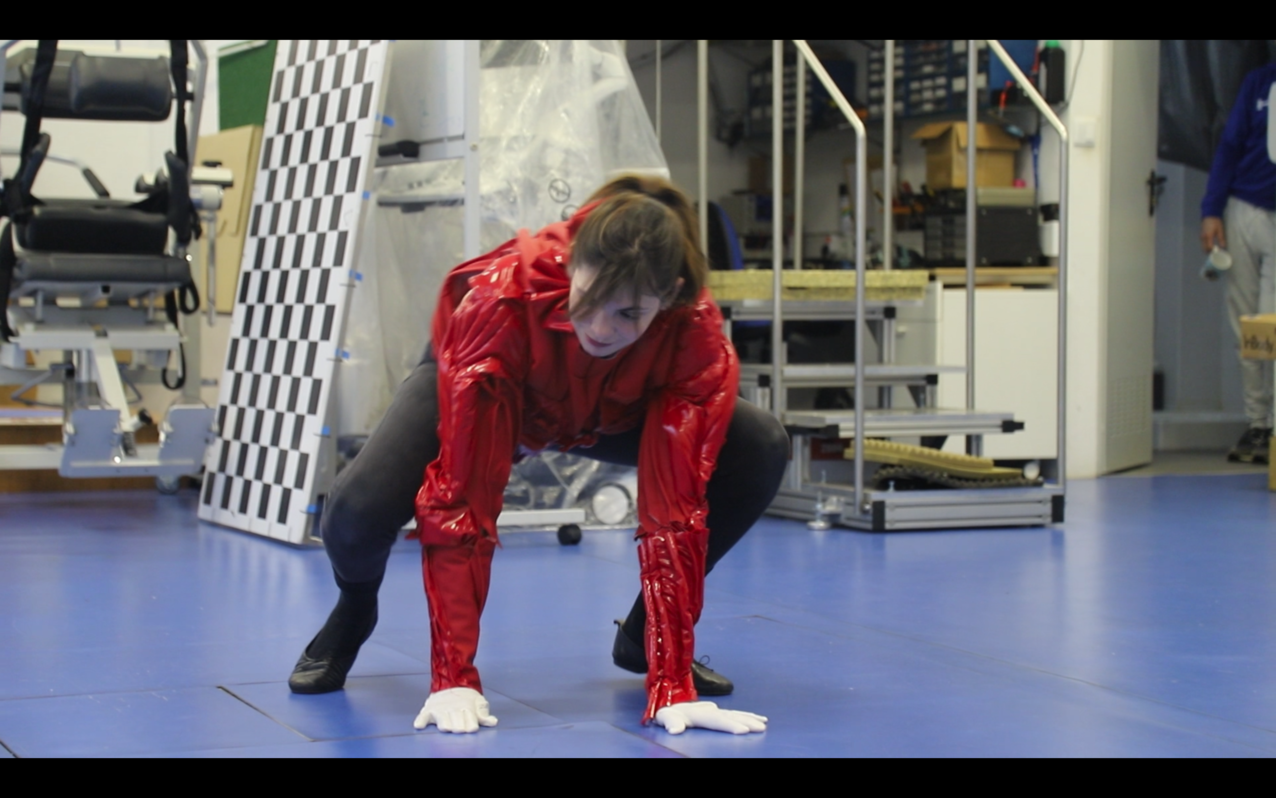
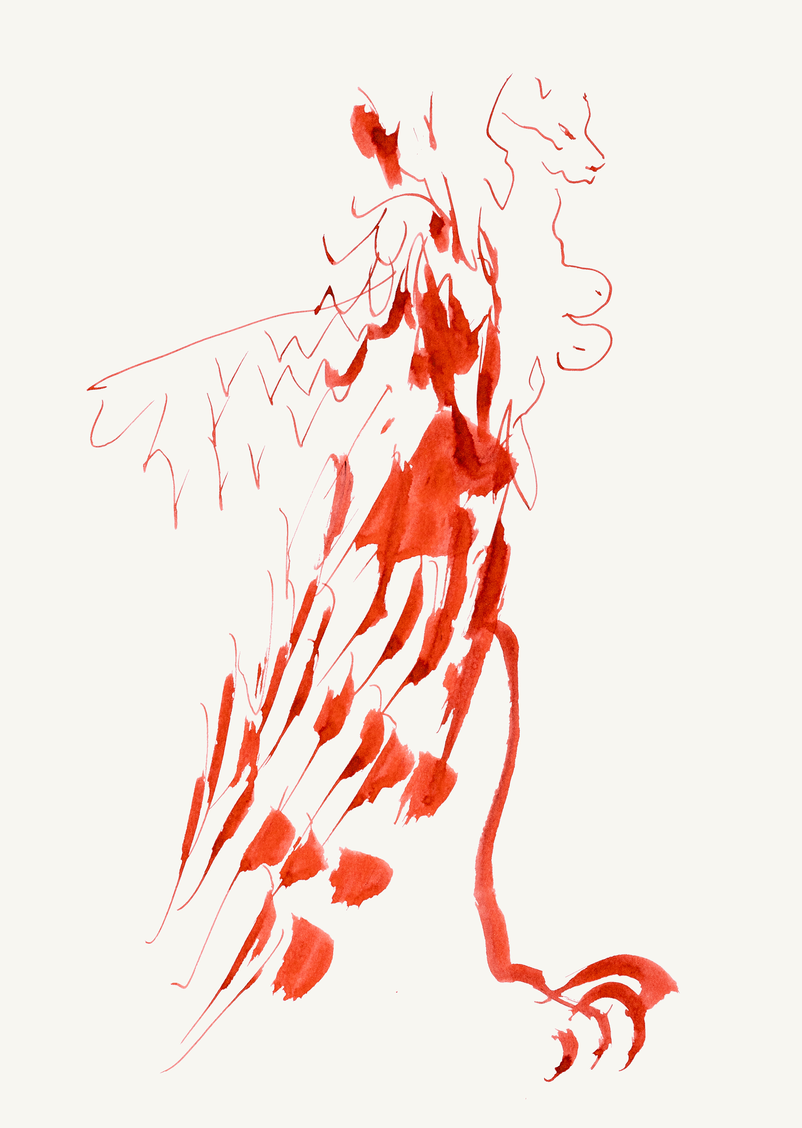
Unfolding the body through such contrasting frameworks reveals its plural, layered realities. Through the motion data gathered at LABIOMEP, I accessed a visual dimension of knowledge focused on human movement — thereby disrupting Charms’ fictional narrative. From these recordings, I created the video Conjuring Alternative Bodies (After Unique Forms of Continuity in Space) (2024), an explicit reference to Umberto Boccioni’s Futurist sculpture. This association aroused during the viewing process, alongside other visual stimuli that influenced the selection and exclusion of specific movements and prompting new drawings.
With the assistance of an engineer and technician, reflective markers were affixed to my body using the “animation” model. The Qualisys software translates the spatial positioning of these markers into skeletal models and records movements across a manipulable timeline: past, present, and future. Although the system implies a linear temporality, the visualization is in fact plastic: traces may be isolated, merged, omitted, or emphasized. The program also enables the replacement of the human figure with a geometric skeletal representation. I chose to make this substitute figure invisible, invoking its presence through an imaginative act that filled the void with traces of motion — evoking the perceptual phenomenon of “phantom tones” in auditory experience.
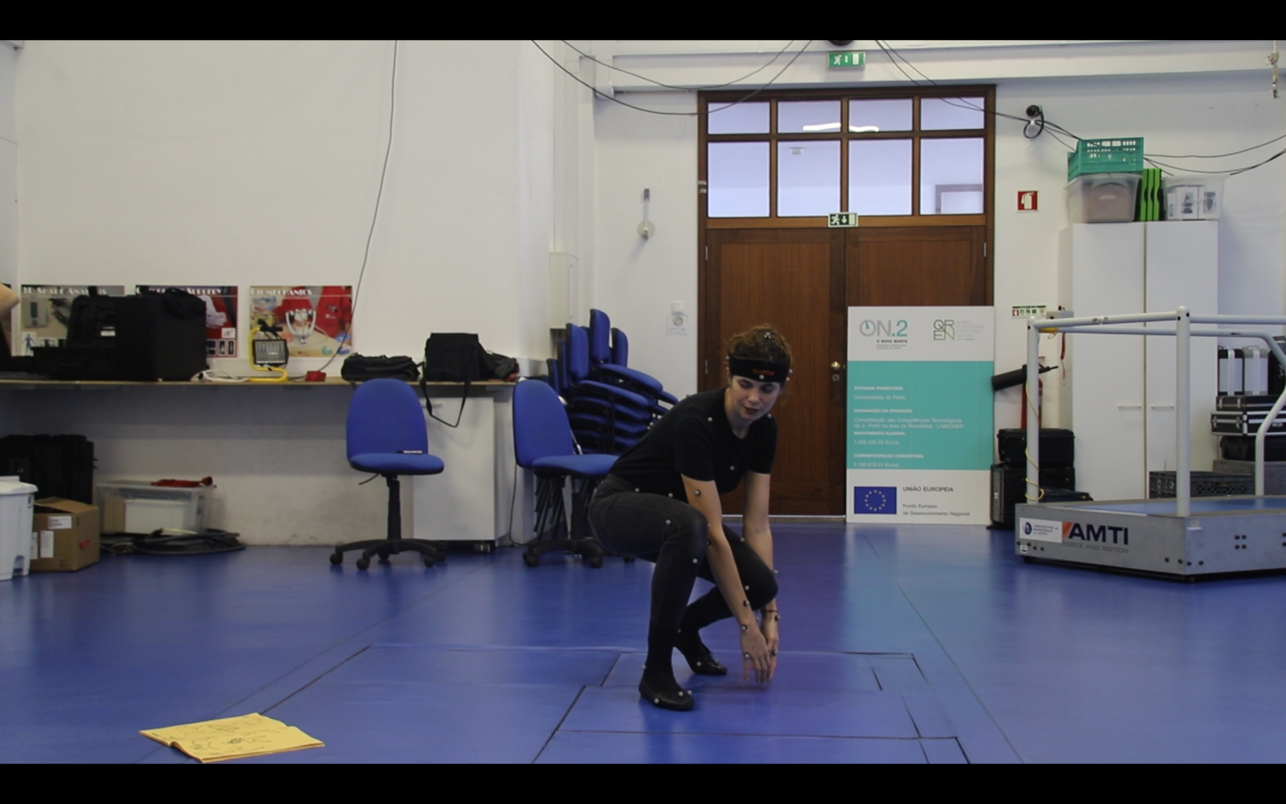
Photographic documentation of motion capture experiment using animation markers at the Laboratory of Biomechanics, University of Porto. (2024).
The first phase of the experiment involved imagining and drawing in space with the entire body. While recordings were intended for later video editing, my primary interest was in detecting congruencies or deviations between imagined and recorded movements. This raised fundamental questions: Can one produce an image of the imaginary body? If movement is implicated in imagination, can any traceable relationship be found between intention, bodily execution, and recorded data? To test these questions, I initially sketched lines on paper as prompts for movement. However, the transition from two-dimensional sketches to three-dimensional movement consistently fractured any formal resemblance. These early drawings served as anchors — guides for the body’s exploratory gestures. Yet the translation of paper to space, mediated by embodied imagination, inevitably foreshadowed the impossibility of literal transfer — revealing instead a dynamic terrain of possibility.
Throughout this process, I sought to understand whether the imagined image and the bodily trace would align. Interestingly, echoes of the original sketches were perceptible in the captured data. Although the drawings originated as mental constructs, the Qualisys software materialized them into lasting, visual records: transforming the body into a technological projection device.
Several challenges emerged. Initially, I felt disoriented within my own body and needed physical anchoring. I held two pens to ground myself, establishing a tactile link to gravity. Eventually, I released them, surrendering to the unknown dimensions of the body—those less accessible or “forgotten.” A significant challenge involved shifting awareness from dominant body parts (arms and legs) to others less frequently engaged. Gradually, I directed movement to elbows, knees, and the head. If I had to draw the body as I feel it, it would likely feature oversized eyes, hands, and elongated toes—a distorted sensory cartography.
Upon analysing the recorded traces, a stark divergence between intention and execution became evident. These spatial drawings—emerging from a position both inside and outside the body—were simultaneously lived experiences and digital recordings, captured by engineer Pedro Fonseca.
In a second phase, I imagined symmetrical drawings and instructed the body to realize them in space. The human body’s bilateral symmetry supports this endeavor: with two cerebral hemispheres coordinating opposing sides of the body, the structural logic of symmetry permeates our anatomy. We speak of left and right limbs and organs because something unified lies at the center—the spine, navel, genitals, mouth. I sought to experience the body as a vertically bifurcated mirror, unfolding itself in movement.
In a third phase, I aimed to transform the body’s form through the traces it left in space. Movement could generate a self-reflexive image. Eventually, I began projecting my body schema onto the screen where motion data appeared, blurring the boundary between internal schema and external visualization. It was an almost magical illusion body transfer. I walked, crawled, and enacted various modes of locomotion, using imagination to channel other animal's movements. Strange, hybrid bodies emerged — resembling Mesopotamian demons, Japanese pagodas, or fantastical creatures. I perceived claws on my feet, wings tracing arcs around my torso, and towering trunks.
The same images, however, provoked different interpretations in the lab engineer, underscoring how imagination is shaped by familiarity, emotional resonance, and personal iconography.
Throughout the process, various instances of transformism unfolded. There was the transposition of initial sketches into performative gestures, the visualization of movements via Qualisys, and the subsequent editing into video — followed by a return to drawing inspired by the visual residues of movement. These works — drawings and video — reaffirm the body as a generative site of images and align conceptually and procedurally with a broader commitment to transformation: of images, of biological corporeality, of proprioceptive awareness, and of the mental imagery triggered through physical movement.
This motor exercise demanded a deliberated complicity with imagination to produce visual traces understood as drawings. It also required heightened somatic perception — a sensitivity that sometimes disrupted the fluidity of movement, displacing spontaneity. The sensation of being within a body, even as one is a body, constitutes one of the paradoxes of embodied existence. It is deliriously banal. This perceptual paradox — requiring a degree of dissociation between bodily shcema and external perception — has been discussed by both philosophers and neuroscientists. The fluctuating experience of simultaneously being and having a body is especially pronounced in moments of dissociation, where the boundaries between self and space may dissolve entirely.
In the end, I returned to drawing, guided by what the moving images revealed to me.
Imagination functions as a cognitive faculty and an a priori condition of movement, intricately linked to the simulation of action. Neurological studies reveal that the same brain regions are activated when imagining or executing physical movements (cf. Oliveri & Carlotti, 2021, 324). In the Charms project, I drew upon this evidence to explore the incorporation of alternative bodies into my own, through the interweaving of movement and imagination. The body emerges primarily as a site of transformation — a concept that Charms articulates through a succession of aesthetic phases.
To facilitate this research, I established a collaboration with the Biomechanics Research Laboratory at the University of Porto (LABIOMEP-UP), utilizing their motion capture technology and the Qualisys software. Although the lab primarily engages in biomedical research, its affiliation with the Faculty of Sport also extends its applications to studies of athletic performance. Open to interdisciplinary collaborations, the lab welcomed my project, which intentionally diverged from traditional scientific inquiry. This engagement resonates with the historical emergence of motor physiology laboratories in the late 19th century — a period marked by intensified interest in temporality, gesture, and the dissection of movement over time. These developments were closely tied to comparative anatomy and the early establishment of physiological institutes. In this sense, my presence at LABIOMEP consciously situates itself within this broader historical trajectory.
In this context, the movements I performed were conceived as forms of drawing. Drawing, understood here as a bodily and imaginative practice, serves both to evoke memory and to visualize the absent or the non-existent. To draw with the body is, therefore, a highly imaginative process: is to anticipate, to summon, to render visible. The representation of the body generated by the laboratory’s motion capture system is scientific, abstract, and measurable — just one among many culturally constructed versions of the body. This technical image contrasts starkly with the expressive, costumed body of Charms, situated within an overtly artificial scenic environment.
Conjuring Alternative Bodies (After Forms in Continuity) [Video, color, sound, 8 min loop]. Qualysis program. Barrote M. (2024).
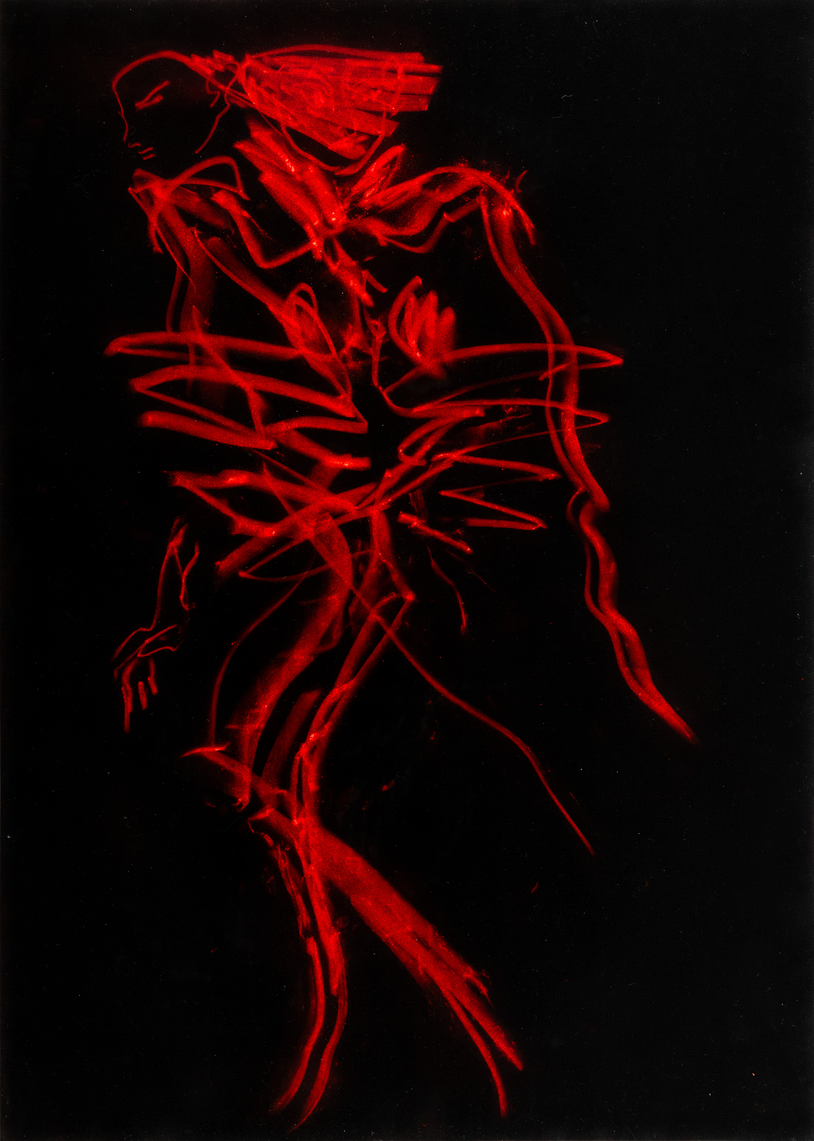
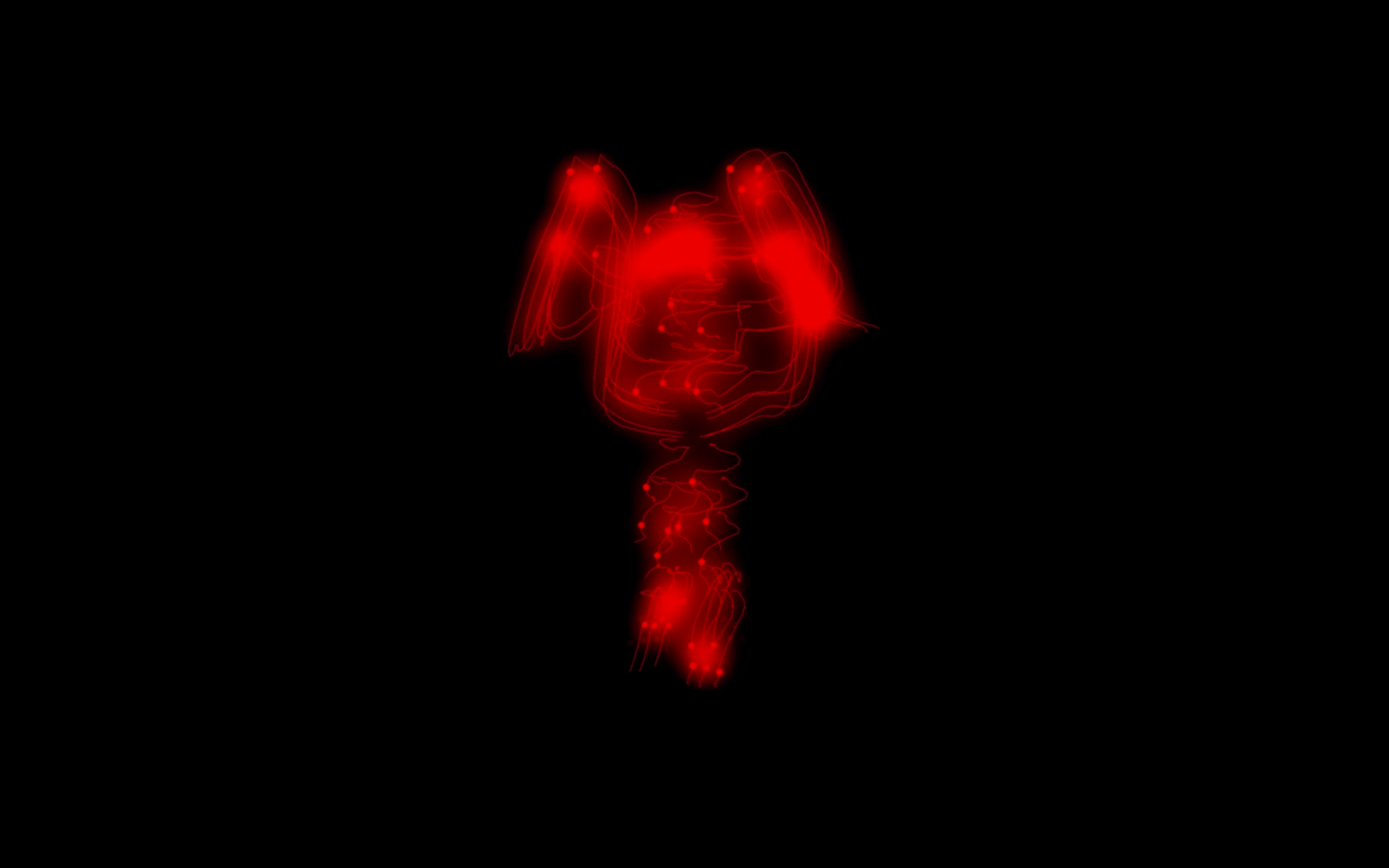
Conjuring Alternative Bodies (After Forms in Continuity) [still from video]. Qualysis program. Barrote M. (2024).