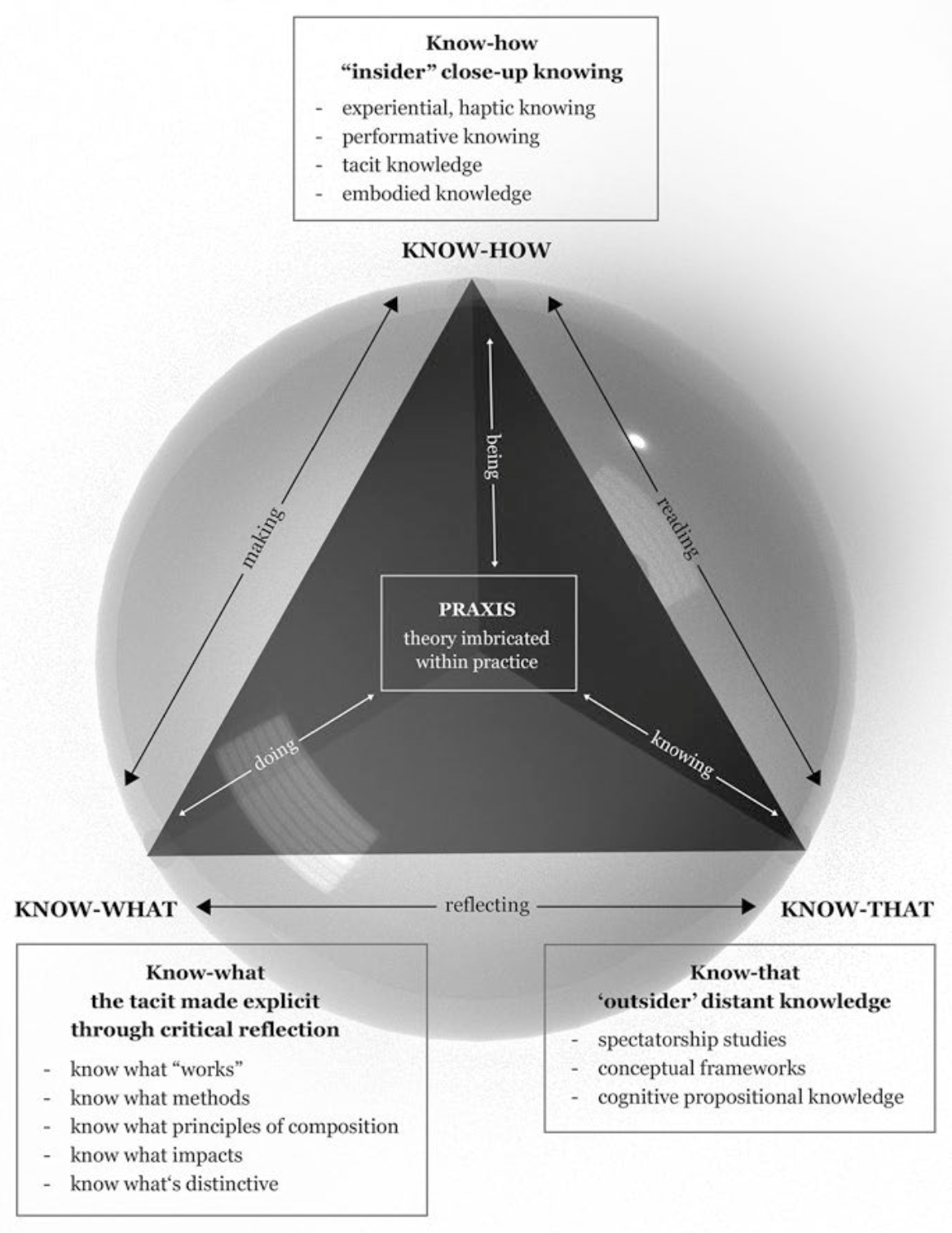
To begin outlining my horticulturally inspired methodology, I will compare tomatoes (and other fruit-bearing annuals such as zucchini and cucumbers) to cyclical frameworks related to the production of various outputs — not just artistic creations such as paintings and performances, but also the fruits of academic labour such as articles, books, and expositions. So-called ‘praxis’ is at the centre of theatre and intermedial performance scholar Robin Nelson’s model (see fig. below), which represents what artistic research is (ontology) and the knowledge it produces (epistemology). Nelson describes ‘praxis’ as ‘the possibility of thought within both “theory” and “practice” in an iterative [repeating] process of “doing-reflecting-reading-articulating-doing”’ (2013: 32). This model is a useful way of appreciating the dynamics of knowing in artistic research, which Nelson locates at the meeting point ‘of different, but interlocking, spheres, notably “the arts world”, “the mediasphere” and “the academy”’ (2013: 23). Nelson notes that these are only three in ‘a much larger constellation of interconnected praxical spheres’ (2013: 23), and I have already included life and work as part of this constellation earlier.
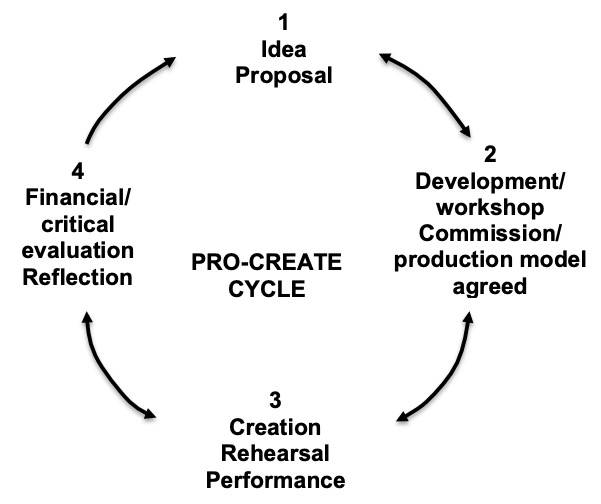
Jessica Walker’s Pro-Create Cycle (see fig. above) and her Embodiment Cycle (see fig. below) are excellent examples of Nelson’s praxis, manifesting significant new insights.
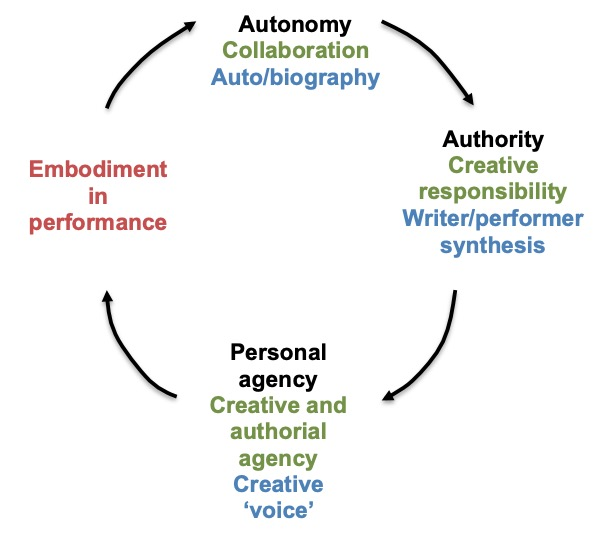
These cycles are representative of the processes that took place in the performance projects discussed in Walker’s PhD, but they are similar to many (if not most) performing arts productions and the corresponding experiences of performers, creators, and researchers (in Walker’s case, a hybrid of all three). The Pro-Create model name incorporates the ‘abbreviations of the professional and creative cycles it maps’ but is also intended to represent ‘the process of procreation’ (Walker 2015: 13). Walker identifies this model as a ‘methodological meta-framework’ and also emphasizes how each stage of the cycle itself includes multiple processes (2015: 10). What is so ground-breaking about Walker’s model is how she integrates industry expectations and restrictions into the mix. As she explains,
There was not as yet a creative practice, live performance model foregrounding the ‘professional’ in its conceptual framework. As a representation of these forms of research, this is understandable; the modelling of performative research is a visualisation of research process, and that process, especially within an academy setting, is not contingent on or affected by a need to be commercially viable. These models can, therefore, afford to be inward-looking. They analyse process on its own terms, without casting the net wider to look at how that process is, or might be affected by outside forces. (Walker 2015: 13–14)
As I mentioned earlier, my particular interest in artistic research is its potential for building bridges between professional artistic practice and the academy, and thus the existence of Walker’s model is particularly relevant. The fact that she is also working within the field of music theatre further emphasizes the usefulness of her insights to my research. Framed by the creation of three artistic works, Walker’s thesis is largely interested in the context of the product-driven arts industry. She concisely notes that the Pro-Create Cycle represents ‘how to describe and analyse a creative process which is reliant on industry take-up’ (2015: 15).
Walker discusses her models in relation to … [next page]