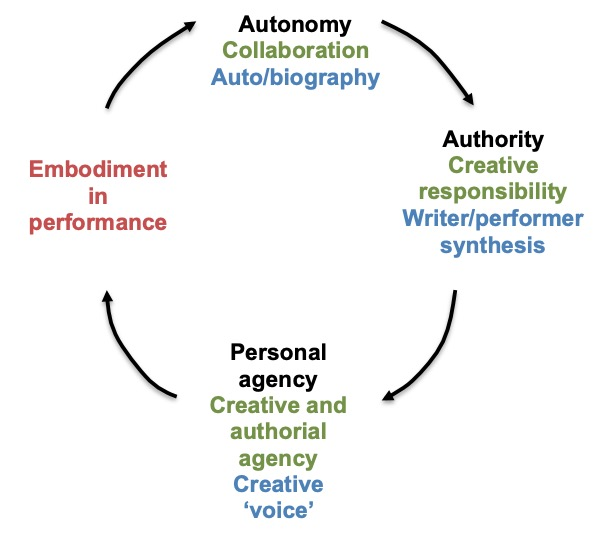
Walker discusses her models in relation to several sorts of agency (professional/career, creative, personal, etc.) and how these can establish a virtuous circle. As she describes, ‘the more pronounced the creative and personal agency, the more acute the phenomenological awareness of embodiment became. This suggests that the trajectory towards embodiment was linked with the process towards agency, in which autonomy led to authority, resulting in increased agency’ (2015: 119). As with her Pro-Create Cycle (where she identified the ‘missing link’ of ‘financial/critical evaluation’), Walker’s Embodiment Cycle highlights the importance, indeed necessity, of ‘Embodiment’ not only in the cycle towards personal, creative, and authorial agency but also in the production of identity itself (‘creative “voice”’).
So how do these observations relate to my tomatoes, zucchinis, and cucumbers? In ‘The Iterative Cyclic Web’ (Fig.), Smith and Dean mention a variety of ‘outputs’ — archivable results produced in both artistic and academic contexts — that can emerge from practice-led research, research-led practice, and academic research (2009: 20). Performances, recordings, scores, interviews, blog and other social media posts, grant applications, lectures, articles, books, PhD theses — these are just some of the outputs by which we map our careers (if artistic biographies and academic CVs are any indications).
Unlike Walker, my primary interests in this exposition are neither these outputs nor the specific processes that lead to them. However, this is not to say that such processes and outputs are not important; indeed, they are vitally important given the expectations of our product-driven artistic and academic industries. Rather, I am curious about how these outputs can be understood more complexly, as things emerging from multiple and intersecting artistic and research practices. In this way, one can envision each output mirroring the life cycle of an annual plant: a seed is sown and begins to germinate and grow; the plant is nurtured; the plant bears fruit, which generates new seeds; the plant’s life ends and the cycle can begin again. The metaphor of the ‘annual cycle’ is particularly apt for those performing arts productions that have extensive tours, given that most annual plants produce several fruits in a season. Even if always subtly different, annual cycles produce outputs that are understood, familiar, and have a clearly defined lifespan. Also, each output is limited by the capacities of the plant variety itself — that is, each plant’s (production’s) potential is restricted to what it can do in the span of one growing (artistic) season.
The reception and (self-)perception of so-called ‘outputs' are often central to how… [next page]