Accepting the map’s textual nature means accepting a plurality of interpretations, an inherent narrative quality. The map emerges then as a paradigm for the denial of place, a narrative fiction of what cannot be found anywhere but that can, at the same time, be projected everywhere […] Maps offer the domestication of nature and involve an arbitrary formulation of the world that implies territories that, if not notably habitable, are at least transversable, since they have been acknowledged. (Gibellini 2011)
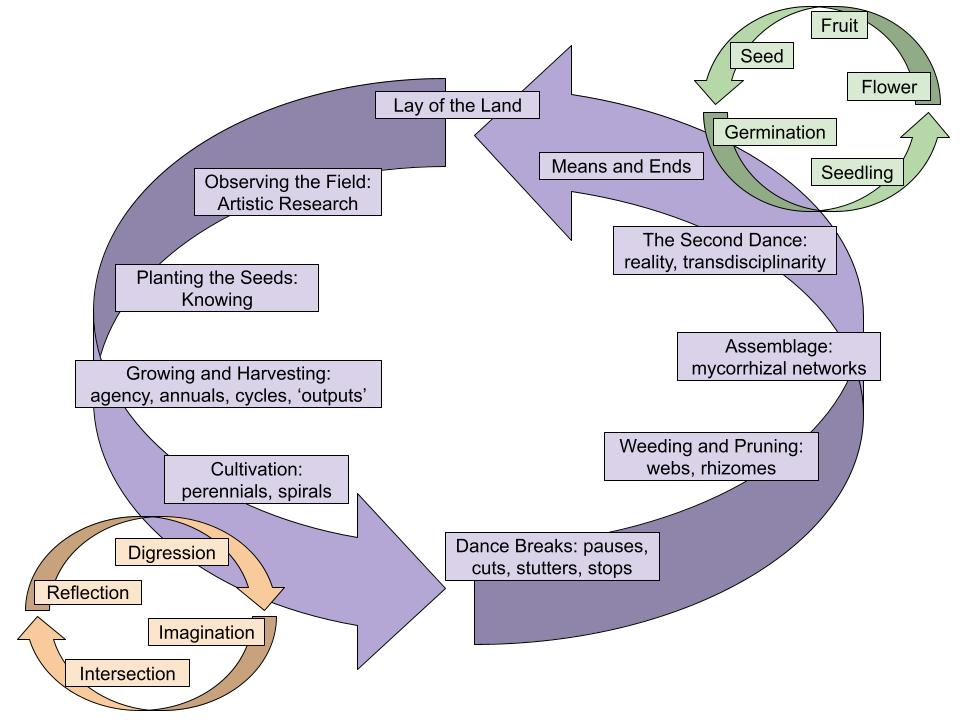
The map above shows three cycles, each one representing a series of processes that were important during my doctoral project. The trajectory I will lead you through visits all of the ‘stops’ on this map, and this route corresponds to the exposition’s table of contents (always accessible at the top left corner of the page). That being said, it is good to know that the route meanders, continually jumping between the three cycles. Therefore, I suggest taking a brief moment to contemplate each of the three cycles individually before beginning your journey.
To help you keep your bearings as you travel through this exposition, each page begins with a fragment of the map identifying the ‘stop’ you are at. You can also see where you are at the start of each page by hovering over the ‘See full map’ link (you can try it on this link now). When you hover over the link, a popover of the full map will appear that reveals your current location highlighted in yellow. At the end of each page, you can proceed to the next ‘stop’ by either clicking on the map fragment in the bottom right corner, or clicking the ‘next page’ link.
Hovering over links elsewhere in the exposition also produces popovers that either cross-reference an image discussed elsewhere or provide additional contextual information. You can always retrace your steps via the back button in your browser and then return to where you paused your trip by using the forward button. It is also possible to jump back several steps at once via the table of contents. If you do this, just be sure to make a mental note of where you are beforehand if you want to continue again from the same place (or use the back button until you find it).